Skip to Main Content

Quality Management at the University of Liechtenstein

Architektonischer Holzpavillon mit Blick ins Rheintal auf dem Campus der Universitaet Liechtenstein.

Quality management is an integral part of the University of Liechtenstein’s overall strategy and supports the university’s continuous development. The University of Liechtenstein is committed to upholding internationally recognised and nationally anchored quality standards.

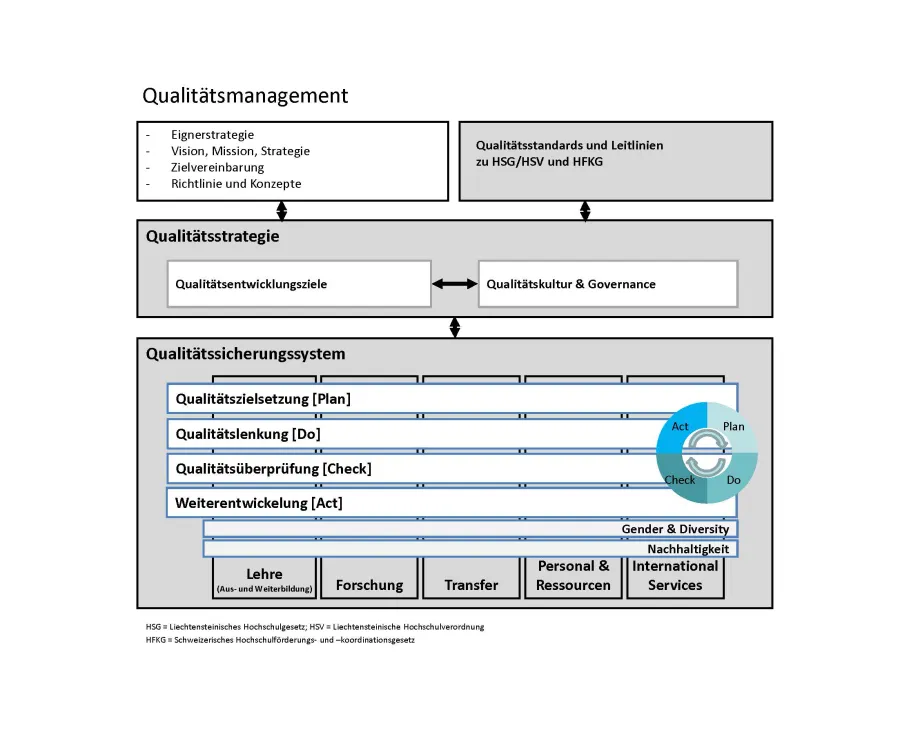
The university implements a quality strategy, quality standards and guidelines, and a quality assurance system. Together, these elements constitute the university’s quality management framework.

Architektonischer Holzpavillon mit Blick ins Rheintal auf dem Campus der Universitaet Liechtenstein.

Quality Strategy, Guidelines and Structures

The University of Liechtenstein’s quality management is based on internationally established practices in higher education quality assurance while taking into account the specific institutional context of the university.

It is embedded in the The University of Liechtenstein Act (LUG), the Ownershipstrategy, the university’s Vision and Mission, the performance agreement between the Government and the University, as well as in the target agreements of the Rectorate and the academic institutes.

The University of Liechtenstein complies with the quality standards set forth in the Liechtenstein Higher Education Ordinance and adheres to the standards defined by the Swiss Higher Education Funding and Coordination Act (HFKG). As a university located in Liechtenstein, compliance with the Liechtenstein Higher Education Ordinance is legally binding. For eligibility under the Swiss Intercantonal University Agreement (IUV, 2019), the university also demonstrates conformity with the quality standards of the HFKG.

The University of Liechtenstein’s quality strategy outlines the objectives for quality development, the principles of quality culture, and the university’s governance structures.

The quality assurance system is based on a continuous improvement process structured according to the Plan–Do–Check–Act (PDCA) cycle. It comprises the following elements across all core areas of the university – teaching (degree and professional education), research, knowledge and technology transfer (services), international services, and resources (including staff, infrastructure, and finances):

  • Plan – definition of quality objectives
  • Do – implementation and steering of quality measures
  • Check – monitoring via instruments and indicators
  • Act – development and adaptation of quality assurance measures

The quality assurance system is integrated with the university’s process management and is linked to its risk management framework as well as the Internal Control System (ICS) of the University of Liechtenstein.
Portrait-Qualitaetsmanagement_Universitaet-Liechtenstein

Quality management at the University of Liechtenstein is an integral part of the university’s overall strategy and contributes actively to its development. The University of Liechtenstein is committed to complying with nationally mandated and internationally recognised quality standards.

This quality strategy defines six overarching quality development objectives for the University of Liechtenstein:

Objective 1: The university meets all applicable national quality standards. In addition, quality development at the University of Liechtenstein is aligned with international benchmarks in the fields of Architecture, Business, and Business Law.

Objective 2: Quality management is an integral component of the university’s overall strategy and supports its ongoing development.

Objective 3: The quality assurance system supports the university and all stakeholders in achieving the overarching objectives derived from the university’s Mission, Vision, and Ownership Strategy.

Objective 4: Closed quality assurance loops are defined and implemented for all core operational areas: teaching, research, knowledge and technology transfer, and resource management.

Objective 5: Continuous improvement is a central aim. Governance structures ensure that representative stakeholder groups at all levels are actively involved in the quality development process.

The university’s quality management is based on a shared understanding of quality, as articulated in the Ownership Strategy, the university’s Vision and Mission, its overarching strategy, the performance agreements, and various policies and strategic frameworks.

At the core of this quality understanding is the following definition of university culture:

University culture encompasses the shared values, traditions, and attitudes of all members of the university community. It is reflected in our actions and communication, as well as in the design and use of our buildings and spaces. University culture shapes how we speak, act, organise, teach, conduct research, and engage in shared experiences within the university environment.

The following principles underpin and secure the quality of university culture:

  • Clear responsibilities: Roles and responsibilities are clearly defined and communicated.
  • Participation: Strategic goals, overarching frameworks, and regulations are developed and refined through dialogue with relevant stakeholder groups.
  • Transparency: Decisions are communicated openly and implemented in a way that is understandable and traceable for all involved.
  • Communication: Mutual respect forms the basis of all interactions and actions.
  • Integrity and commitment: The values and attitudes expressed in strategies, frameworks, and guidelines are consistent, coherent, and sustainable. They are not merely formalised documents, but are actively embraced and exemplified through personal engagement and conviction.

The governance and organisational structure of the University of Liechtenstein is designed to operate across multiple levels. A robust and transparent governance framework is essential for achieving the university’s strategic goals and fulfilling its institutional mission. The structure reflects the interests and needs of a diverse range of stakeholders.

The The University of Liechtenstein Act (LUG), together with the university’s wie auch die Statuten and additional regulations, defines the governance structure, including its bodies, responsibilities, and decision-making powers. Quality management is embedded at various levels of the organisation ranging from the University Council, the Senate, and the Rectorate to the Quality Management and Accreditation Departement, as well as a number of working groups, committees, and advisory bodies.

Overview of the Organisational Structure

The quality of teaching and learning at the University of Liechtenstein is guided by the following objectives:

  • Objective 1: All degree programmes comply with the national qualifications framework and the international Bologna standards (including the awarding of academic degrees). Programmes are based on a clear programme concept, admission guidelines, curricula, a module handbook, and examination regulations that define performance assessment. Their academic positioning within the international higher education landscape is clearly articulated. New programmes are accredited by an external agency; existing programmes are subject to regular internal evaluation.
     
  • Objective 2: Each degree programme is based on defined learning outcomes derived from the university’s mission, aligned with international standards. The achievement of these intended learning outcomes is continuously assessed.
     
  • Objective 3: Courses and overarching modules are based on learning objectives specified in the module descriptions, and each course contributes meaningfully to the programme as a whole. Subject requirements, actual workload, and prior knowledge are well balanced and appropriately aligned.
     
  • Objective 4: Assessment criteria are defined early on for each course, clearly communicated to students, and applied consistently, transparently, and systematically.
     
  • Objective 5: The qualifications imparted in the study programmes prepare students effectively for their professional careers. Teaching at the University of Liechtenstein makes a sustainable contribution to the long-term success of its graduates.
     
  • Objective 6: Teaching staff possess strong subject-specific qualifications (academic or practice-based) and demonstrate excellent didactic competencies.


Quality Assurance Instruments in Teaching and Learning

  • Programme evaluations
  • Admission procedures
  • Learning outcomes monitoring at programme level
  • Course evaluations (Degree Programmes)
  • Graduate surveys
  • Academic staff development and review
  • Analysis of grade distributions
  • Plagiarism checks for bachelor’s theses, master’s theses, and dissertations.

The quality of research at the University of Liechtenstein is guided by the following objectives:
 

Objective 1: Good Scientific Practice, a Respectful Research Culture, and Societal Responsibility

  • Research is conducted in accordance with the university’s principles and regulations for safeguarding good scientific practice.
  • The University of Liechtenstein fosters a transparent, respectful, and integrity-based research culture that is developed and lived collectively.
  • Research makes a substantial contribution to a socially, economically, and ecologically sustainable society.
     

Objective 2: Excellent, Relevant, and Competitive Research

  • Research at the University of Liechtenstein is driven by excellence within clearly defined topics in focus.
  • Its competitiveness in these areas is reflected through high-impact scientific publications, benchmarked against the standards of the respective research discipline.
  • Researchers at the university enjoy strong international recognition and collaborate with globally renowned experts and research networks.
  • Research aims to provide answers to key challenges of our time and actively contributes to forward-looking regional development.
  • The university positions itself as a hub for the excellent development of early-career researchers.
     

Objective 3: Compliance and Professionalism in Research Projects

  • Research projects comply with the rules, guidelines, and legal frameworks of the respective funding institutions and sponsors.
  • Project management in research is conducted with a high degree of professionalism, focusing on the effective planning and control of performance, time, and costs.
Any Questions?

We’re here to help

Eva Frommelt MBA, MSc
Head - Quality and Accreditation Head - Research Management
Employee