A Festive Day Dedicated to Innovation and Sustainability
A Festive Day Dedicated to Innovation and Sustainability
The Dies Academicus is the university’s academic celebration day and offers an opportunity to pause and look ahead to the future.
"It is my pleasure to welcome you today to our Dies Academicus – a special day on which we pause to celebrate our academic community, our achievements, and our shared goals. Dies Academicus is not only an opportunity to reflect on the past year but also a moment of coming together, of exchange, and of inspiration. Today, we focus not only on the accomplishments of our researchers and students, but also on the values that define our university," said Carmen Dahl, Head of Communications and Marketing at the University of Liechtenstein, at the beginning of her moderation.
Opening Speech
In his opening speech, Rector Christian Frommelt emphasized:
"2024 was a year marked by major successes, such as the RIBA reaccreditation of our School of Architecture, the appointments of Benjamin van Giffen and Sebastian Stöckl as new professors, and prestigious awards received by members of the university – notably the 'Outstanding Artist Award 2024' from the Republic of Austria for Martin Mackowitz, in recognition of his significant contribution to societal transformation and support for sustainable building.
With the founding of the Earth Hub in autumn – the new Competence Center for Earthen Construction at the University of Liechtenstein – the university has taken another step toward becoming a sustainability-focused university, which we aim to achieve through strategic alignment in our five fields of activity: research, teaching, continuing education, knowledge transfer, and dialogue."
Government Greeting
Rachel Guerra, Head of the Office of Education, delivered the greetings of the government and stated:
"The University of Liechtenstein continues its efforts to improve access and break down barriers. This is what has allowed it to develop into a modern educational institution. The university once again ranks at the top as an entrepreneurial university. In the recently published GUESSS Report 2023 (Global University Entrepreneurial Spirit Student’s Survey), it was among the leaders in the DACHL region and achieved impressive results in international comparison.
It also received another international accreditation in the past year. The University of Liechtenstein places great importance on high-quality teaching and research. A highlight was certainly the successful accreditation of the Liechtenstein Business School and the Liechtenstein Business Law School according to AACSB standards. Other areas such as student numbers and research performance also showed positive developments.
Furthermore, continuing education at the University of Liechtenstein was strengthened. The part-time programs offer new opportunities for career advancement and network expansion in Liechtenstein, Eastern Switzerland, the Rhine Valley, and the DACH region as a whole. This marks another milestone and has created a modern learning environment.
All of these developments clearly show that, after a turbulent phase, a period of consolidation is beginning for the University of Liechtenstein. I congratulate the university on its successful development and valuable work."
Keynote Speech
In her keynote address, Prof. Dr. Konstantina Papathanasiou spoke about the connections between sustainability, ethics, and white-collar crime law:
"At the heart of business ethics lies the challenge of how companies can align economic goals with social responsibility and moral principles. The goal is to find a balance between economic success and ethical behavior – a balance that not only maximizes profit but also ensures long-term benefits for society and the environment.
The relevance of business ethics is especially evident in the digital sphere. Digitalization is changing the responsibility patterns of companies in terms of ethical obligations. Often, the focus is placed on the economic benefits of digital business models, while ethical consequences for various stakeholders are overlooked. A deep understanding of Corporate Digital Responsibility is becoming increasingly important – it's about fulfilling legal standards (e.g., data protection) and subjecting digital business models to ethical reflection."
Pro Bono Award 2024
For the first time, the Pro Bono Award of the University of Liechtenstein and the Foundation "Lebenswertes Liechtenstein" was presented during this year's Dies Academicus.
Cornelia Faisst, mentor for Pro Bono Architecture and project coordinator, introduced the program:
"This award honors the commitment and passion students invest in projects that benefit society – in the spirit of ‘pro bono publico’, for the public good.
Through the 'Pro Bono' learning format, the university bundles activities to contribute to achieving the UN’s 17 Sustainable Development Goals of Agenda 2030. Students are encouraged to translate their knowledge into sustainable actions that create value for society and the environment.
There were eight nominated projects in architecture and seven in business administration. The jury selected the two winning projects about three weeks ago."
Daniel Haselsberger, mentor for Pro Bono Architecture, added:
"The Pro Bono Award is not only a recognition but also a call for all of us to actively engage in the community, take responsibility, and contribute to positive change. Each of us has the potential to make a difference. Since 2020, we’ve already had implemented Pro Bono projects in architecture, and awards are considered over two years – this year, for 2020 and 2024."
Architecture Awardees
Students Sophie Breitruck, Michelle Bösch, and Ramon Kobras were honored for their project Kaplan Bonneti Connect, setting standards for social responsibility in architecture.
Business Awardees
Representing mentor Florian Rieder (unable to attend due to teaching commitments), Bernd Schenk presented the award in Business Administration:
"Unlike in architecture, only projects from the respective year are awarded in business administration. This year’s Pro Bono Award went to Luca Banzer, Laurin Diem, and Timo Volenter. Their project 'Digital Fit 50+' is marked by an inclusive approach aimed at empowering people over 50 to confidently use digital media and promote digital inclusion. Follow-up events are already planned for the coming year."
Liechtenstein Young Researchers Award 2024
At Dies Academicus, research prizes were also awarded. The CHF 10,000 prize is awarded annually to motivate promising young researchers, promote research in areas relevant to Liechtenstein, and strengthen Liechtenstein as a research location.
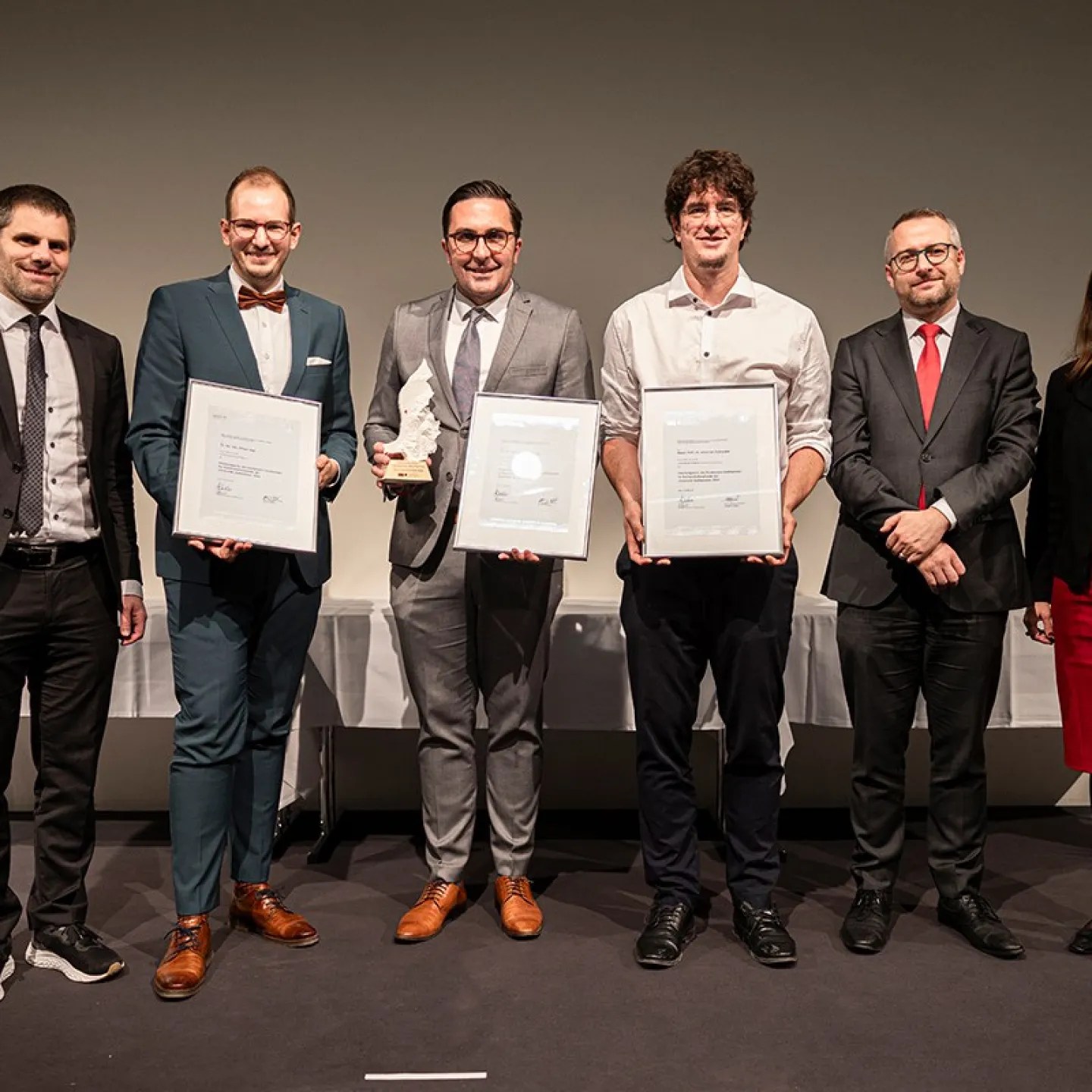
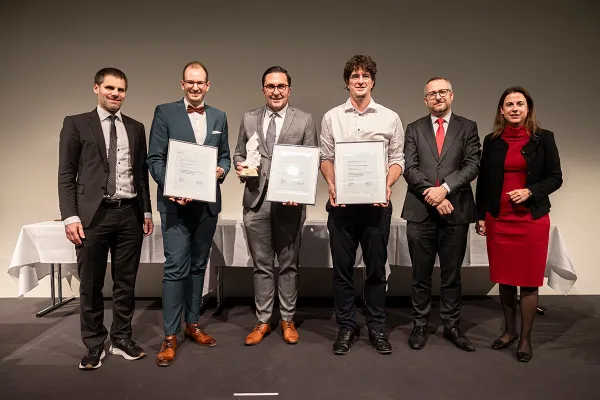
Stephan Jäger, Secretary General of the Ministry, and Prof. Dr. Konstantina Papathanasiou presented the diplomas to:
- Dr. Djordje Zivkovic for his dissertation “Top Management Team Incentives and Paradox”
- Assoc. Prof. Dr. Johannes Schneider for his publication “Understanding and Leveraging the Learning Phases of Neural Networks”
- Dr. Simon Liegl for his project “Affective Signalling in the Digital Workplace”
Student Speech and Best Teaching Awards
Student representative Sophie Breitruck reflected on the year:
"What do we take with us from 2024? I believe it is the realization that the world presents both great challenges and new opportunities. We’ve seen people come together worldwide to strive for a better future – and we’ve experienced how small, heartwarming moments can offer hope. It is up to us to carry these insights into our studies and lives and actively shape the future."
Maximilian Haage presented the Best Teaching Awards on behalf of the student association USLV:
- Best Teaching Award: Wolfgang Schadner
- Best Junior Teaching Award: Jeffrey Lee Brüstle
"Both prizes, awarded by students, honor outstanding commitment, innovative teaching methods, and the ability to motivate students sustainably. Schadner and Brüstle set new standards in academic teaching and are role models for combining expertise with personal support."
Closing Remarks
Lothar Ritter, President of the University Council, concluded:
"When I took office in April 2023, I was surprised and impressed by what I found at the university. The manageable size, the personal interaction among members, the focus on Liechtenstein’s specific needs, and at the same time, internationally oriented teaching and research with students from around the world deeply impressed me.
Given our accreditation as perhaps the only foreign university in the Swiss Intercantonal University Agreement, it is only logical for the University Council to examine the Swiss higher education system more closely and adopt some 'good practices' – without giving up the unique strengths of the public University of Liechtenstein. Together with all university members, we can develop a motivated and successful future."