Corporate Governance in modernen Organisationsformen
Project Description
In the last few years, the innovative energy of entrepreneurship has led to the flattening of the power distribution within the company. Due to the positive economic effects, such modern forms of organization as holacracy enjoy great popularity. Traditional hierarchical structures and functions will be abolished and company's structure will be continuously developed. These developments challenge traditional corporate governance models that are used in modern organizational forms.
The research project deals with the question of how far such modern organisational forms are compatible with the mandatory functions and powers of the corporate bodies and the resulting questions of their liability. Within the framework of comparative law, the limits and possibilities of dualistic structured organisational models, e.g., in Austria and Germany, or monistic structured organisational models, e.g., in Switzerland and Liechtenstein, are presented. In addition, new corporate governance models for modern organizational forms are to be worked out and developed at the same time. Another aim of the research project is to investigate whether the structural design possibilities of individual legal forms, e.g. the foundation or the cooperative, can better meet the challenges of corporate governance faced by modern organisational forms.
Project results:
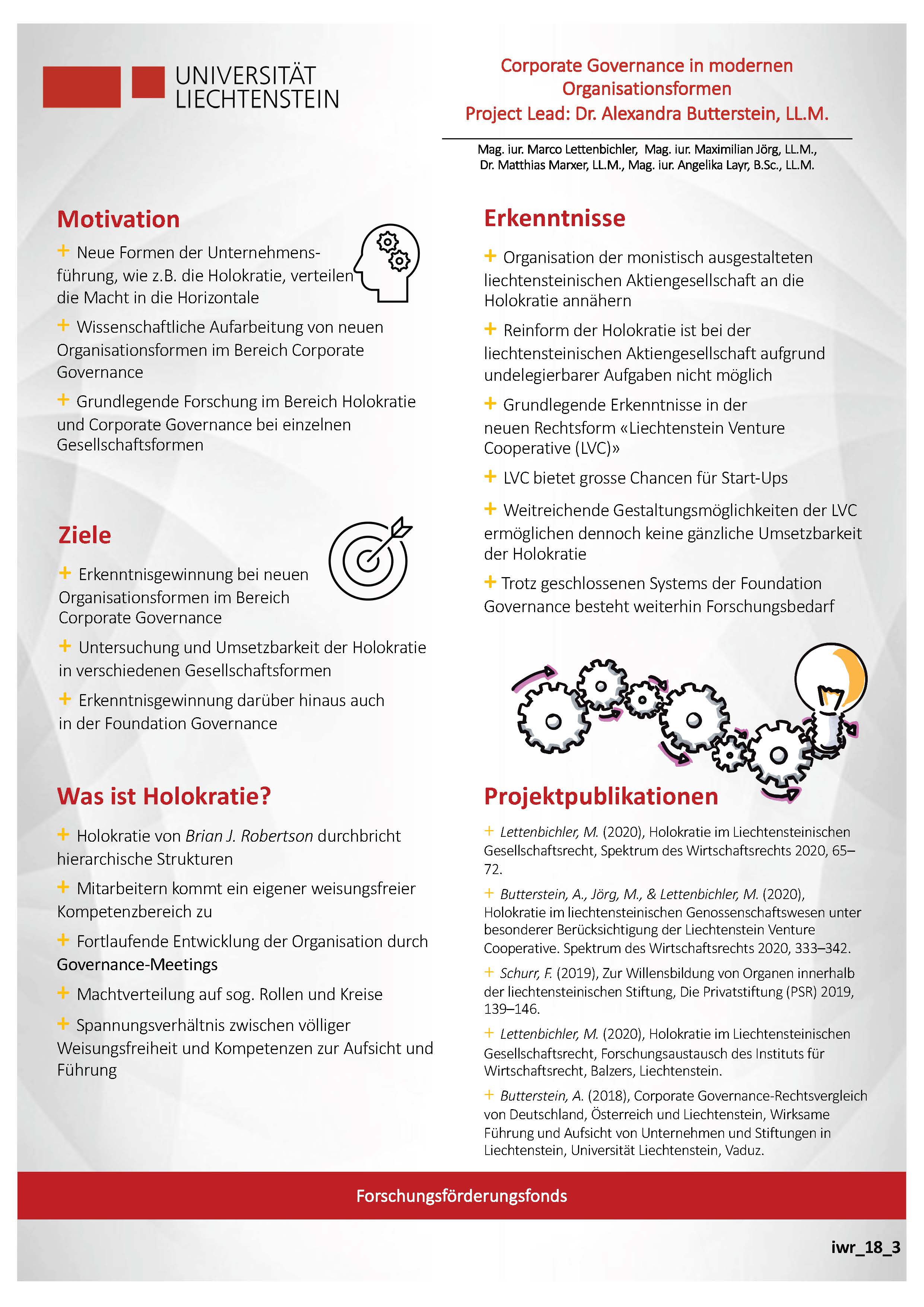
The research project deals with the question of how far such modern organisational forms are compatible with the mandatory functions and powers of the corporate bodies and the resulting questions of their liability. Within the framework of comparative law, the limits and possibilities of dualistic structured organisational models, e.g., in Austria and Germany, or monistic structured organisational models, e.g., in Switzerland and Liechtenstein, are presented. In addition, new corporate governance models for modern organizational forms are to be worked out and developed at the same time. Another aim of the research project is to investigate whether the structural design possibilities of individual legal forms, e.g. the foundation or the cooperative, can better meet the challenges of corporate governance faced by modern organisational forms.
Project results:
Relevance to Liechtenstein
Corporate Governance in modernen Organisationsformen Moderne Organisationsformen für Start-Ups erfreuen sich in Liechtenstein mittlerweile grösster Beliebtheit. Dies zeigt auch eine neue Rechtsform, die im Jahre 2017 vom liechtensteinischen Gesetzgeber eingeführte wurde. Die Liechtenstein Venture Cooperative wird auf ihre Vereinbarkeit mit der Holokratie untersucht. Die LVC stellt eine kleine Genossenschaft dar und wurde vom Gesetzgeber mit der Intention geschaffen, Gründern eine neue, kostengünstige Gesellschaftsform zur Verfügung zu stellen, damit Innovation und Gründergeist im Land gefördert werden. Ebenso wird die Einführung der Holokratie für die liechtensteinische Aktiengesellschaft untersucht. Das Forschungsprojekt liefert insofern wichtige Erkenntnisse für den Gründerstandort Liechtenstein.
Scientific, Economic and Societal Impact
Das vorliegende Forschungsprojekt hat sich erstmalig mit der LVC wissenschaftlich auseinandergesetzt und leistet insbesondere für Rechtsanwender und Gründer somit einen wesentlichen Beitrag.
Ein weiterer Schwerpunkt des Forschungsprojektes lag im Bereich der Foundation Governance anlässlich der zehnjährigen Stiftungsrechtsreform. Die Untersuchungen haben gezeigt, dass insbesondere im Bereich der Willensbildung von Stiftungsorganen weiterhin Forschungspotenzial vorhanden ist. Die gewonnenen Erkennt-nisse zeigen, dass die allgemeinen Vorschriften des Personen- und Gesellschaftsrechts, welche die liechtensteinische Aktiengesellschaft als Vorbild hatten, sich nicht in allen Detailfragen auf liechtensteinische Stiftun-gen übertragen lassen.
Durch die vielen dispositiven Normen im Personen- und Gesellschaftsrecht kann eine starke Annäherung an die betriebswirtschaftlichen Organisationsm
Ein weiterer Schwerpunkt des Forschungsprojektes lag im Bereich der Foundation Governance anlässlich der zehnjährigen Stiftungsrechtsreform. Die Untersuchungen haben gezeigt, dass insbesondere im Bereich der Willensbildung von Stiftungsorganen weiterhin Forschungspotenzial vorhanden ist. Die gewonnenen Erkennt-nisse zeigen, dass die allgemeinen Vorschriften des Personen- und Gesellschaftsrechts, welche die liechtensteinische Aktiengesellschaft als Vorbild hatten, sich nicht in allen Detailfragen auf liechtensteinische Stiftun-gen übertragen lassen.
Durch die vielen dispositiven Normen im Personen- und Gesellschaftsrecht kann eine starke Annäherung an die betriebswirtschaftlichen Organisationsm