Zivil- und gesellschafts-rechtliche Fragen des "Smart Home"
Project Description
Smart homes are not dreams of the future, but are becoming increasingly popular, especially in Liechtenstein. The project will deal with private law issues raised by intelligent housing forms. Due to technological progress, a multitude of legal questions arises, such as: Who is liable for an incorrect order of a self-filling refrigerator? Is a household robot a legal entity or rather who is liable for its malfunctioning? Are one-click order buttons compatible with consumer protection? The project focuses on corporate, contract and consumer protection law. Whether other legal systems in the German-speaking area offer a satisfactory solution for legal problems that arise will also be investigated.
Project results:
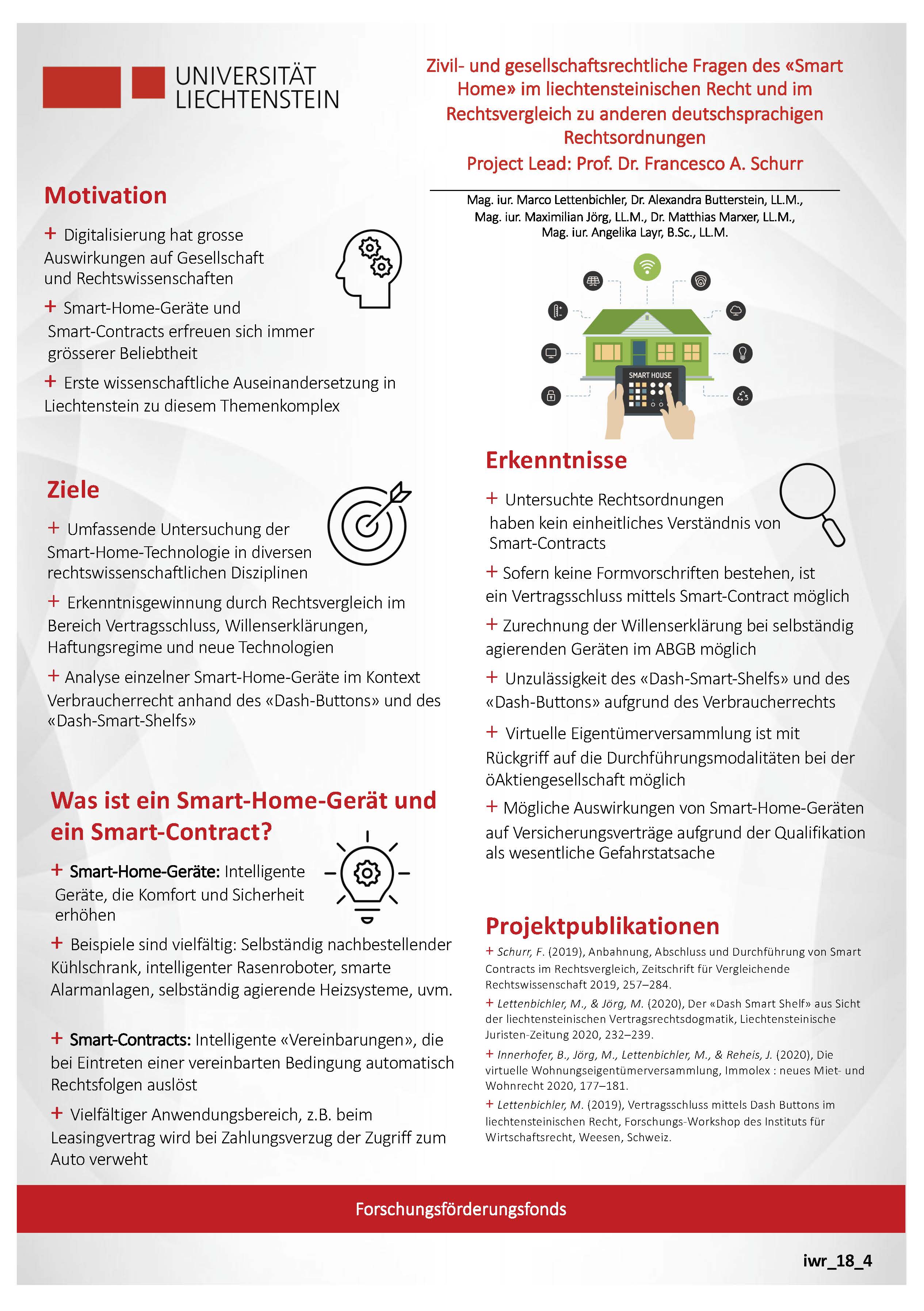
Project results:
Relevance to Liechtenstein
The opportunities offered by this new housing forms have also been recognized in Liechtenstein. For example, some Liechtenstein municipalities had a feasibility study carried out in which it was examined whether a residential generation-appropriate house, equipped with Smart Home technology, could be implemented. Smart home technology could use motion detectors to make an emergency call if necessary, or a tablet could be used to control the light, room temperature and roller shutters. This not only promotes safety, but could also help elderly people to lead a self-determined life even in old age.