Recap of the “Anti-Money Laundering” Intensive Course
Recap of the “Anti-Money Laundering” Intensive Course
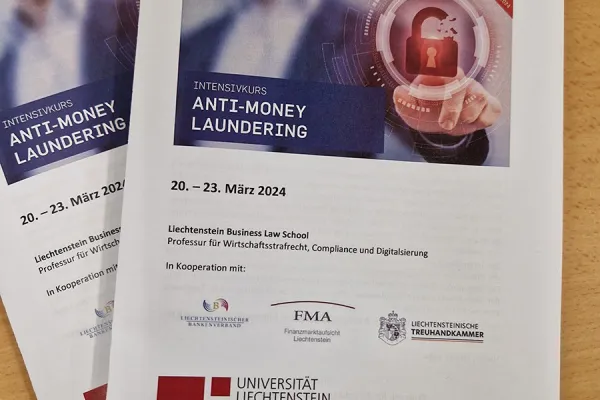
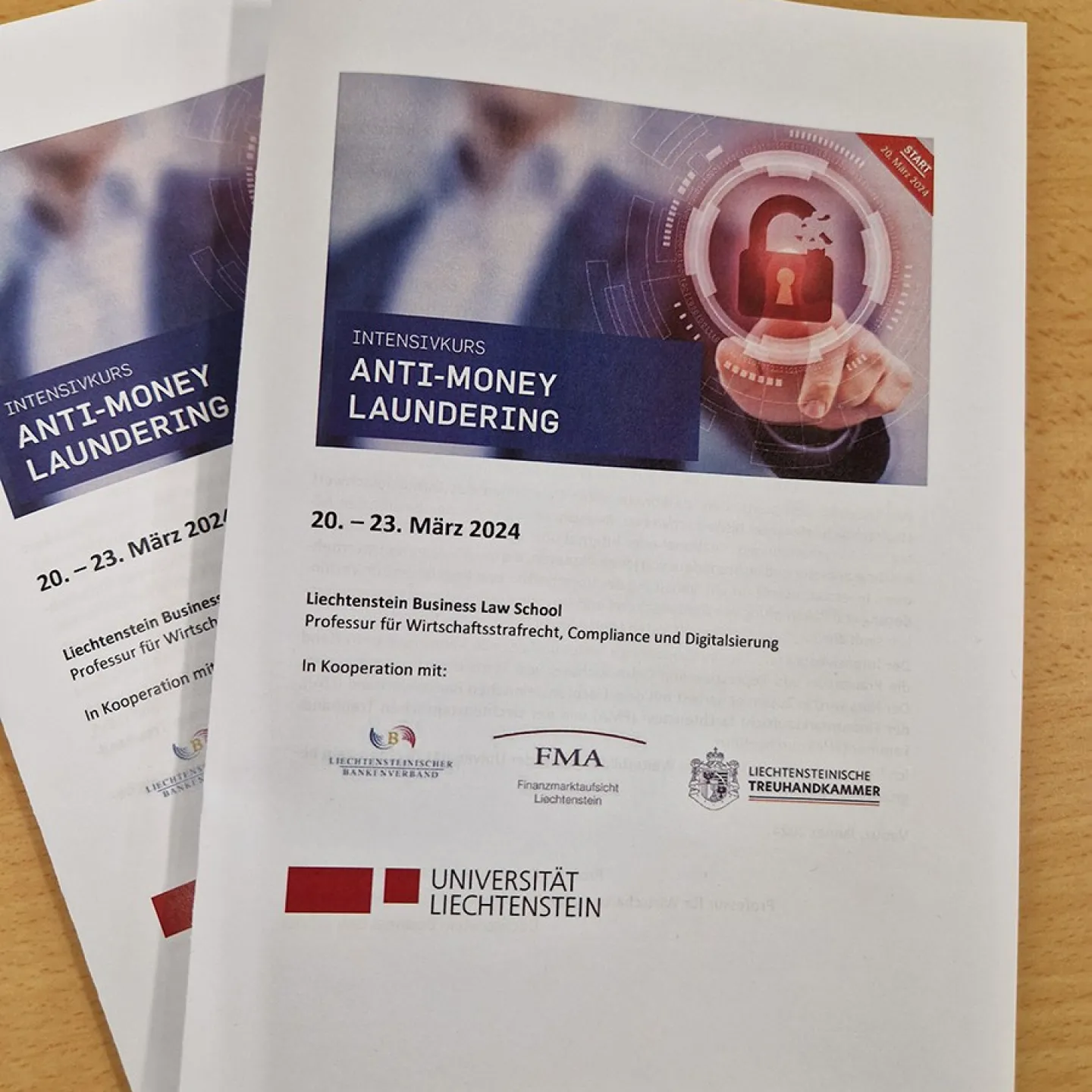
From March 20 to 23, 2024, the Chair of Economic Criminal Law, Compliance, and Digitalization held the “Anti-Money Laundering” intensive course for the third time.
The legitimate financial and economic cycle is often exploited for money laundering and terrorist financing purposes. Such criminal activities can damage a company’s reputation and undermine the integrity of the entire financial center. MONEYVAL evaluates the effectiveness of its member states’ systems in combating these crimes. The “Anti-Money Laundering” intensive course provides comprehensive knowledge for the prevention and prosecution of money laundering, organized crime, and terrorist financing.
Over the course of twelve lectures, the program addressed a wide range of topics related to the phenomenon of money laundering. The course opened with Henrik Stefan, CAMS (Senior Regulatory Compliance Officer, LGT Bank AG, Vaduz), delivering a lecture on “MONEYVAL – Data & Facts.”
Next, Mag. iur. Philipp Röser (FMA Liechtenstein) provided insights into current international regulatory developments and the role of the Financial Market Authority.
The subsequent lecture by Dr. Elena Scherschneva, expert and business consultant in the field of AML and CTF prevention (AML-Compliance e.U., Bad Fischau-Brunn), had to be postponed. Dr. Scherschneva will address, in a separate online session, the reporting obligations in cases of “suspected money laundering, terrorist financing, or organized crime,” as well as the consequences of (non-)reporting suspicious activities, illustrated with real-life case examples.
The second day focused on “Criminal Liability Risks in Case of Violations of the Due Diligence Act.” Mag. iur. Daniel Gehri (FMA Liechtenstein) spoke about the administrative criminal provisions of the SPG, with a focus on distinguishing between intent and negligence.
Dr. iur. Michael Jehle (Princely Court of Liechtenstein) followed with remarks on the judicial criminal provisions of the SPG, before concluding the day together with Mag. iur. Wolfgang Walch (Economic Crime Unit, Liechtenstein National Police) with a “tour d’horizon” from a practitioner’s perspective.
The third day began with a lecture on the criminal provisions concerning organized crime and terrorist financing, presented by course leader Prof. Dr. Konstantina Papathanasiou, LL.M. (Chair of Economic Criminal Law, Compliance, and Digitalization, University of Liechtenstein).
Next came a lecture on criminal liability risks under § 165 of the Criminal Code, delivered by Prof. Univ.-Prof. Dr. Severin Glaser, Professor of Financial and Economic Criminal Law at the Institute of Criminal Law, Criminal Procedure Law, and Criminology at the University of Innsbruck. Following this, Univ.-Ass. Dr. Jonas Divjak (Institute of Criminal Law and Criminology, University of Vienna; from April 1, Postdoctoral Researcher at the local Chair of Economic Criminal Law, Compliance, and Digitalization) presented on the topic of “Data Protection Criminal Law.”
The fourth and final day of the intensive course focused on “Anti-Money Laundering and Counter-Terrorism in the Digital Age.” Lic. oec. publ. Sébastien Caduff (épiphany AG) began with a lecture on “Cryptocurrency as a Challenge and Opportunity.”