Diverse, Relevant, and Internationally Visible: Publications of the Liechtenstein Business School in the First Half of 2025
Diverse, Relevant, and Internationally Visible: Publications of the Liechtenstein Business School in the First Half of 2025
Research at the Liechtenstein Business School is as diverse as it is current: In the first half of 2025, numerous studies were published and presented at international conferences – ranging from citizen science and artificial intelligence to cryptocurrencies and resource-efficient investing.
These publications not only demonstrate a high level of academic quality but also highlight a strong connection to socially and economically relevant issues. The following contributions provide an insight into the broad spectrum of research topics. Additional links to further publications and news can be found below.
Research for All: How Citizens Can Shape Science
Science is no longer just the domain of lab coats and ivory towers – as shown by a new research project from the University of Liechtenstein. In a study published earlier this year in the prestigious journal Electronic Markets, Michael Gau and his co-authors present an innovative system that actively involves citizens in research. Rather than merely consuming results, participants are encouraged to think along, ask questions, and explore problems together with researchers. This is made possible through a digital platform that has been designed and evaluated in several studies with volunteers. The goal is to bring science closer to everyday life and work together to find solutions to real-world challenges. A significant step towards a more open and participatory research culture.
Gau, M., Greif-Winzrieth, A., Maedche, A., Weinhardt, C., & vom Brocke, J. (2025). Engaging citizen scientists: designing an open research system for collaborative problem exploration. Electronic Markets. https://doi.org/10.1007/s12525-025-00757-z
Generative AI in Action – Between Fascination and Implementation
In March, digital-liechtenstein.li, in cooperation with the University of Liechtenstein, hosted a webinar on Generative AI and MLOps – and the interest was tremendous! Over 200 participants joined the session to learn more about the latest developments in this field.
The speakers, Prof. Dr. Johannes Schneider and Jonas Bokstaller, provided fascinating insights into the current state of Generative AI and demonstrated how Machine Learning Operations (MLOps) work in practice.
Three Contributions at DESRIST 2025
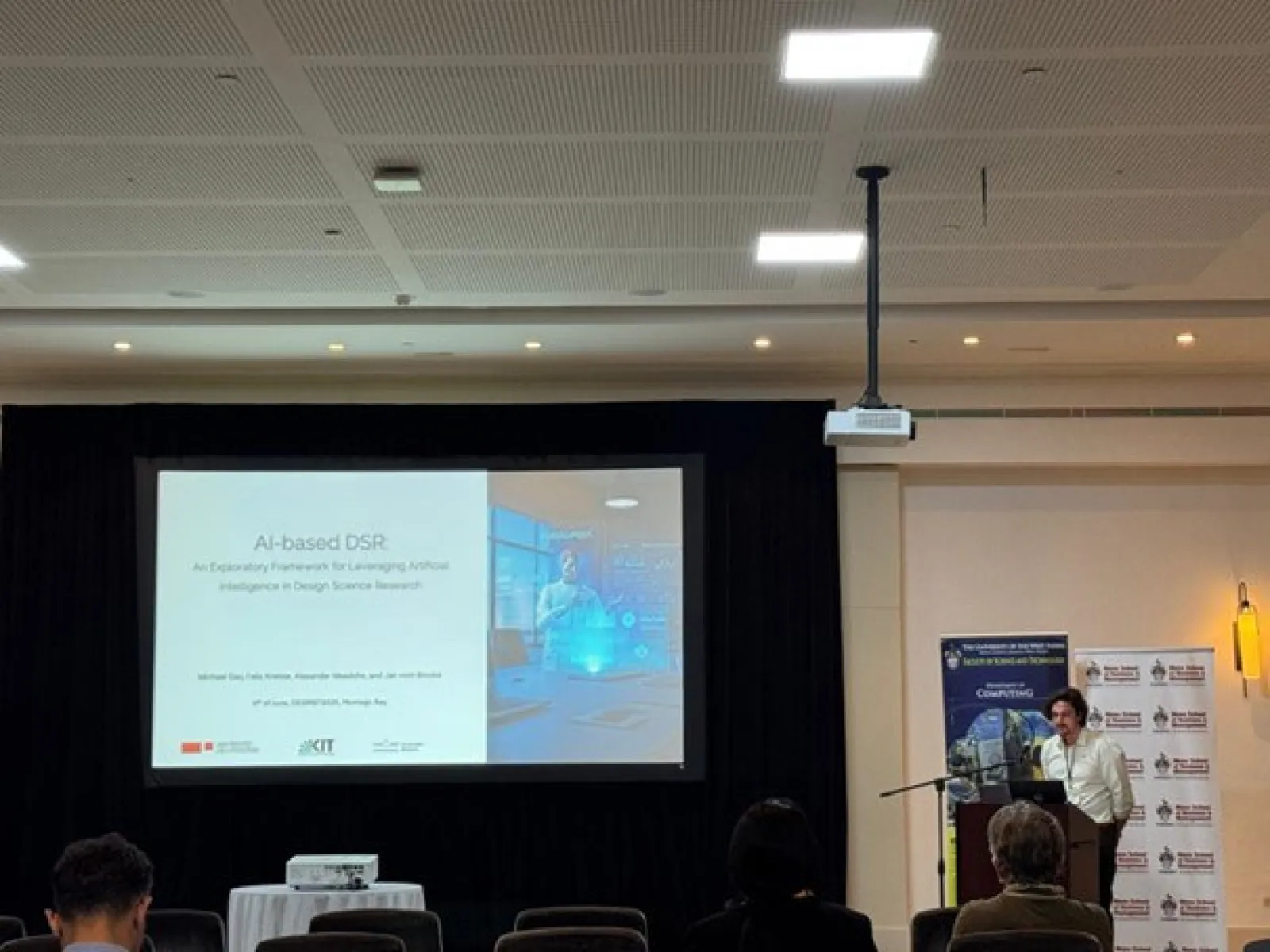
Michael Gau, Senior Scientist at the University of Liechtenstein, participated in this year's DESRIST – the leading conference in the field of Design Science Research – with three contributions alongside his colleagues:
- The paper "AI-Based Design Science Research: An Exploratory Framework for Leveraging Artificial Intelligence in Design Science Research" explores how artificial intelligence can be integrated into the design science process. It presents a framework that supports researchers and practitioners in harnessing the potential of AI.
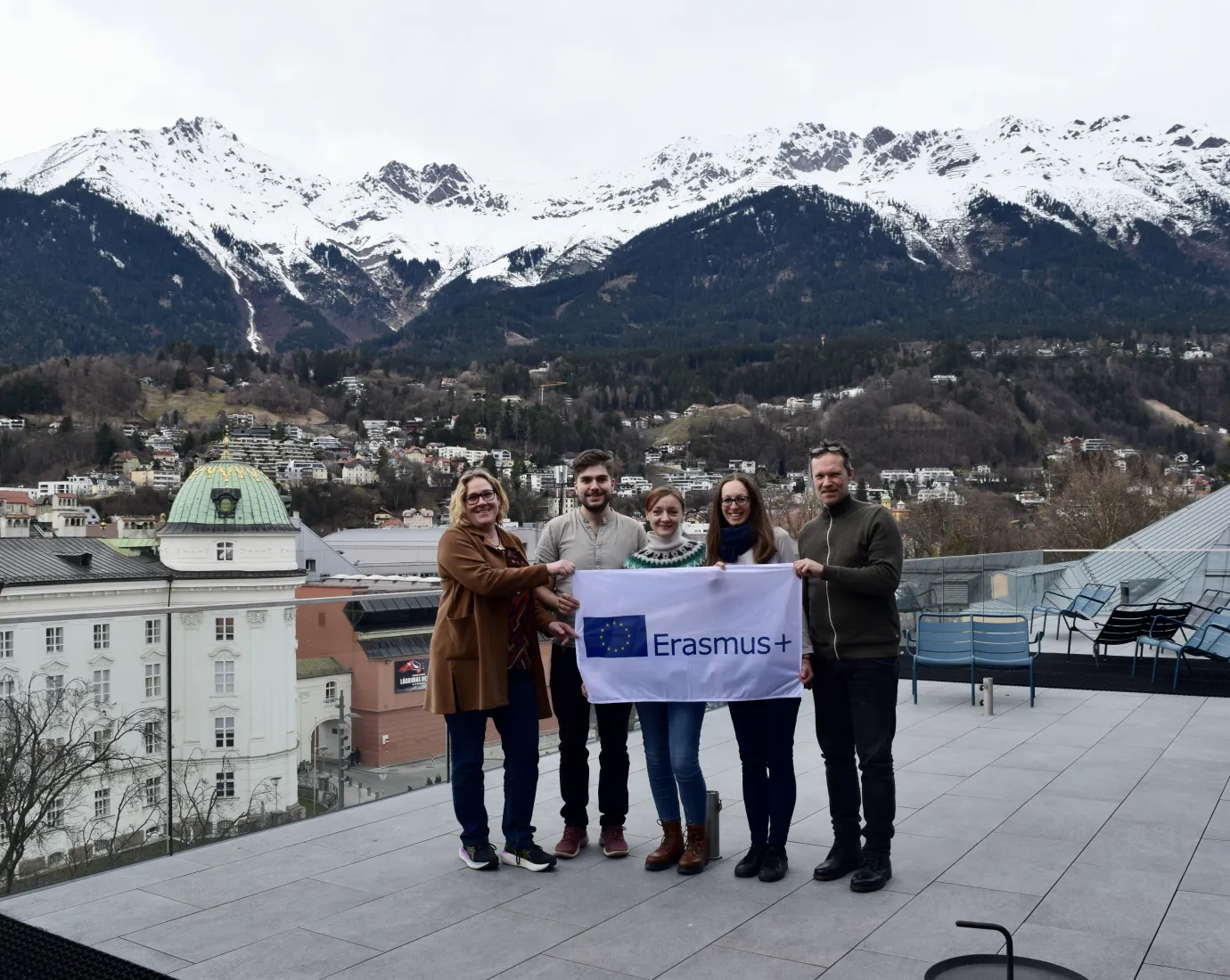
- The paper "Past Lessons, Future Directions: An Author-Informed Review of Design Science Research in Information Systems" was developed as part of the Erasmus+ project Design Science Research Academy. Based on 14 interviews with DSR experts, it analyzes the evolution and future of design science research in the field of information systems.
- The third contribution introduced the Design Science Research Academy, developed within the Erasmus+ project of the same name – an open prototype for innovative and collaborative DSR teaching materials.
Artificial Intelligence in Focus: Job Postings as a Trend Barometer
How can future trends in AI be identified? The conference paper "Job Postings Analysis as a Tool for Technology Foresight," presented by Marie Scheuffele, doctoral candidate at the Liechtenstein Business School, at the ISPIM Innovation Conference in Bergen (Norway), introduces a new approach: Using text mining, more than 100,000 online job postings from 2023 and 2024 were analyzed globally to reveal current developments in the demand for AI-related skills.
The study not only identifies in-demand AI competencies and their evolution across time, countries, and industries – it also demonstrates how job advertisements can serve as a data-driven foundation for technology foresight. The paper was nominated for the prestigious Knut Holt Award, which recognizes the best conference paper at the ISPIM Innovation Conference.
Reference:
Scheuffele, M., Martini, M., John, M., & Brecht, L. (2025). Job Postings Analysis as a Tool for Technology Foresight. Paper presented at the ISPIM Innovation Conference, Bergen, Norway.
Phishing Detection: The limitations of existing detectors against Chinese phishing websites (and how to fix these)
Phishing websites are a major global issue. Yet many existing detection systems focus almost exclusively on the “Western” side of the world---overlooking that phishing websites are pervasive also in other areas, such as China. An international study, co-authored by Dr. Giovanni Apruzzese, Assistant Professor of Data & Application Security, shows that many common phishing detectors that work well on websites tailored for Western users (e.g., English or German) struggle to identify fraudulent websites from China – in some cases, with detection rates below 1%.
To investigate this, the research team collected a new dataset of Chinese phishing websites (ChiPhish) and tested existing systems. Based on their findings, they proposed an improved detector that identifies phishing sites from various regions with a detection rate above 98% – while maintaining a very low false positive rate.
The study was published in the renowned journal Computers & Security:
Yuan, Y., Apruzzese, G., & Conti, M. (2025). Beyond the West: Revealing and Bridging the Gap Between Western and Chinese Phishing Website Detection.Computers & Security (January).
Identifying Technology Trends – Thanks to Online Job Postings
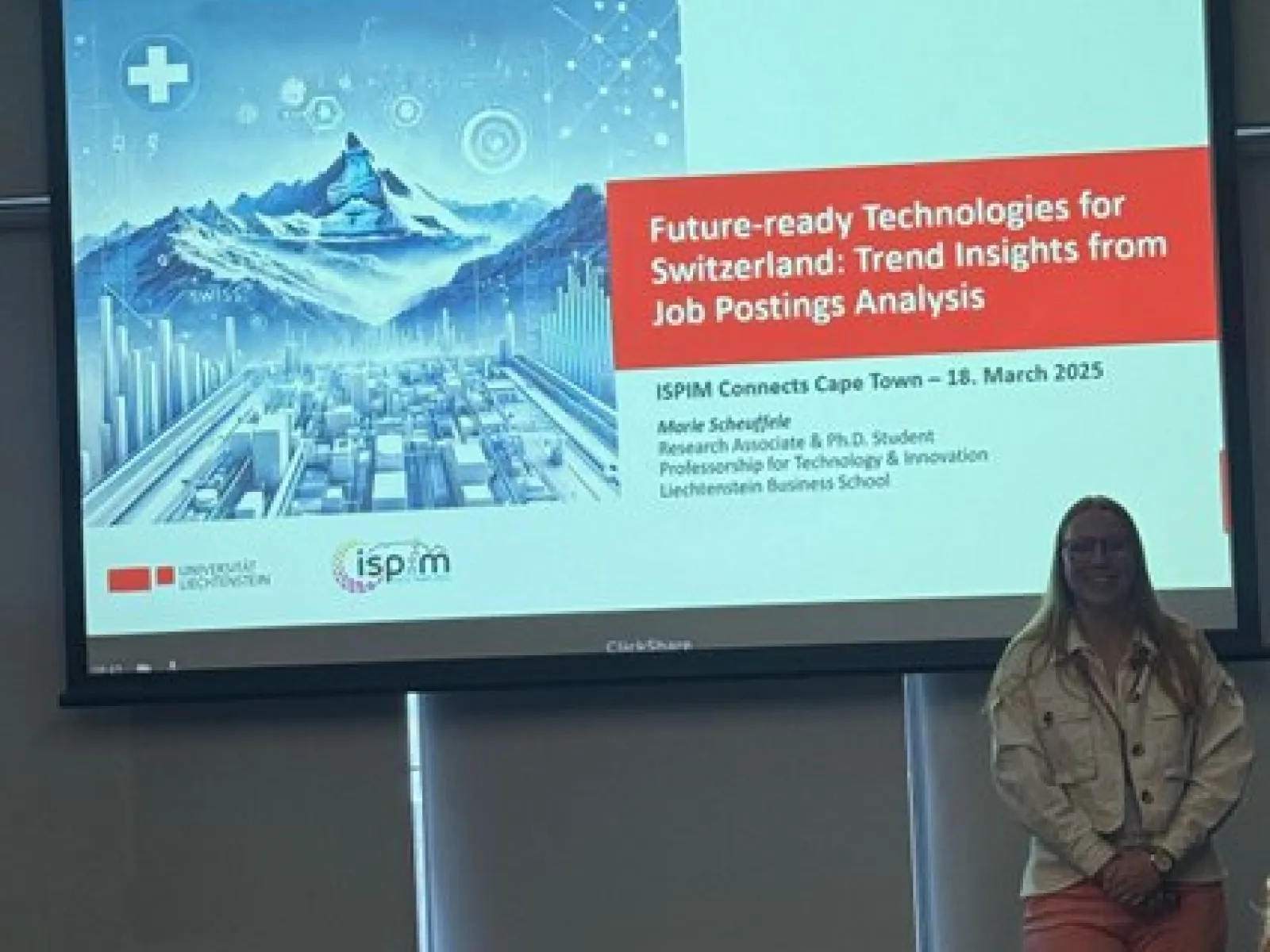
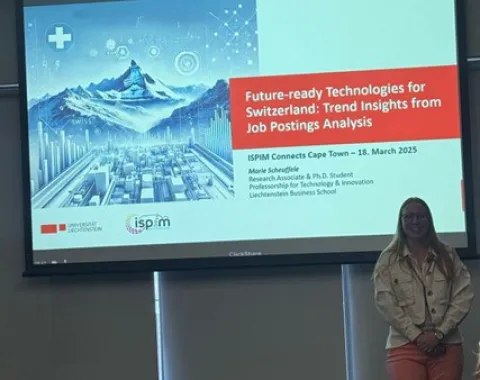
In March, Marie Scheuffele, a doctoral student at the Liechtenstein Business School, presented her research on future-relevant technologies for Switzerland at the ISPIM Connects conference in South Africa. Together with Prof. Dr. Leo Brecht, she examined how online job postings can be used as an alternative data source to identify technological trends and analyse the hiring behaviour of Swiss companies across various industries. The conference paper also provides an overview of current scientific trend studies as well as new data-driven approaches in innovation research.
Scheuffele, M., & Brecht, L. (2025). Future-ready technologies for Switzerland: Trend insights from job postings analysis. Paper presented at the ISPIM Connects Cape Town, South Africa - Transforming Futures Through Innovation, Cape Town, South Africa.
Investing Resource-Efficiently – and Earning More? New Study Reveals Surprising Resu
Can companies that use resources such as energy or water particularly efficiently perform better on the stock market? This is the question explored by a study presented at the 36th ISPIM Innovation Conference in Bergen.
Thomas Beales, Dr. Djordje Zivkovic, and Prof. Dr. Leo Brecht from the Liechtenstein Business School applied a novel analytical method called Data Envelopment Analysis (DEA) and tested it on a sample of 1,500 publicly listed U.S. companies. The surprising finding: firms with high resource efficiency achieved better returns than those assessed using standard ESG criteria.
The study suggests that focusing on actual environmental performance rather than general sustainability ratings may lead to more successful long-term investments.
Beales, T., Zivkovic, D., & Brecht, L. (2025). Resource efficient firms and stock returns. Paper presented at the 36th ISPIM Innovation Conference, Bergen, Norway.
Why Choosing the Right Crypto Exchange Can Make or Break Your Returns
Cryptocurrencies are booming – but many people are unaware that choosing the right trading time and exchange can save (or cost) a lot of money. A new study by the Liechtenstein Business School shows: Anyone trading cryptocurrencies like Bitcoin or Altcoins should pay attention to liquidity – that is, how easily and quickly one can buy or sell without significantly impacting the price.
Prof. Dr. Martin Angerer, Dr. Marius Gramlich, and Prof. Dr. Michael Hanke analyzed thousands of trading data points and found that trading conditions vary significantly depending on the platform, time of day, and currency. On some exchanges, trading is significantly cheaper – especially for less-known coins.
Also interesting: Exchanges themselves can influence how liquid their markets are – for example, by the number of trading pairs offered or through specific trading rules. In short: Paying attention to the details in crypto trading can help avoid high hidden costs and increase profits.
Angerer, M., Gramlich, M., & Hanke, M. (2025). Order Book Liquidity on Crypto Exchanges. Journal of Risk and Financial Management, 18(3).
Central Bank Digital Currency: Threat to Banks or Opportunity for Stability?
More than 100 central banks worldwide are currently working on the introduction of Central Bank Digital Currencies (CBDCs). But how would such a new form of money affect the behavior of bank customers?
A new study by Prof. Dr. Michael Hanke, Professor of Finance, and researchers from the UK investigates precisely this question. Through economic experiments, the researchers analyze how people behave when they can convert their bank deposits into CBDCs – and which designs of these digital currencies increase or reduce the risk of a bank run.
The findings are especially relevant for central banks and policymakers: Anyone aiming to introduce CBDCs must ensure that these innovations stabilize – rather than destabilize – the financial system.
Shakina, Ekaterina, Hanke, Michael and Ellis, Scott. "Central Bank Digital Currencies: Experimental Evidence of Deposit Conversion". The B.E. Journal of Economic Analysis & Policy, vol. 25, no. 1, 2025, pp. 127–137. https://doi.org/10.1515/bejeap-2024-0192
Self-Leadership: The Underrated Key Competence for Entrepreneurs
What does it take to successfully start and grow a business? The new study "Self-leadership: The essential drive for entrepreneurs" by Prof. Dr. Marco Furtner, Professor of Entrepreneurship & Leadership, together with Dr. Simon Liegl and Dr. Kilian Klösel, shows: One of the most crucial factors is the ability to lead oneself – meaning to set clear goals, develop a vision, stay organized and motivated, and follow through with ideas.
The researchers show that self-leadership strengthens the impact of personality on innovation and performance. In other words: Entrepreneurs who can lead themselves are more innovative and effective – regardless of how strong their entrepreneurial personality is.
Their conclusion: Anyone planning to start a business should work deliberately on their self-leadership skills – ideally before the first idea is ever implemented.
Furtner, M., Liegl, S., & Klösel, K. (2024). Self-leadership: The essential drive for entrepreneurs. Journal of the International Council for Small Business.
Further studies were presented at the European Conference on Information Systems (ECIS). An overview can be found here.
Moreover, three additional papers were published in international academic journals, all of which have already been featured in dedicated news articles: