


1. BarCamp Liechtenstein
1. BarCamp Liechtenstein
School or Professorship:

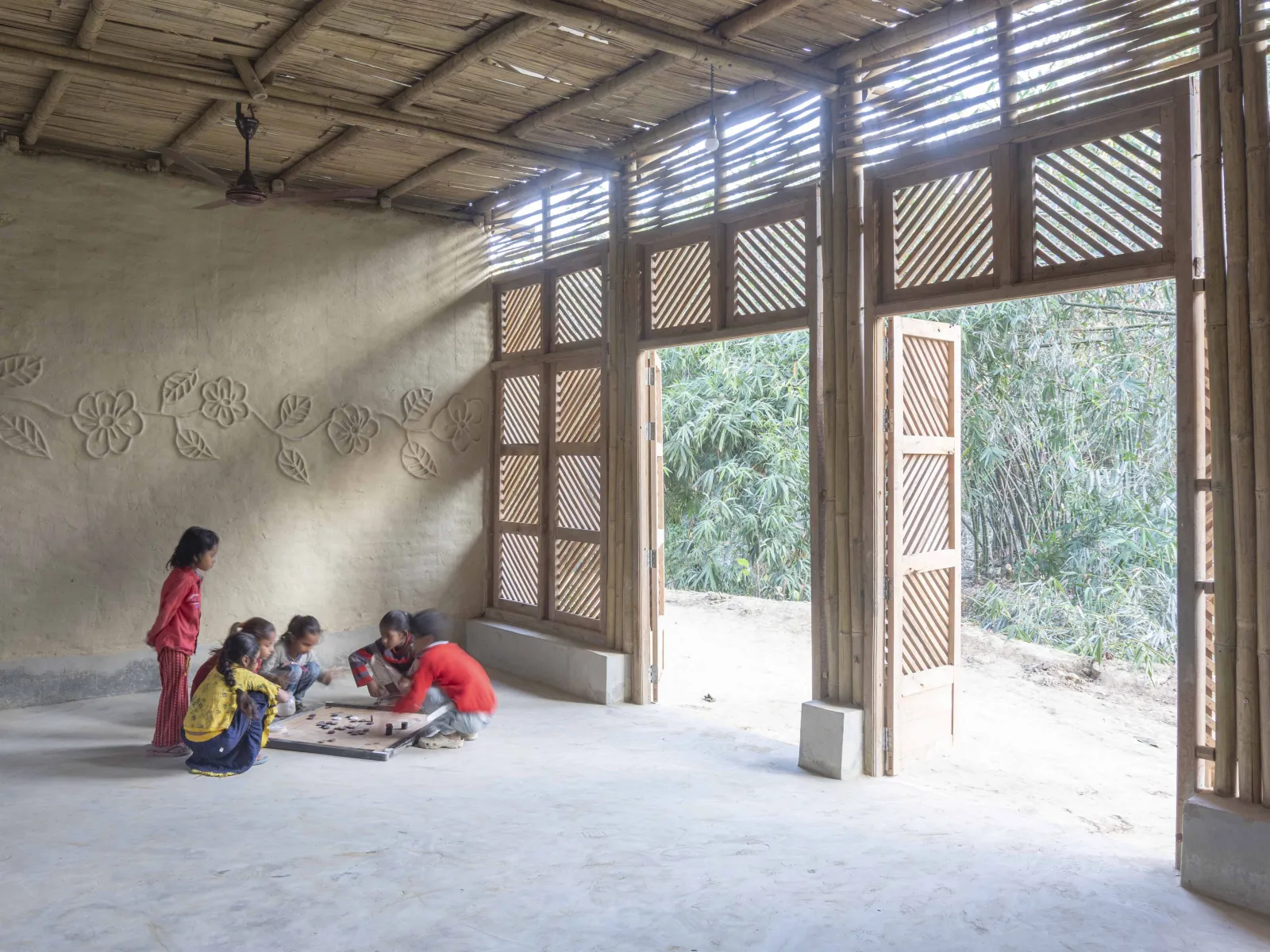
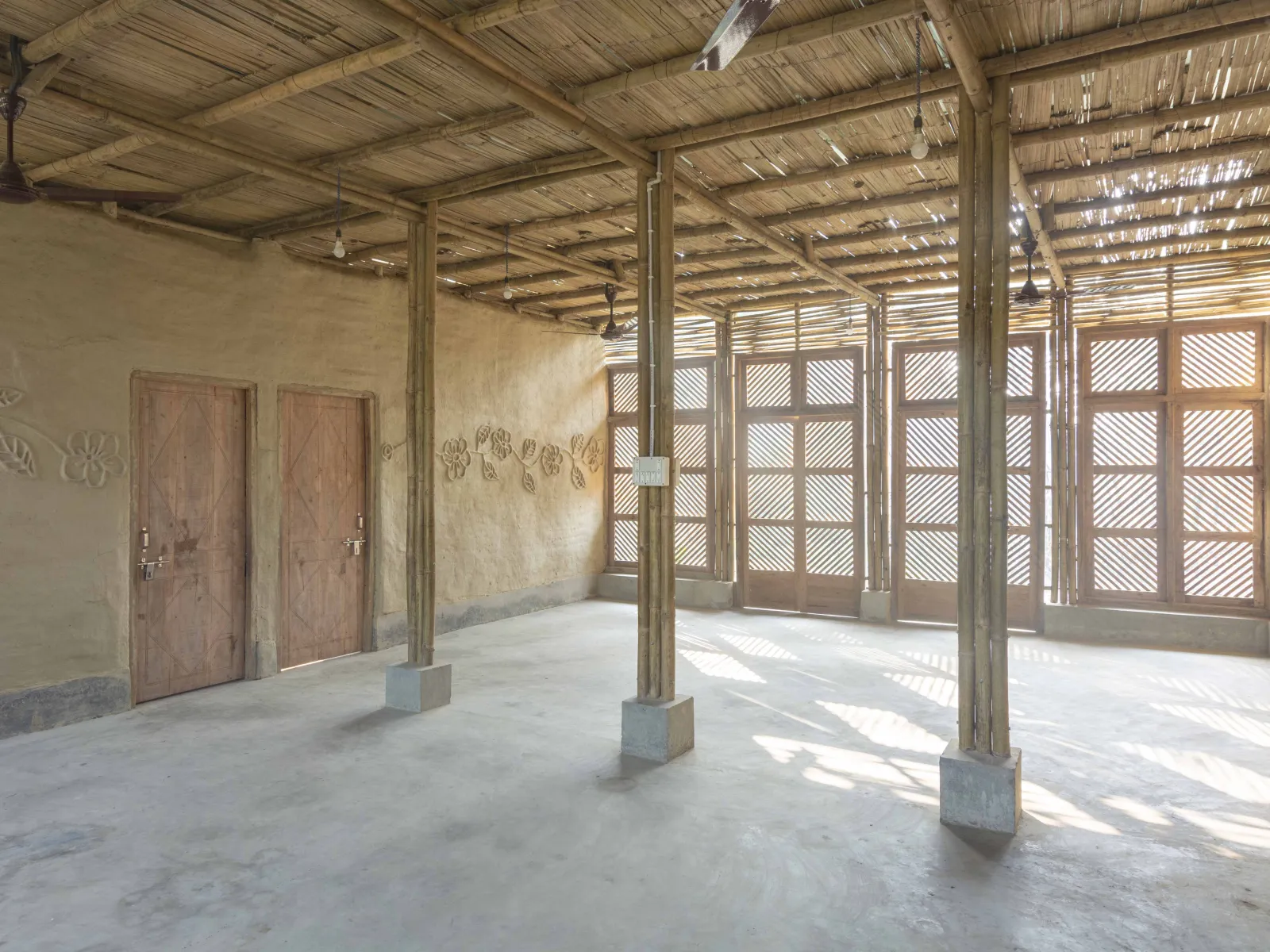
What an architecture aiming not for economic growth but for a good life and social justice might look like? The question of what an architecture that does not strive for economic growth but instead for a good life and social justice might look like was what motivated my partner Isha and me to take a rather different professional path. Shortly after completing our architecture studies, we founded the non-profit organisation Arch Aid in 2020. We questioned the need for further new buildings in Switzerland and, at the same time, due to Isha’s background, became aware of the considerable need for climate-resilient and safe buildings in India.
We had become tired of engaging with luxury problems. Instead, we wished to contribute to improving the living conditions of disadvantaged people in India by creating essential building infrastructure. At first, we regarded our work as a largely one-sided process, a transfer of knowledge and financial resources from Switzerland to India. By using regenerative and local building materials such as earth, bamboo, wood and straw, we attempted to strengthen regional value creation rather than support an internationally operating cement and steel industry. In doing so, we realised that people in a remote Indian village orient themselves towards urban ways of building and living. “The houses and streets where you come from are not made of earth either, are they?” a villager confronted us. The village looks to the nearest town, that town looks to the large cities of Delhi or Mumbai, and these, in turn, take inspiration from Dubai, London or New York.
In Bahuarwa, where we built a school, only few households have a toilet, but almost every adult owns a mobile phone. There is no functioning public school, yet there is high-speed internet. Urban building and lifestyle models from the Global North are therefore at least digitally accessible. It was thus hardly surprising that, for many, the most beautiful house in the village was the one built in reference to a villa owned by Bollywood star Shah Rukh Khan in Mumbai. Earth or bamboo were nowhere to be found.
The rejection of natural building materials is not only the result of exposure to other digital models but is also connected to the effects of climate change, which are themselves closely linked to our way of life in the Global North. Increasing extreme weather events in the Himalayan region to the north cause flooding in the flatlands of Bihar, with severe consequences for vernacular building traditions. Earth foundations become undermined, walls erode, and entire buildings collapse. As a result, doubts regarding natural building materials grow, and the shift towards fired bricks, cement and steel accelerates.
A further reason for the growing rejection of regenerative building materials is economic. The rapidly expanding cement and steel industry, often with roots in the Global North, recognises remote regions as new markets. It displaces local building culture to the point where, in many cases, no alternative remains but to construct a building with cement and steel. Consequently, in rural parts of India, it is becoming more difficult to use regenerative materials because the necessary craftsmanship no longer exists.
The ideals of progress, the consequences of climate change and the influence of global building industries are only some of the interdependencies between the Global North and the Global South that accompanied us during the construction of the school. Turning “not enough” into “enough” also requires turning “too much” into “enough”. Especially concerning the latter, we, and I in particular as a Swiss architect, learned valuable lessons during our several months on site. When we gave local craftsmen instructions on the proportion of earth, straw and water to mix, they waved us off. “You know these materials from books, we grow up with them.”
To better understand the needs of the schoolchildren, we took part in their daily routines. They proudly showed us their homemade toys: a cricket bat made of bamboo, figures shaped from earth or balls crafted from discarded painter’s tape. During the subtropical winter, we wore a second jumper in the evenings and warmed ourselves by an open fire. At the same time, we received video calls from friends in Switzerland who were sitting in front of the television wearing shorts while snow fell outside. In these moments, the question of the right measure repeatedly arose in our minds.
Although our work in India is financially and structurally restricted and requires a pragmatic approach to architecture, the buildings we construct should not only be durable and functional but also aesthetically convincing. However, the aesthetic lies not in the spectacular or extraordinary but in the simple and small. During the planning and construction of the school in Bihar, we realised that a radical use of regenerative materials such as earth and bamboo was not practical if the building and the applied methods were to be accepted by the local population. Unlike in our context, the use of natural building materials does not signal environmental awareness but poverty. Only members of marginalised castes in Bahuarwa still live in buildings made of earth and bamboo.
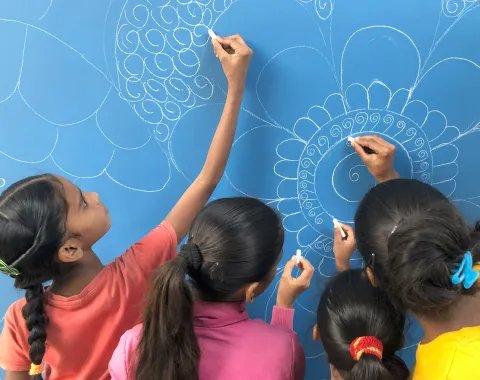
In dialogue with the community, we defined the right balance between natural and more processed materials. The social meaning of a material was just as significant as its technical properties. This led us to undertake a form of bluewashing analogous to greenwashing. We concealed the use of regenerative materials with a blue coating on the façade to prevent the schoolchildren from being stigmatised. If “enough” is to be understood as a fair distribution of the planet’s limited resources, then an effort from both sides is required. When confronting another culture, we not only come to know it but also become more aware of our own. During our work in India, we learned to regard our activities not as a one-directional transfer in the sense of development aid but as a joint learning process.
If we measure development and progress by how we interact with our environment, the question arises of who actually requires help. Instead of seeking sustainability in materials and products, we learned in India that usage is ultimately decisive. The question of “enough” cannot be answered through technological progress alone but requires that we understand sustainability as a practice rather than a product. Numerous sustainability strategies familiar to us from lectures and books, from upcycling and repair workshops to communal living and self-sufficiency in one’s own garden, are part of our daily experience in India. Yet they exist not as a result of environmental awareness but out of necessity. In the face of an escalating environmental crisis and increasing disparities between abundance and scarcity, the question arises of how long we can continue to avoid confronting the issue of the right measure. “Enough” could be a promising design principle for our ways of building as well as our ways of living.
Architect Daniel Haselsberger leads a design studio at the University of Liechtenstein, where he is also completing his doctorate. In his dissertation, he investigates the social meaning and acceptance of regenerative building materials in the Indian state of Bihar and seeks options to combine them with new building methods and materials. Together with his partner, Isha Haselsberger, an architect born in India, he founded the non-profit organisation Arch Aid in 2020. From 2022 to 2024, they built a school for children from marginalised castes in the Indian state of Bihar in collaboration with the NGO Bahuarwa Foundation. Haselsberger linked the construction of the school with his research. While the school benefited from the analysis of local building culture, the planning and construction process provided data for his doctoral work and created value for the local community.
This article was first published on 5 November 2025 in the journal “Hochparterre”.


For the past three years, society has been preoccupied with one central question: What impact will the rapid rise of artificial intelligence—especially so-called large language models (LLMs)—have on our lives? What will it mean for children who learn in school with or through LLMs? And how might these technologies reshape the everyday experiences of older generations?
These questions also resonate in the field of digital security. Will LLMs become a true game changer—or will the hype subside and “business as usual” return? One thing is certain: cybersecurity is undergoing significant change, though not always in the way many expected.
LLMs have quickly proven themselves as tools for generating highly convincing phishing emails, fake executive calls, manipulated videos and sophisticated disinformation. These risks are substantial but, in principle, manageable. The real test of LLMs as potential cyberweapons, however, is happening in the more technical corners of the digital realm.
At the heart of cybersecurity lies the task of identifying and eliminating vulnerabilities—programming errors that can allow attackers to execute commands, encrypt data or steal information. Detecting such weaknesses requires deep technical expertise. Here, LLMs offer a powerful productivity boost thanks to their ability to answer complex questions and propose useful solutions—hallucinations notwithstanding. Who benefits? Anyone who uses them, regardless of their intentions.
A similar development can be seen in a very practical domain: hacking. This involves overcoming protective barriers designed to safeguard the integrity of IT systems. To simulate attackers’ behaviour and address security issues quickly, organisations rely on penetration tests. Here too, LLMs increase efficiency and reduce costs—not only for defenders, but also for attackers.
Conclusion: Even in the era of LLMs, the race for technological advantage remains unchanged. Security continues to be a competition between human unscrupulousness—and human integrity.

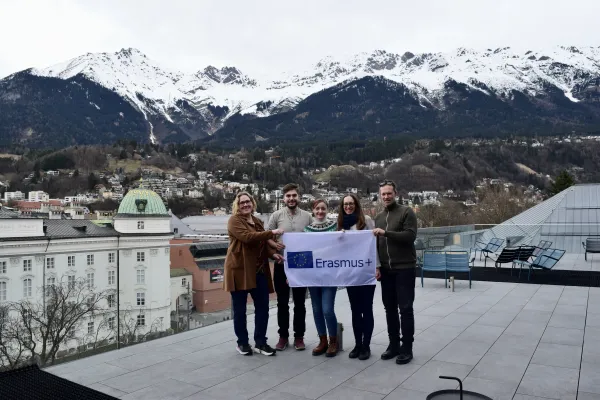
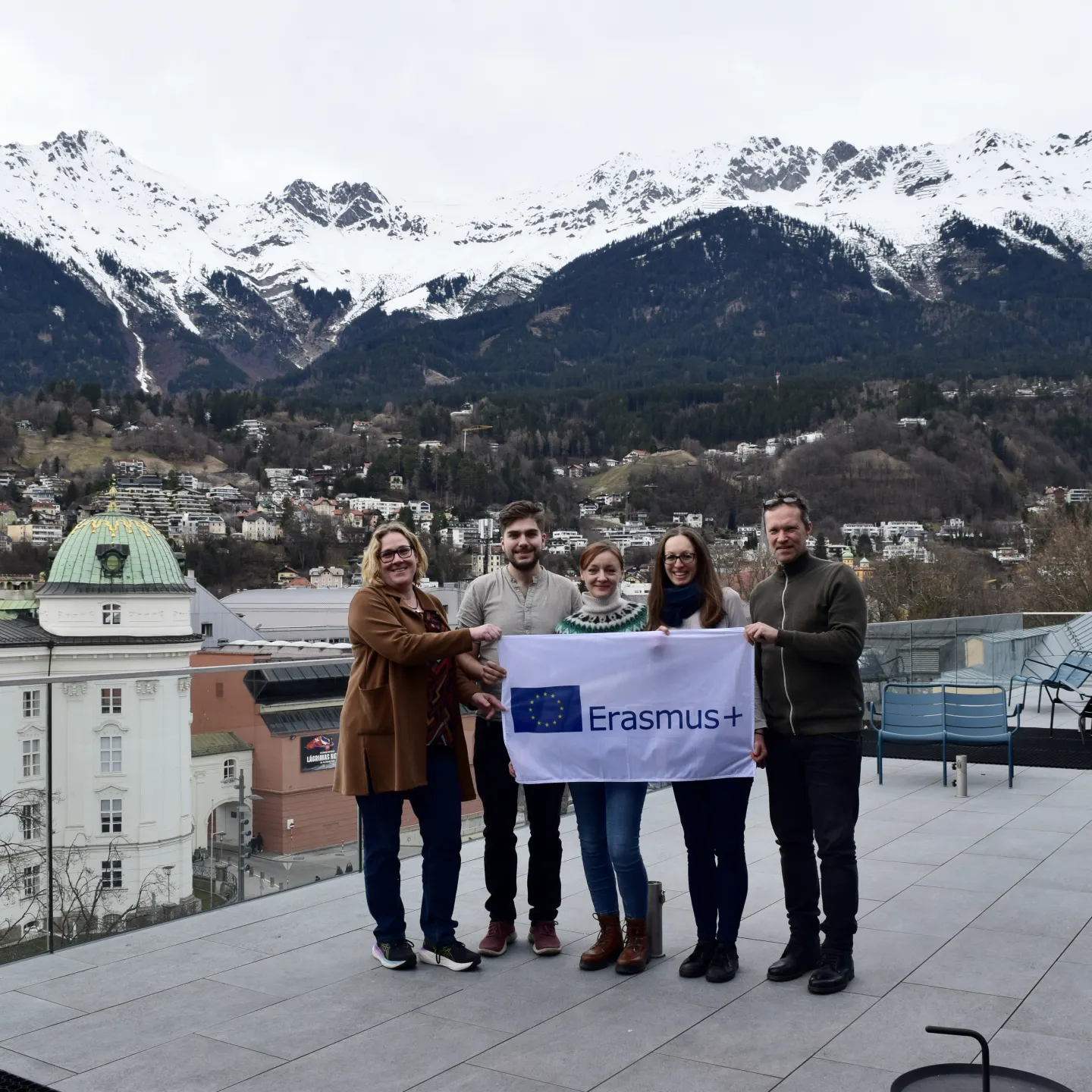
Singing brings people together – even online. In the ERASMUS+ research project “Choir@Home,” the University of Liechtenstein (Dr. Janine Hacker), in collaboration with the Mozarteum University Salzburg (Prof. Dr. Heike Henning) and Anhalt University of Applied Sciences (Prof. Dr. Alexander Carôt), investigated how singing together can take place in virtual spaces and be reimagined.
The COVID-19 pandemic has demonstrated the importance of digital alternatives in the cultural sector. While some choirs successfully made the transition to digital, others struggled with technical hurdles or a lack of social interaction. This is exactly where the Choir@Home project came in: the aim was to enable choirs to rehearse digitally and to create new educational concepts and social conditions for effective collaboration in virtual space. An international online laboratory choir tested the developed concepts in over 30 online choir rehearsals and performed five virtual concerts. Direct feedback from participants helped to continuously improve the concepts. At the same time, the results were made available to a wide audience via social media, press articles, information events, and scientific publications. In addition, teaching materials were developed for the implementation of individual online choir projects.
The project achieved all of its goals—and even exceeded many of them. It created a comprehensive knowledge base on suitable digital tools, developed practical guidelines for choir directors and choirs, and proved through online rehearsals that singing together can also be lively and socially connecting in a digital setting.
The Choir@Home project shows how digital choir singing can be successful – not as a substitute for singing in person, but as a complement to it. It opens up new opportunities for musical participation and digital inclusion and provides choirs, educators, and cultural institutions with valuable materials and solutions for the future.
The results of the project are available on the project website: https://choirathome.com/index.php/results/
The video for the Christmas carol “Bell Carol” by the online lab choir can be viewed on YouTube: https://youtu.be/zOAHHX6A8p0?si=B7tVT7Zi8gwNi8Hx
[1] The research project “Online Choirs: How to carry out virtual choir rehearsals with the help of digital tools” was funded under Key Action 2 (Cooperation Partnerships) of the European Union's ERASMUS+ program (project no.: LI01-KA220-HED-000086928).
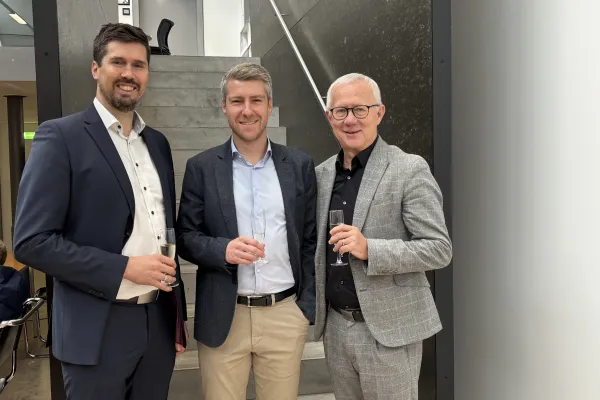
Adrian’s research talk addressed learning and unlearning in coopetition between startups and incumbents, based on a qualitative study. His research shows how both startups and established firms must let go outdated routines and assumptions to collaborate and compete effectively, demonstrating how unlearning enables organizations to adapt and innovate. In addition, he delivered an inspiring student lecture on storytelling in marketing, combining theory and practice in a way that created exceptional value for the participants.
Prof. Martin Angerer acted as chair of the committee, joined by Prof. Jan Mendling, Prof. Dr. Marco Furtner, Prof. Francesco Schurr, and Prof. Dr. Leo Brecht as committee members, together together with representatives from the academic middle management and from the student body Marie Scheuffele, Maximilian Haage. In addition, Leo Brecht served as Adrian’s mentor, guiding and supporting him on his path toward achieving his habilitation.