China – Shanghai
China – Shanghai
My learning experience at Tongji University
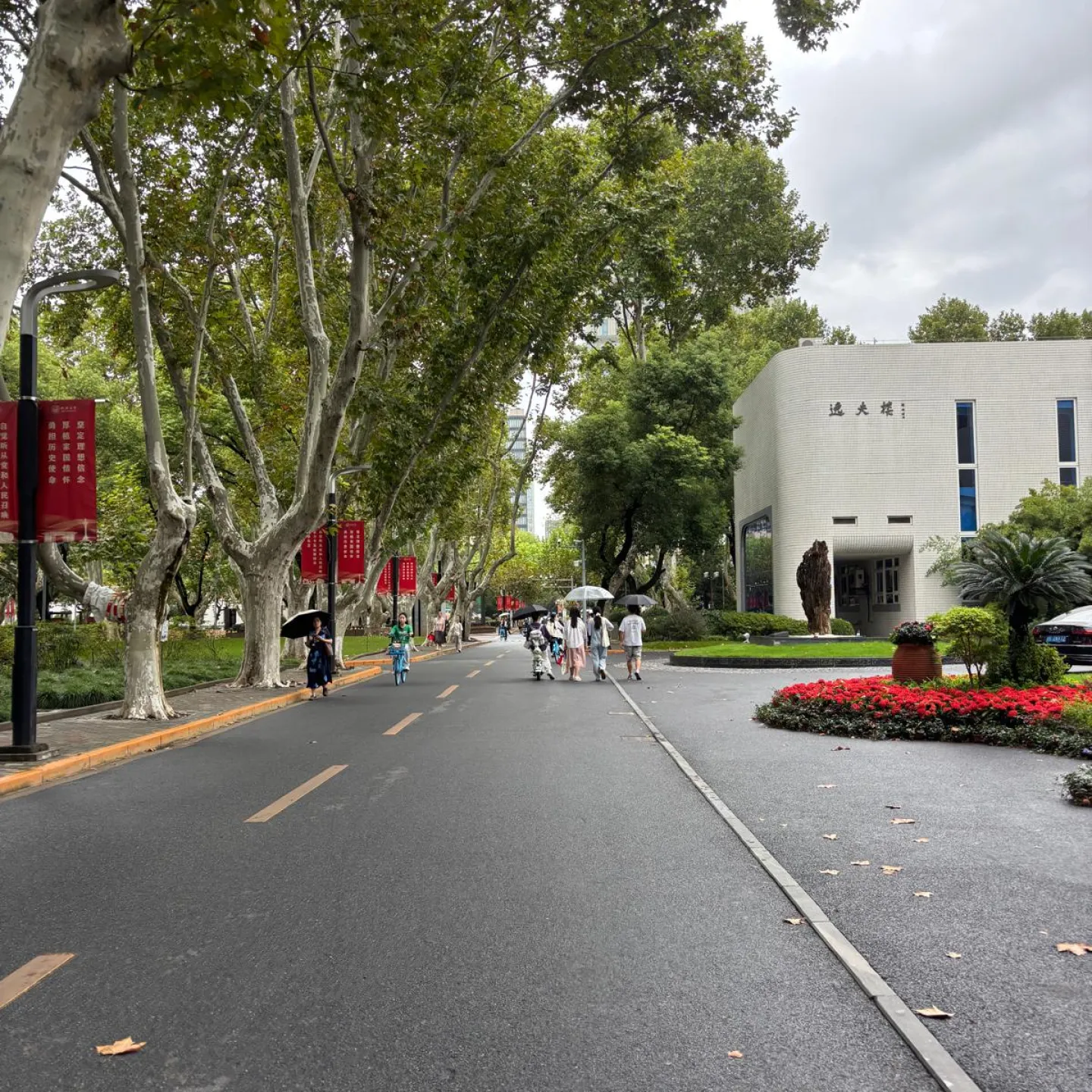
Shanghai is of course a huge step up in scale compared to Liechtenstein. But not only the city felt unfamiliar at first, also the university felt very different and not familiar at all. Tongji University feels like its own little city. The campus is huge, full of buildings, people, canteens, stores and many different sports facilities.
The first big surprise for me was already at the entrance. To even get onto the campus you have to pass a controlled gate with security checks. You can only enter with a valid student card. After that you find yourself in the middle of this giant campus where you basically cannot find your way without a map. Even now, after several months, I still discover new places or meet new people. This is a big contrast to the small and very manageable campus in Liechtenstein that you can cross in five minutes.
One of the biggest unfamiliar things was the learning culture. The most noticeable difference is the amount of courses. Regular Tongji students often take ten or more courses at the same time. At the University of Liechtenstein we have fewer courses but they are more intense, deeper and more detailed.
In China it is more about producing a lot and doing many things in parallel, while at home we focus more on depth, analysis and reflection. In the beginning it was hard to understand that having a lot of work does not always mean that the content is thought through in detail.
The relationship with teachers is also different. Teachers here are respected a lot and communication is more distant. In Liechtenstein it is normal to quickly have a more personal connection and speak very directly. Here feedback is often very soft and less direct. This can be nice because you have more freedom, but sometimes you miss clear criticism that helps you improve.
The expectations also change a lot from course to course. Some teachers are very strict about attendance and punctuality, others are not strict at all. The types of assignments also vary from presentations to creative tasks to videos and essays.
Another thing that surprised me was how insecure many Chinese students are about their English. Many apologise immediately for their “bad English” and do not dare to speak with us. This is a bit sad because it would actually be a great chance for everyone to practice.
In some group projects the university mixes Chinese and international students on purpose. The biggest challenge is coordination. Not only because of the language but also because of different working styles, programs and expectations. With time you learn to adapt, communicate in different ways and work more flexibly.
Slowly the unfamiliar things became part of my daily routine. Paths that felt confusing at first became familiar. I found places with really good food, a hidden souvenir shop, a rooftop to watch the sunset and my favourite study spot in the library.
The cafeteria became a real meeting place. You always run into someone you know and start talking or meet new people. After a while the huge campus began to feel “small”, almost like a village inside a megacity.
The longer I studied at Tongji, the more I understood the system, the learning rhythm and the social life. It even started to feel like a home that you do not really need to leave because you have everything there. You can study in the library, relax in the park, or spontaneously join basketball or try kungfu.
In the end I can say that this experience taught me a lot about intercultural learning. I had to adapt to a new learning system, work in groups with very different people and find ways to complete projects even when communication was difficult.
I learned how different learning can look in other countries. Some value depth more and some value performance and variety. I also experienced how a connected campus can create a strong feeling of community and how you meet new people and moments every day. What felt strange at the beginning feels familiar now. And that is the biggest development for me.