Fourth Intensive Course on “International Sanctions Law”
Fourth Intensive Course on “International Sanctions Law”
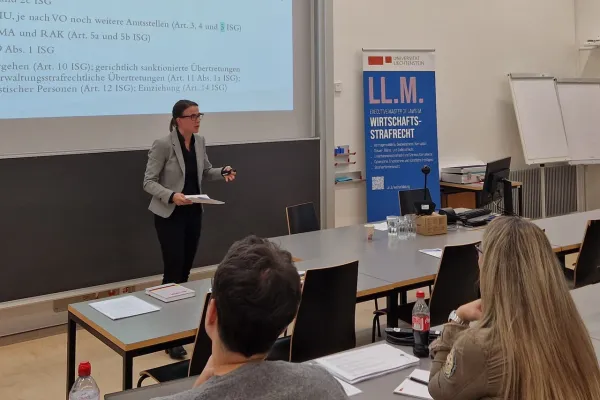
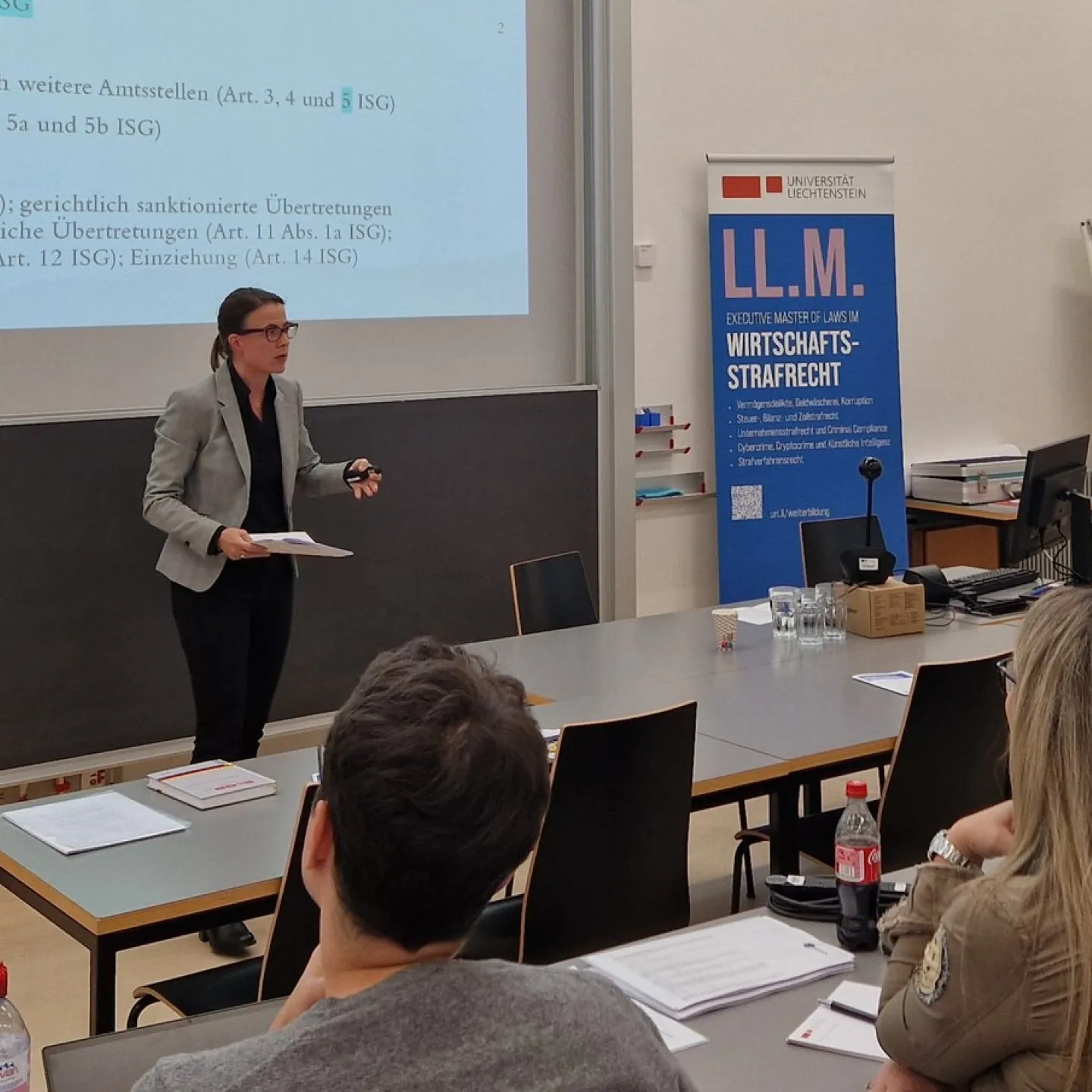
On 3 and 4 October 2024, the Chair for Economic Criminal Law, Compliance, and Digitalization held the fourth edition of the intensive course "International Sanctions Law."
Following the welcome address by Prof. Dr. Konstantina Papathanasiou, LL.M., the course featured seven presentations covering various aspects of international sanctions law. The opening lecture was delivered by Dr. Georges Baur (Research Associate in Law at the Liechtenstein Institute, Gamprin-Bendern), who provided insights into the international framework of Liechtenstein’s sanctions law (UN–EEA treaties with Switzerland) and the political dimensions of sanctions.
Prof. Dr. Konstantina Papathanasiou, LL.M. (Chair of Economic Criminal Law, Compliance, and Digitalization) then introduced Liechtenstein’s Sanctions Act (ISG), focusing on Articles 1–5b and 9 ISG, and explained the criminal provisions in Articles 10 and 11 ISG. The focus was on distinguishing between intent and negligence, as well as on the liability of legal persons. These provisions were illustrated using the criminal provisions of the Ukraine Regulation. The presentation concluded with a look at the EU Directive 2024/1226, which defines criminal offenses and penalties for violations of the Union’s restrictive measures.
Next, Biba Homsy (Partner and Founder, Homsy Legal, Geneva/Luxembourg) gave an online presentation on “Practical Issues in Sanctions Law in Luxembourg.”
The first day ended with a talk by Mag. Piotr Daniel Kocab, LL.M. (Gasser Partner Attorneys at Law) titled “Fear of the OFAC – Resignation from a Foundation Board Due to Russia-Related Connections? What Is Reasonable to Expect from a Foundation Board Member?”
On the second day, Dr. Teresa-Christina Macan, Dr. Hannah Blecha, LL.B., and Lic. iur. Alexander Schwartz (Schwärzler Attorneys at Law) presented “Practical Issues in Sanctions Law in Liechtenstein and Switzerland, Focusing on Sanctions Against Russia Based on the Ukraine Sanctions Regulation,” analyzing recent case law and practical examples.
This was followed by a presentation by Mag. Piotr Daniel Kocab, LL.M. (Gasser Partner Attorneys at Law) on the topic “Over-Compliance: How Much Protection Does the Law Offer?”
The course concluded with a presentation by Gerd König (Financial Crime Prevention LGT, Vaduz) on the significance and scope of international sanctions, with a focus on EU–US relations and their impact on Liechtenstein banks.
The strong interest of the numerous participants once again confirmed the need for in-depth and ongoing dialogue on this highly relevant and complex subject. The next course will take place on 10 and 11 April 2025.
Further information is available at www.uni.li/isg.