Skip to Main Content

Corporate sustainability and its implications on company (non-) financial performance

Project Description

This research project focuses on alternative perspectives on sustainability by examining the interdependencies of corporate sustainability efforts and firm performance. By integrating (non-) financial indicators into the analysis, the research outcome provides indications for not just corporate financial management but also for innovation decisions, and organizational structures of companies from various industries. Ultimately, the research project is strongly interdisciplinary and embraces knowledge from different faculties and areas of research.

Project Participants

Employee
Jennifer Nadine Schein MSc
- PhD-Student
PhD-Student
Employee
Prof. em. Dr. Marco J. Menichetti
- Supervisor
Professor Emeritus - Liechtenstein Business School
Supervisor

Corporate Social Responsibility and Risk: Perspectives on Materiality, Trust and Investor Preferences

Project Description

This study contributes to the academic literature on CSR and ESG risk materiality. By disentangling aggregated ESG ratings according to their underlying key performance indicators (KPI) and empirically testing their industry-specific risk materiality, we intent to provide further evidence on the relevance of ESG issues on firm value through lower firm risk and the importance of accounting for materiality. Moreover, we provide additional insight on investors' preferences regarding ESG components as a way of risk management. In this respect, the results provide valuable feedback for asset managers on how to successfully identify risk material ESG criteria, but also on how to use them as a way of signalling to investors. Finally, we conclude by assessing the impact of firms' CSR activities on a countries overall level of public trust, with public trust being another key component in reducing the sensitivity to negative market shocks on a broader country level.

Project Participants

Employee
Prof. em. Dr. Marco J. Menichetti
- Professor
Professor Emeritus - Liechtenstein Business School
Professor
Employee
Dr. Lars Kaiser
- Principal Investigator
Principal Investigator
Employee
Dr. Hendrik Peer Kimmerle
- Project Collaborator
Project Collaborator

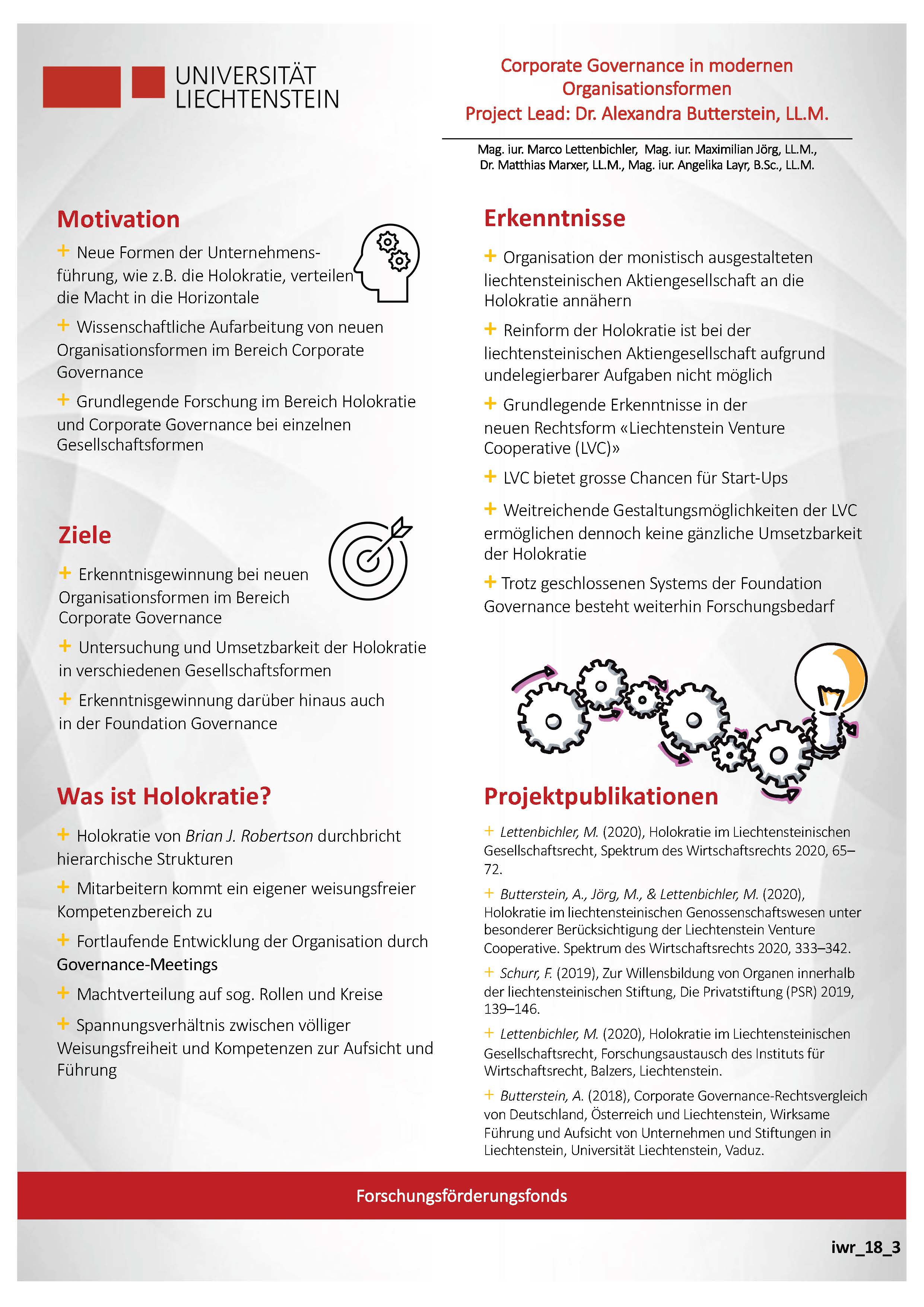
Corporate Governance in modernen Organisationsformen

Project Description

In the last few years, the innovative energy of entrepreneurship has led to the flattening of the power distribution within the company. Due to the positive economic effects, such modern forms of organization as holacracy enjoy great popularity. Traditional hierarchical structures and functions will be abolished and company's structure will be continuously developed. These developments challenge traditional corporate governance models that are used in modern organizational forms.
The research project deals with the question of how far such modern organisational forms are compatible with the mandatory functions and powers of the corporate bodies and the resulting questions of their liability. Within the framework of comparative law, the limits and possibilities of dualistic structured organisational models, e.g., in Austria and Germany, or monistic structured organisational models, e.g., in Switzerland and Liechtenstein, are presented. In addition, new corporate governance models for modern organizational forms are to be worked out and developed at the same time. Another aim of the research project is to investigate whether the structural design possibilities of individual legal forms, e.g. the foundation or the cooperative, can better meet the challenges of corporate governance faced by modern organisational forms.

Project results:

Relevance to Liechtenstein

Corporate Governance in modernen Organisationsformen Moderne Organisationsformen für Start-Ups erfreuen sich in Liechtenstein mittlerweile grösster Beliebtheit. Dies zeigt auch eine neue Rechtsform, die im Jahre 2017 vom liechtensteinischen Gesetzgeber eingeführte wurde. Die Liechtenstein Venture Cooperative wird auf ihre Vereinbarkeit mit der Holokratie untersucht. Die LVC stellt eine kleine Genossenschaft dar und wurde vom Gesetzgeber mit der Intention geschaffen, Gründern eine neue, kostengünstige Gesellschaftsform zur Verfügung zu stellen, damit Innovation und Gründergeist im Land gefördert werden. Ebenso wird die Einführung der Holokratie für die liechtensteinische Aktiengesellschaft untersucht. Das Forschungsprojekt liefert insofern wichtige Erkenntnisse für den Gründerstandort Liechtenstein.

Scientific, Economic and Societal Impact

Das vorliegende Forschungsprojekt hat sich erstmalig mit der LVC wissenschaftlich auseinandergesetzt und leistet insbesondere für Rechtsanwender und Gründer somit einen wesentlichen Beitrag.
Ein weiterer Schwerpunkt des Forschungsprojektes lag im Bereich der Foundation Governance anlässlich der zehnjährigen Stiftungsrechtsreform. Die Untersuchungen haben gezeigt, dass insbesondere im Bereich der Willensbildung von Stiftungsorganen weiterhin Forschungspotenzial vorhanden ist. Die gewonnenen Erkennt-nisse zeigen, dass die allgemeinen Vorschriften des Personen- und Gesellschaftsrechts, welche die liechtensteinische Aktiengesellschaft als Vorbild hatten, sich nicht in allen Detailfragen auf liechtensteinische Stiftun-gen übertragen lassen.
Durch die vielen dispositiven Normen im Personen- und Gesellschaftsrecht kann eine starke Annäherung an die betriebswirtschaftlichen Organisationsm

Keywords

Corporate Law Foundation Law Corporate Governance

Contribution of mindfulness and/or self-leadership training program to the meaningful potential development of current and future leaders in organization especially in the context of VUCA

Project Description

The main research project is about an intervention study whereby part-time students (with several years of working experience) and fulltime students (some working experience) are allocated to three different training groups. They attend either the semester-long elective (i) "Mindfulness / Mindful Leadership", (ii) "Self-Leadership" or (iii) an alternative elective. The latter group (iii) acts as an active control group. The purpose of this study is to find out if such trainings can increase besides the obvious mindfulness and self-leadership skills also aspects related to self-efficacy, self-esteem, risk-readiness, locus of control, proactivity, well-being, happiness/satisfaction, resilience and dealing with uncertain times caused e.g. by the corona pandemic. To sum up, prepare the future leaders for working and leading in a demanding, digitalized VUCA-world that we are facing more and more.

This leads to the following research question:
What kind of contributions could a mindfulness and/or self-leadership training program make to the meaningful potential development of current and future leaders in organization especially in the context of VUCA?

Keywords

Leadership Self-leadership Mindfulness Employability VUCA

Project Participants

Employee
Prof. Dr. Marco Furtner MBA
- Supervisor
Professor - Entrepreneurship and Leadership Academic Director MSc EIL - Liechtenstein Business School
Supervisor
icon
Employee
Mag. Elias Jehle CEMS MIM
- PhD-Student
PhD-Student
Univ.-Prof. im Ruhestand MMag. Dr. Norbert Kailer
- Co-Supervisor
Co-Supervisor

Content-aware Business Process Management (CA-BPM)

Project Description

Ziel des Forschungsvorhabens "Content-aware Business Process Management" (CA-BPM) ist die Entwicklung einer Konzeption zum Geschäftsprozessmanagement, welche die neuartigen Herausforderungen berücksichtigt, die mit der fortschreitenden Digitalisierung betrieblicher Inhalte und Dokumente einhergehen. Bearbeitet werden Fragestellungen zur Gestaltung von Geschäftsprozessen, die in einem hohen Maße von Content abhängig sind (hier: "contentintensive Geschäftsprozesse"). Das Projekt setzt damit an der Schnittstelle zwischen BPM (Business Process Management) und ECM (Enterprise Content Management) an und führt die bisherigen Arbeiten am Institut für Wirtschaftsinformatik im Forschungsschwerpunkt BPM fort. In diesem primär bedarfsdeckenden Forschungsprojekt steht ein grundlegender Erkenntnisgewinn zum Management content-intensiver Geschäftsprozesse im Vordergrund. Inhalt ist die Erarbeitung einer theoretisch fundierten Grundlage zur praktischen Ausgestaltung eines Geschäftsprozessmanagements, das die spezifischen Anforderungen des betrieblichen Content Managements berücksichtigt. Konkret wird untersucht: (1) welche Anforderungen für das Geschäftsprozessmanagement aus der zunehmenden Digitalisierung betrieblicher Dokumente und Inhalte resultieren; (2) inwiefern diese Anforderungen in existierenden Ansätzen zum Geschäftsprozessmanagement berücksichtigt werden; (3) wie content-intensive Geschäftsprozesse charakterisiert und gestaltet werden können; (4) welche Faktoren in ihrem Management zu berücksichtigen sind; (5) welche Strategien sich zum Management content-intensiver Geschäftsprozesse eignen; und (6) wie moderne ECM-Systeme zu ihrer Unterstützung eingesetzt werden können. Zur Sicherstellung der Generalisierbarkeit und der Praxisrelevanz der Ergebnisse werden mehrere Fallstudien mit prozessorientiert arbeitenden Unternehmen unterschiedlicher Branchenzugehörigkeit durchgeführt (Hilti, Hoval, Ivoclar Vivadent, OMICRON electronics und ThyssenKrupp Presta).

Relevance to Liechtenstein

Das Projekt thematisiert mit ECM eine sehr neuartige Technologieklasse. Damit wird eine höchst aktuelle Problemstellung der (Informations-)Gesellschaft adressiert, die schon heute in vielen Lebensbereichen relevant ist und in Zukunft noch an Bedeutung gewinnen wird (z.B. die Suche nach Dokumenten oder die kollaborative Bearbeitung von Inhalten). Auch für die Region hat dieses Thema eine hohe Bedeutung; entsprechend zählen die Unternehmen Hilti, Hoval, Ivoclar Vivadent, OMICRON electronics und ThyssenKrupp Presta zum Projektkonsortium.

Scientific, Economic and Societal Impact

Das Projekt kann eine Stärkung des Wirtschaftsstandorts Liechtenstein bewirken. Der Großteil der Unternehmen ist aufgrund der regionalen Besonderheiten international (bis global) ausgerichtet und sieht sich erheblichen Problemen in der Bewältigung des täglich anfallenden Contents gegenüber. Dabei geht es nicht nur um Möglichkeiten der Effizienzsteigerung. Auch die Gefahr rechtlicher Konsequenzen spielt eine große Rolle. Das Projekt kann hier grundlegende Erkenntnisse schaffen, die von vielen Unternehmen – nicht nur in der Region – dringend benötigt werden. Durch die regionale Kommunikation der Ergebnisse können Entscheidungsträger auch für dringende Fragestellungen der Bewirtschaftung von Content sensibilisiert werden. Das Projekt thematisiert mit ECM zudem eine sehr neuartige Technologieklasse. Damit wird eine höchst aktuelle Problemstellung der (Informations-)Gesellschaft adressiert, die schon heute in vielen Lebensbereichen relevant ist und in Zukunft noch an Bedeutung gewinnen wird (z.B. die Suche nach Dokumenten oder die kollaborative Bearbeitung von Inhalten).

Keywords

Business Process Management

Project Participants

Employee
Dr. Alexander Simons
- Project Collaborator
Project Collaborator
Employee
Prof. Dr. Jan vom Brocke
- Principal Investigator
Visiting Professor - Information Systems and Process Science
Principal Investigator
icon
Employee
Dr. Andrea Harr
- Project Collaborator
Project Collaborator

Publications

Computergestützte Freiformen in der Architektur

Project Description

Die Anzahl der Entwürfe von Freiformarchitektur nimmt in den letzten Jahren massiv zu. Deren seltenen Realisierungen zeigen jedoch massive bautechnologische Mängel auf - häufig fehlen ihnen ein stimmiges Gesamtkonzept aus Entwurf und Fertigungsmethode. Das Forschungsvorhaben "Computergestützte Freiformen in der Architektur" bietet einen Weg an, dieses Ungleichgewicht technologisch zu lösen: Vom digitalen Entwurf des Architekten bis hin zur computergesteuerten Formenherstellung soll eine lückenlose, digitale Produktionskette erarbeitet werden. Der inhaltliche Schwerpunkt ist hierbei ein auffaltbares Schalungssystem aus Wellpappe für Beton-Freiformflächen.
Eine wabenförmige Geometrie, eine einfache Herstellungstechnologie und die überraschende Materialwahl Wellpappe zeigten bereits in einer Vorstudie viel versprechende Ergebnisse und Vorteile. Ein zu entwickelndes Computerprogramm übersetzt hierbei die Geometrie der Freiform in die Steuerungsdaten der CAM Produktion (Computer aided manufacturing).

Von diesem Projekt, der beispielhaften, vollständigen digitalen Produktionskette und der Entwicklung von Anwendungsszenarios sollen neue Impulse für das Bauen von Freiformen erwartet erzeugt werden.

Scientific, Economic and Societal Impact

- Erweiterung des Formenvokabulars in der Architektur
- Umsetzung der Idee File to Production für den Baustoff Beton
- PIanungssicherheit und Kostenersparnis bei individuellen Formen

Keywords

Construction research Architectural design Architecture Lightweight construction Computer-aided design and manufacturing (CAD/CAM)

Project Participants

Employee
Prof. Oliver Fritz
- Principal Investigator
Principal Investigator
Employee
Tom Pawlofsky
- Project Collaborator
Project Collaborator

Charakteristika und Quellen des Produktivitätswachstums in Liechtenstein

Project Description

...

Project Participants

Employee
Dr. habil. Kersten Kellermann
- Project Collaborator
Project Collaborator
Employee
Prof. Dr. Carsten-Henning Schlag
- Principal Investigator
Principal Investigator

Capacity building in environmental and economic policy modelling and data analysis

Project Description

As part of this research project, we are improving existing models to analyze current challenges such as climate change, regional inequalities and demographic change. The following questions will be examined:
  • How large is the fiscal burden of CO2 taxation? What policy approaches could be used to mitigate the regressive redistributive effect?
  • How can the pension system be designed to take account of demographic change on the one hand, but also to take account of increasingly unequal life expectancy on the other?
  • How can AI-based now-casting microsimulation models be expanded to include regional components?

Relevance to Liechtenstein

The development of strategies to combat climate change is highly relevant for Liechtenstein. A central point here is to create incentives for companies and consumers to reduce their CO2 emissions. This can be implemented with the help of a CO2 tax. However, this raises the question of how heavily which types of households are taxed.
Another topic relevant to Liechtenstein is how pension systems can be designed to take account of demographic change on the one hand, but also to take account of increasingly unequal life expectancy on the other.
Furthermore, this project will extend AI-based now-casting microsimulation models to include regional components and attempt to address cross-border socio-political issues.
To involve Liechtenstein stakeholders (government and official bodies, NGOs, foundations, political parties and associations) as well as stakeholder groups at the EU level (EU Commission, DG EMPL, DG JUST), the research process is designed to be open. Various communication formats are chosen and public events are held to foster dialogue and knowledge transfer. Academic validation of the research content is achieved through conference presentations and scientific publications.

Scientific, Economic and Societal Impact

This project aims to improve researchers' and students' digital skills - both analytical and programming. It focuses on the development and use of big data applications, the programming of microsimulation models and the analysis of complex data sets. By adopting these innovations into the curriculum, we aim to improve teaching skills and materials. By addressing climate change and gender equality in our research, teaching and open formats, we aim to raise awareness of these European policy issues within and beyond academia.

Can Formal Rules Promote Happiness in the Workplace? The Influence of Formalization, Types of Rules and Organizational Identity on an Employee’s Happiness

Project Description

Philosophy has explored what the term happiness describes and how
it can be achieved in great depth. A common distinction of happiness
in the literature is made between the direct experience of enjoyment
(hedonism) and the experience of living in accordance with one's true
self (eudaimonia).
Through my research I will analyze how these two forms of happiness
influence employee behaviour, how they are influenced by different
facets of work and how a company can support its employees in
becoming happy. This will mainly be achieved through empirical
research (qualitative and quantitative).
Investigating the sources of happiness is not only beneficial for
workplace improvements, but also for general improvement of
physical, psychological and social health of a society.

Project Participants

Employee
Dr. rer. oec. Harmonie Sauer
- PhD-Student
PhD-Student
Employee
Prof. Dr. oec. publ. Antoinette Weibel
- Supervisor
Supervisor
Prof. Dr. Heike Bruch
- Co-Supervisor
Co-Supervisor

Family Buyouts - Influence of Corporate Governance on Strategic Renewal

Project Description

It is the goal of many entrepreneurs to keep the business within the hands of their family. From the standpoint of firm survival, passing leadership and ownership from generation to generation represents a degree of persistence. Herein lies a paradox. The longevity of family firms is imperiled by the process that is necessary for their continued existence: succession. On one hand, family firms can experience stability as a result of internal succession. On the other hand, the extrapolation of the existing strategy can threaten the firm. It is this phenomenon - the way to the future for family businesses - that the present dissertation seeks to understand. The focus hereby lies on buyouts, the popular succession option whereby the incumbent management or external managers buy the company. The thesis examines the implications of leadership- and ownership fluctuations on strategic change and growth. 118 buyout-entrepreneurs evaluate changes in those variables from a retrospective perspective. The method of structural equation modeling is used to examine the sample. It is found that the composition and power of the entrepreneurial teams as well as the diminishing influence of the family relate to strategic change. Moreover, the results show that strategic change leads to growth. These results have important implications for succession research and entrepreneurial practice.

Keywords

Entrepreneurship Corporate succession Company growths

Project Participants

Employee
Prof. em. Dr. Urs Baldegger
- Supervisor
Supervisor
Employee
Dr. Thomas Götzen
- PhD-Student
PhD-Student
Employee
Prof. Dr. Arist von Schlippe
- Co-Supervisor
Co-Supervisor
Subscribe to