Skip to Main Content

Applied Behavioral Change Interventions in Crowdfunding

Project Description

Reward-based crowdfunding initiatives offer backers non-financial rewards in return for their pledges, typically the chance to pre-purchase products or any other product-related incentives. Better rewards cost more, so the more backers choose high-priced rewards, the easier it gets for the project initiators to reach their intended funding targets. The PhD dissertation is intended to explain how backers' decisions can be influenced applying behavioral change interventions by conducting online experiments to test the possibility of selected interventions in reward-based crowdfunding. Against this background, a webpage based on Kickstarter.com will be designed and used for research issues. If successful, this study will have important practical and theoretical implications for the design of crowdfunding systems from a behavioral science perspective.

Keywords

Crowdfunding Behavioural Finance design principles Choice architecture Dual Process Theory Experimental Research

Project Participants

Application Consulting by Using Big Data IoT Handheld Device Platform

Project Description

The trend towards IoT devices not only in consumer electronics but also in industrial applications is increasing in the last few years. Such IoT devices offer a massive amount of data which is produced by construction companies and their on-site workers nearly in real time. There is already research going on how to actually make use of this gathered big data collection, but by combining it with additional sources such as customer data, repair information, billing, etc. I am taking it a step further and want to recognize even more sophisticated patterns and trends. The goal is to discover, how to process the different data sources by using a combination of supervised and unsupervised state-of-the-art Machine Learning models to extract as much information as possible. These insights in form of patterns, trends, anomalies, etc. are integrated in business consulting processes to create value for both, the manufacturer and its customers.

Deploying Behavioral Finance Tools To Improve Financial Decision Making

Project Description

Behavioral Finance tools have already been successfully incorporated within the FinTech sector. They mainly assess client risk tolerances and whether clients are susceptible to common cognitive biases. The author opts to write a cumulative dissertation format with three to four articles, subsequently the research project can be also divided into various parts: First, the author wants to develop his own software for continuous double auction market experiments based on the open-source and online software platform O-Tree. So far, experimental research has largely ignored algorithmic trading, however OTree offers the possibility to implement this feature. Second, he wants to incorporate Behavioral Finance tools into the robo-advisory process. He wants to identify clients at risk of making poor financial decisions during a market downturn and evaluate whether nudges can decrease the risk to exit the market at the wrong time. Third, he will further develop the theoretical aspects of his paper "The Rating Game" and analyse the rating reputation premium by running multivariate regressions.

Finally, he will be part of the FFF project "Perception and processing of informative signals on financial markets" at the Chair of Finance and use to some extent the derived results for his experimental designs.

Keywords

Behavioural Finance experimental research design Experimental Research Continuous Double Auction Laboratory Experiment

Project Participants

Antecedents of Innovation and Firm Performance in Family Businesses

Project Description

Innovation is considered to be a crucial factor for the economic success and survival of family firms (Leenen, 2005). Certainly, the topic is of high theoretical and practical relevance and continuously receives rising attention by researchers and practitioners that aim to illuminate innovation in family firms from different perspectives (e.g. Altindag et al, 2011a; Craig und Moores, 2006; Spriggs et al., 2013). However, when considering the strong linkage between the family and the business in family businesses (Gersick et al., 1997), surprisingly little has been investigated in terms of factors such as inner familial functionality and/or socio-emotional wealth as antecedents of innovativeness. In fact, aspects such as family functionality and socio-emotional wealth play a decisive role for the well-being and performance of family businesses, as family members often put a greater deal of effort into the business than non-family employees. On the contrary, in case the inner familial functionality is negative and/or socio-emotional wealth preexists to a low degree the innovativeness and also performance of the business might be affected.
Therefore, this research project investigates the effect of factors, such as family functionality and socio-emotional wealth on the innovativeness and performance of family businesses. Established scales will be used to conduct a quantitative empirical study. As a result, we aim to highlight implications for both researchers and practitioners to better understand how family level factors affect innovativeness and the performance of family business.

Relevance to Liechtenstein

Liechtenstein verfügt, wie auch die wichtigsten Wirtschaftssysteme weltweit, über einen signifikanten Anteil an Familienunternehmen. Um in Anbetracht dessen die Wettbewerbsfähigkeit von Familienunternehmen, welche neben ökonomischen im selben Masse nicht-ökonomische Ziele verfolgen, zu erhalten respektive auszubauen, versucht das Forschungsprojekt zu eruieren, ob und inwieweit intrafamiliäre Faktoren die Innovationsbereitschaft/Innovationsfähigkeit beeinflussen.

Keywords

Family Owned Companies Innovation family level factors

Project Participants

Employee
Dr. Matthias Filser
- Principal Investigator
Principal Investigator

Change of Value Networks due to Data Use and Digitalization in the Construction Sector

Project Description

Digitalization has led to tremendous effects on nearly all aspects of human life within the last decades. In the corporate world, these impacts become apparent, when considering that the world's most valuable companies originated mainly from the oil and gas sector ten years ago, whereas the current most valuable companies rely on digital business models. While sectors such as media and finance already reached high degrees of digitalization, remains the construction sector at the bottom of the list. Recently, Building Information Modelling (BIM) emerged as a promising method to digitalize all phases of a building's lifecycle and the collaboration and communication of all involved stakeholders. Scholars and practitioners have already identified the numerous advantages that come with the usage of BIM. However, there is indication that BIM will enable entirely new ways of value creation in the construction sector, which yet remain unexplored.
This dissertation project aims to identify novel opportunities of action to create value in the construction sector and to quantify their impact. To achieve these goals, a case study will be conducted to understand the concept of BIM through the lens of different stakeholder groups, followed by multiple quantitative studies, wherein the human interaction with selected BIM-enabled IT artefacts is studied in more detail. This research endeavor is intended to create valuable contributions to the IS community, as well as fruitful insights for local businesses in the process of digital transformation.

Keywords

digital transformation Building Information Modeling (BIM) Mixed Methods

Project Participants

Employee
Dr. rer. oec. Valentin Holzwarth MSc
- PhD-Student
PhD-Student
Employee
Prof. Dr. Jan vom Brocke
- Supervisor
Visiting Professor - Information Systems and Process Science
Supervisor
icon
Prof. Dr. Andreas Kunz
- Co-Supervisor
Co-Supervisor

Change of Value Networks due to Data Use and Digitalization in the Construction Sector

Project Description

Digitalization has led to tremendous effects on nearly all aspects of human life within the last decades. In the corporate world, these impacts become apparent, when considering that the world's most valuable companies were mainly from the oil and gas sector ten years ago, whereas the current most valuable companies have business models based on digitalization. While businesses in sectors like media and finance are already highly digitalized today, the construction sector remains at the bottom of the list. The main approach for digitalizing in construction sector is called Building Information Modeling (BIM), which aims to set up and make use of digital models representing physical buildings along their entire life cycle. Current BIM research is mainly dedicated to the planning and production phase of buildings.
The dissertation project aims to investigate how additional benefits can be created within value networks in the operating phase of buildings. As a first step, a literature review on the concept of the value network will be conducted, followed by single or multiple case studies. Next to valuable contributions to the academic community, the created results are intended to support local businesses in the process of digital transformation.

Keywords

value network digital transformation Building Information Modeling (BIM) case study research design

Project Participants

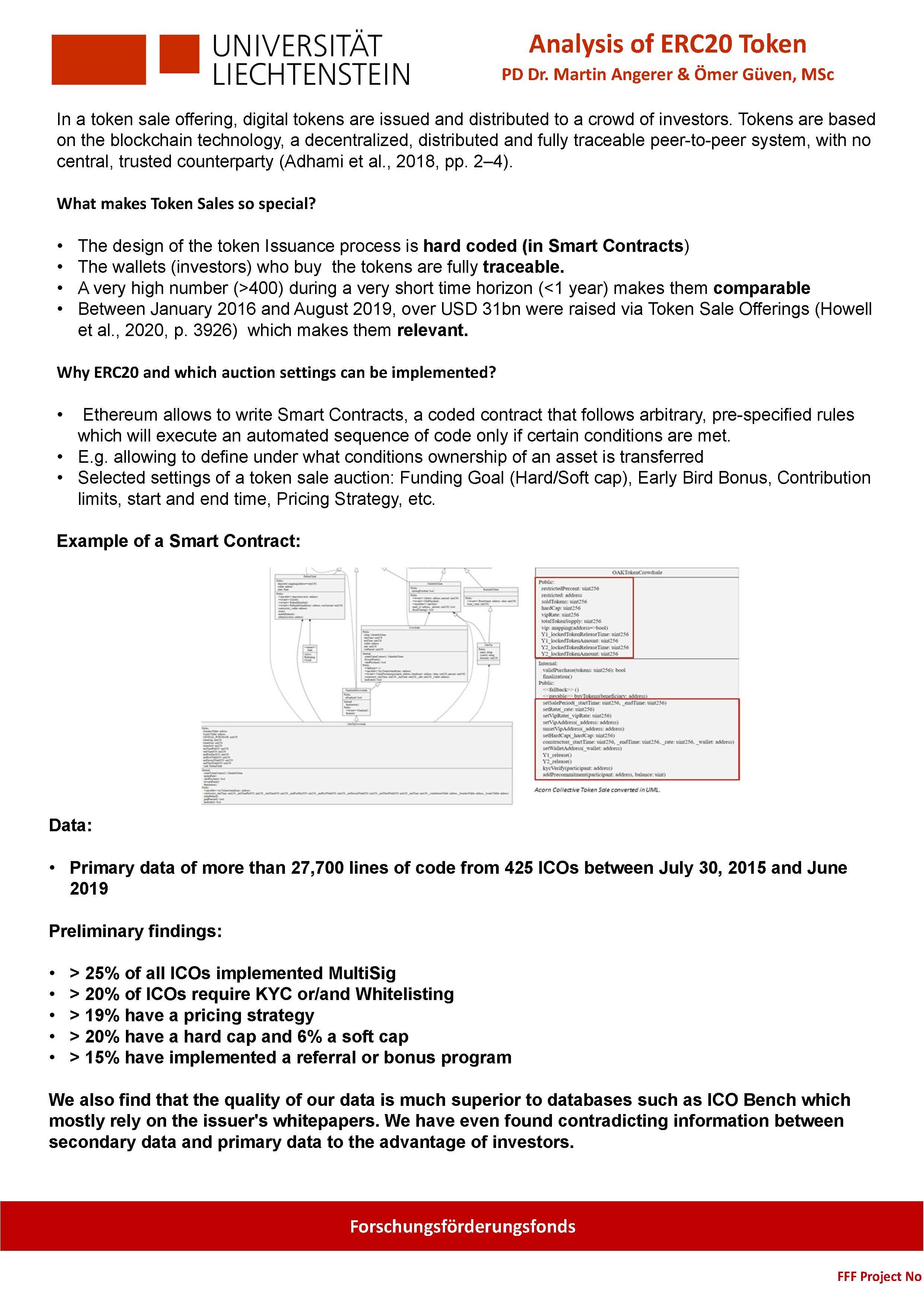
Analysis of ERC 20 ICO Token Sale Designs

Project Description

Zwischen 2016 und 2019 konnten über 31 Milliarden USD an Kapital über ICOs eingesammelt werden. ICOs oder Token Sales ist eine innovative Finanzierungsform für junge Unternehmen. Dabei werden digitale Tokens an ein breites Investorenpublikum ausgegeben - ähnlich wie bei einem Crowdfunding. Die Besonderheit ist, dass der Prozess auf der Blockchain-Technologie basiert, ein voll transparentes Peer-to-Peer System. Transaktionen, die auf der Blockchain abgebildet werden, sind über einen Explorer ablesbar und vollständig - also bis zum Beginn der Transaktionskette - nachvollziehbar.
72% dieser ICOs erfolgen auf der Ethereum Blockchain, die es erlaubt Smart Contracts zu programmieren. Smart Contracts sind vorspezifiziertee Kontrakte zwischen verschiedenen Parteien, die automatisch exekutiert werden, sofern die vorspezifizierten Prämissen und Konditionen erfüllt werden. Da Ethereum "turing-complete" ist, können komplexere Befehle vorprogrammiert werden und beispielsweise Eigentumsrechte, Identitätsrechte oder Reputationssysteme automatisch übertragen werden. Der Smart Contract kommt auch bei der Erstemission zum Einsatz und so können bestimmte
Anforderungen und Bedingungen direkt an die Emission geknüpft. Unsere Arbeit untersucht das Design und die Auktionsmechanismen, die beim Token Sale Prozess zum Einsatz kommen und welche Auswirkungen diese auf den Erfolg des Token Sales haben. Es gibt bereits vergleichbare Studien, die sich entweder auf die verschiedenen Ausprägungen des Designs fokussieren oder die Einflussfaktoren für den Erfolg eines ICOs messen. Unsere Forschung schließt n die Lücke zwischen Auktionsdesign und Erfolg von ICOs. Da unsere Daten vollständig auf Primärdaten basieren und einen deutlich höheren Detailgrad aufweisen, können wir die bisherig bekannten Dimensionen und Charakteristika um weitere Kategorien erweitern und konnten darüber hinaus feststellen, dass die Angaben in den Whitepapers widersprüchlich zu den im Code implementierten Befehlen sind. Wir vermuten, dass ein nicht unerheblicher Teil der Sekundärdaten im Widerspruch zu den Primärdaten steht. Zu diesem Zweck haben wir mehr als 300,000 Transaktionen zwischen July 2015 und Juni 2019 über einen Blockexplorer heruntergeladen und uns 425 als ICO gekennzeichnete Crowd Sale Contracts angeschaut, also 27,700 Codezeilen.
Unsere bisherige Untersuchung zeigt, dass den Kategorien "Security", "Restrictions", "Sales Stages", "Efficiency" und "Referrals" bisher zu wenig Beachtung geschenkt wurde und wir vermuten, dass die Mechanismen einen deutlich höheren Einfluss auf den Ausgabepreis hat als bisher vermutet. Beispielsweise schenken bisherige Untersuchungen der "MultiSig"-Komponente kaum Beachtung, wobei es ein hohes sicherheitsrelevantes Merkmal darstellt. Wir konnten die bisherigen Auktionsmerkmale um mindestens 25 weitere Komponenten erhöhen und sind in dem Prozess die Kategorien zu systematisieren.

Project results:
Relevance to Liechtenstein

Liechtenstein ist globaler Vorreiter im Aufbau eines auf Blockchains und anderen Technologien basierenden finanzwirtschaftlichen Ökosystems, der Token Economy. Die Entwicklung der entsprechenden Kompetenzen und Geschäftsfelder ist erklärter Teil des Regierungsprogramms als auch eines der Fokusfelder der aktuellen Finanzplatzstrategie. Einer der Eckpfeiler der neuen technologischen Entwicklungen sind dabei auf Blockchain basierende, sogenannte „Token“, mit dem aktuell meist verwendeten Standard ERC20. Im Rahmen des Projekts wurden die möglichen Ausprägungen und Eigenschaften des Tokens analysiert und untersucht, welche Charakteristiken in der Vergangenheit von Unternehmen bei der Token Emission gewählt wurden und wie diese zum Erfolg eines Unternehmens beitragen. Die Erkenntnisse helfen Unternehmen in Liechtenstein bessere und erfolgreichere Token Emissionen durchzuführen.

Analysing enterprise content to support decision making

Project Description

Companies create massive amounts of unstructured content, like documents, e-mails, websites, tweets, images, and audio and video files. The management of that content?especially its storage, retrieval, and retention?has been identified as one of the most prevalent challenges in the digital age. The next challenge is analyzing that content in order to support decision making, for example, to identify patterns and relationships, explain why certain results or events occurred, and predict future trends. Various methods for automatically analyzing unstructured large amounts of content have been proposed over the last years. However, these methods' potential has not yet been fully exploited in research. Most studies have approached data-analytics from a predominantly technical perspective, while only few studies have been dedicated to investigating their application in real-life business contexts. Accordingly, the dissertation project explores how to improve organizational decision making through content analytics in actual business contexts. The dissertation is paper-based, so it will cover a series of research questions and draw from diverse research methodology.

Keywords

Enterprise Content Management (ECM) Big Data Content Management Data analytics

Project Participants

Employee
Dr. rer. oec. Roope Jaakonmäki MSc
- PhD-Student
PhD-Student
Employee
Prof. Dr. Jan vom Brocke
- Supervisor
Visiting Professor - Information Systems and Process Science
Supervisor
icon
Employee
Prof. Dr. Oliver Müller
- Co-Supervisor
Co-Supervisor

Analysing enterprise content to support decision making

Project Description

Companies create massive amounts of unstructured content, like documents, e-mails, websites, tweets, images, and audio and video files. The management of that content?especially its storage, retrieval, and retention?has been identified as one of the most prevalent challenges in the digital age. The next challenge is analyzing that content in order to support decision making, for example, to identify patterns and relationships, explain why certain results or events occurred, and predict future trends. Various methods for automatically analyzing unstructured large amounts of content have been proposed over the last years. However, these methods' potential has not yet been fully exploited in research. Most studies have approached data-analytics from a predominantly technical perspective, while only few studies have been dedicated to investigating their application in real-life business contexts. Accordingly, the dissertation project explores how to improve organizational decision making through content analytics in actual business contexts. The dissertation is paper-based, so it will cover a series of research questions and draw from diverse research methodology.

Keywords

Enterprise Content Management (ECM) Big Data Content Management Data analytics

Project Participants

Analyse des aussenwirtschaftlichen Bewusstseins bei KMU - Status Quo (SARI-S)

Project Description

Mit 16 internationalen Partners aus den europäischen Alpenregionen beteiligt sich die Hochschule Liechtenstein am RegioMarket Projekt. Ziel des Projekts ist die Entwicklung einer gemeinsamen Marketing- und Markenstrategie für den gesamten Alpenraum und damit die Stärkung dessen Wettbewerbsfähigkeit. Dieses Vorgehen soll die Vermarktung regionaler Qualitätsprodukte und -dienstleistungen innerhalb und ausserhalb des Alpenraums unterstützen sowie deren Bekanntheitsgrad steigern. Umweltschutz und nachhaltiges Management sowie der Schwerpunkt auf kleine und mittlere Unternehmen stellen wesentliche Schwerpunkte des Projekts dar.

Keywords

Innovation research Entrepreneurship Regional growths International Management Human Resources

Participating Institutions

Van Riemsdijk Chair in Entrepreneurship / Partner
Stabsstelle für Kommunikation und Öffentlichkeitsarbeit / Partner

Project Participants

Employee
Dr. Susanne Durst MSc
- Project Manager
Project Manager
Subscribe to