Executive Master of Laws (LL.M.) in Company, Foundation and Trust Law

Advisory and structuring practice in company, foundation and trust law requires specific knowledge that goes beyond the boundaries of the Liechtenstein legal system. By imparting national, European and comparative legal knowledge, participants are enabled to provide cross-border advice and to engage with international developments in legal scholarship on an equal footing. From a comparative law perspective, particular focus is placed on the legal systems of neighbouring countries Germany, Austria and Switzerland, as well as the Anglo-American legal system.
10% Early-Bird Discount
until 31 March 2026


The LL.M. in Company, Foundation and Trust Law at the University of Liechtenstein was perfect for broadening my legal horizons internationally after my first state examination while simultaneously gaining professional experience. The programme was a genuine enrichment both academically and personally."

The programme offers a valuable overview of national and international company law while also providing the detailed knowledge necessary for practical application."

The LL.M. programme not only provides in-depth professional education in company, foundation and trust law but also creates opportunities for interdisciplinary exchange — for example, in workshops and study trips. The strong practical focus was especially valuable, allowing me to apply what I learned directly in my daily work."
Module Overview
The programme offers in-depth study in nine modules of Liechtenstein, European and international company, foundation and trust law as well as related cross-cutting topics. Taking current legal developments into account, the programme provides specialised legal training that covers Liechtenstein-specific features alongside fundamental knowledge of European law and comparative law.
Module 1 – Fundamentals of the Liechtenstein Legal System and Company Law
This module forms the foundation for further knowledge transfer in the LL.M. programme. The initial focus is on the fundamentals of company law and the structuring possibilities of the segmented legal entity. Participants distinguish between legal entities and partnerships without legal personality. They learn about the various legal forms of partnerships (simple partnership, general partnership [offene Gesellschaft], limited partnership) and cooperatives.
Subsequently, the legal forms of common corporate entities (GmbH and stock corporation) are presented in detail. Advantages and disadvantages of these company types — each compared with neighbouring legal systems — are also covered. Case studies deepen the learned material and integrate it into practical work.
The module concludes with an introduction to European law concerning the legal form of the Societas Europaea and the European Economic Area, as well as their significance for Liechtenstein, particularly considering the European fundamental freedoms and the general prohibition of discrimination.
Module 2 – Liechtenstein Foundation and Anstalt Law
In the second module, students are provided with fundamental knowledge of Liechtenstein foundation and anstalt law. Participants gain a thorough understanding of the two central legal forms within the Liechtenstein legal system and their structuring options. They receive insight into the basic structural and essential characteristics of both private and charitable foundations as well as the anstalt, and are informed about specific features compared with other jurisdictions.
Additionally, students are introduced to commercial register law and learn about foundation supervision, which is exercised by the Foundation Supervisory Authority and the courts. The acquired knowledge is consolidated through case studies. This provides students with insight into succession planning methods using Liechtenstein legal forms as well as creditor protection.
Module 3 – Austrian, Swiss, German, European and International Foundation Law
The third module begins with imparting knowledge of foundation law in Austria, Switzerland and Germany. Participants gain a thorough understanding of the legal forms of the Austrian private foundation, the Swiss and German foundations, as well as their characteristics and structuring options.
The module opens with an insight into the structural and essential features of each foundation and the particularities of the respective legal systems. Building on this foundation, links to Liechtenstein foundation law (Module 2) are established and comparative legal considerations are made. Due to the close relationship between Austrian and Liechtenstein foundation law — influenced by mutual reception in the past — the focus is placed on the similarities and differences in structuring options between the two systems. To deepen their understanding of the various foundation law regimes, participants apply their knowledge in case studies following the lectures, working through practical scenarios.
The module concludes with an introduction to Swiss charitable foundation law, which has taken a pioneering role with the creation of the legally non-binding Swiss Foundation Code.
In addition to general information about charitable foundation law, particular attention is paid to the development and design of the Swiss Foundation Code and practical experience with this regulatory framework. The question is also discussed whether the introduction of such a legally non-binding self-regulation code would be advisable for Liechtenstein as well.
Module 4 – Liechtenstein Trusteeship, English and International Trust Law
The fourth module of the programme is entirely devoted to trusteeship and trusts. Participants begin by learning about the Liechtenstein trust company as well as the trust under Liechtenstein law. Fundamental concepts, the relevant legal framework, and the differences and similarities are presented.
Participants acquire knowledge of the various forms of the Liechtenstein trust company, the individual governing bodies and the settlor’s influence options. The legal status of the settlor, rules on representation and liability, as well as the rights of beneficiaries and creditors, are also examined.
Since trusts are largely foreign to continental European law, the module first covers in-depth doctrinal foundations. This is followed by instruction on the establishment, external effect and influence options over the trust, as well as the legal status of the trustee, the settlor and the beneficiaries. These aspects are also taught comparatively with reference to English trust law. All acquired knowledge is expanded and deepened through practical case studies.
Module 5 – Study Trip to the USA
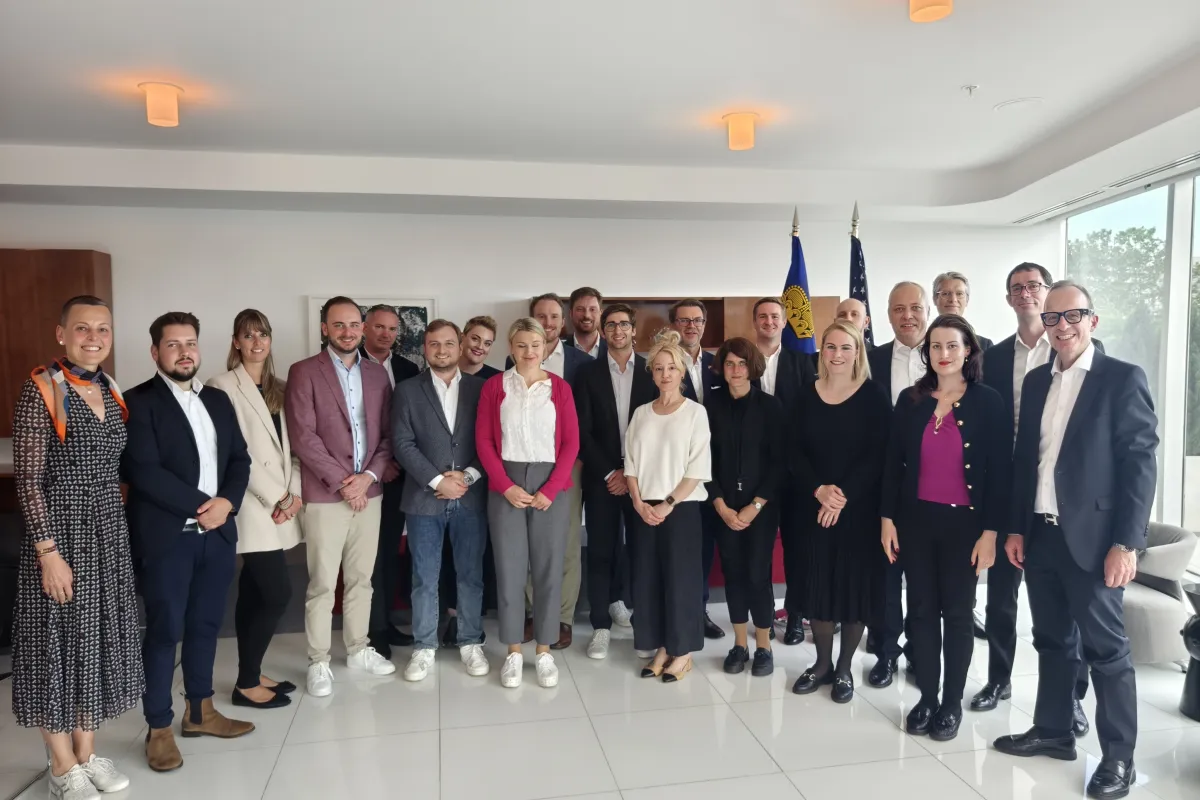
Module 5 offers a diverse and varied programme guaranteed to provide highly engaging experiences. In addition to visits to renowned universities featuring workshops and lectures tailored to the LL.M. programme, relevant national and international companies, organisations and embassies are also part of the trip. Encounters with various personalities from academia and practice further offer opportunities to expand one’s knowledge base and establish valuable contacts.
Participants fulfil the required examination performance by submitting an essay. Instead of the study trip, there is also the option to take a freely chosen module from other Executive Master’s programmes. This provides an opportunity to broaden one’s expertise in other areas of law or taxation according to individual needs.
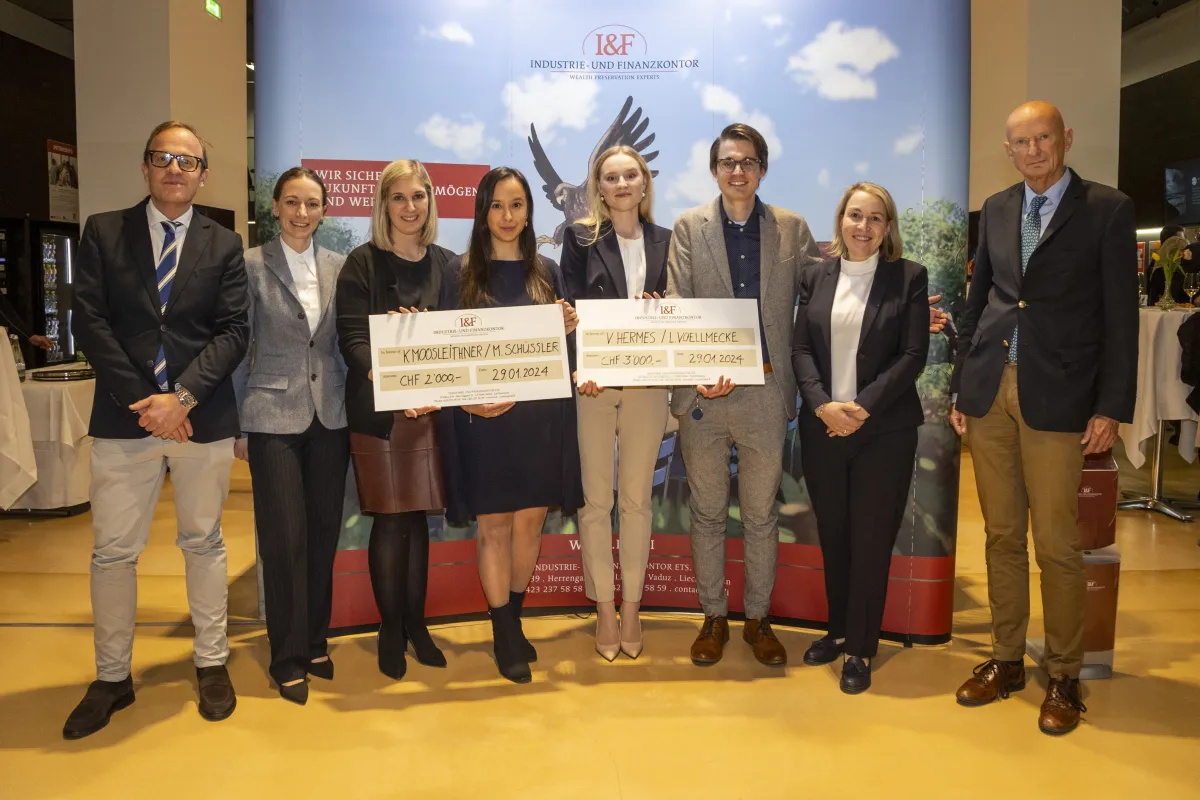
Furthermore, there is the possibility to complete a case study within the framework of the “I&F Family Wealth Preservation Awards” or attend courses worth 5 ECTS for topic-specific preparation for the Liechtenstein trust officer examination in the certificate and diploma programmes in trust services offered by the Chair.
Module 6 – European and International Company Law with Liechtenstein Reference and Fundamentals of Compliance
The sixth module deals with international company law regulations in the Liechtenstein context. Following a basic introduction to UK company law, the fundamental differences between common law and civil law systems are examined in depth. Building on this, participants become familiar with national and international legal sources relevant to cross-border company law matters.
Central aspects of international company law in conjunction with national regulations are explained thoroughly, alongside the available supranational legal forms. The importance of the company statute as a connecting element, the possibility of relocating company headquarters and the resulting consequences are also discussed extensively.
Further key focuses of this module include police and judicial cooperation in civil and criminal matters, as well as the national due diligence law. Participants gain an overview of the respective requirements, regulations and procedural processes. In this context, particular attention is given to the specifics of anti-money laundering efforts, including insights into the procedures involved. The module is rounded off with the fundamentals of economic criminal law.
Instead of elective Module 6, participants may choose a freely selectable module from one of the concurrently running Executive Master’s programmes. Alternatively, there is the option to complete a case study within the framework of the “I&F Family Wealth Preservation Awards” or to attend subject-specific courses worth 5 ECTS for preparation for the Liechtenstein trust officer examination offered as part of the certificate and diploma programmes in trust services provided by the Chair.
Module 7 – Study Trip to Selected Trust Law Destinations
Module 7 is offered as an elective. Students can complete the module by participating in the study trip. Alternatively, they have the option to attend any module from the other concurrently offered Executive Master’s programmes. Additionally, there is the possibility to complete a case study within the framework of the “I&F Family Wealth Preservation Awards” or to attend subject-specific courses worth 5 ECTS for preparation for the Liechtenstein trust officer examination, offered as part of the certificate and diploma programmes in trust services provided by the Chair.
The study trip programme includes lectures at renowned universities as well as workshops and presentations at local institutions and companies, alongside visits to international organisations. Key topics from the local legal environment relating to Liechtenstein as well as from other continental European legal systems are discussed. A diverse accompanying programme complements the study trip content.
Module 8 – Asset Planning and Structuring in the Context of International and National Inheritance, Matrimonial Property, Avoidance and Insolvency Law
The eighth module is dedicated entirely to asset planning and structuring. The first part focuses on international inheritance and matrimonial property law. Participants are initially introduced to the international procedural law fundamentals of Liechtenstein as well as the neighbouring countries (Germany, Austria, Switzerland) regarding inheritance and matrimonial property law, along with relevant international agreements in these areas. Subsequently, the substantive matrimonial property law of the individual jurisdictions is addressed progressively and compared.
With regard to international inheritance law, the module first intensively discusses the applicable agreements and Liechtenstein’s conflict of law provisions. Special emphasis is then placed on international inheritance law before the procedural approach is explained. An overview of international insolvency and avoidance law concludes the first part.
The second part focuses on the possibilities and requirements of asset protection, especially from matrimonial property and inheritance law perspectives as well as in relation to the family office.
Module 9 – International Private Wealth Management (Interdisciplinary Workshop)
In the ninth module, an interdisciplinary workshop takes place in which students from all Executive Master’s programmes jointly address, discuss and present specific cross-cutting topics in international private wealth management through cross-border case studies. This enables the disciplinary insights gained in the individual programmes to be combined across fields.
LL.M. Company, Foundation and Trust Law at the University of Liechtenstein: Programme
LL.M. Company, Foundation and Trust Law at the University of Liechtenstein: Testimonials
Information Sessions for Prospective Students
Currently, no information events can be booked online. In the meantime, we will be happy to advise you personally.
New: 10% Early-Bird Discount until 31 March 2026

Apply now for the Executive Master of Laws (LL.M.) in Company, Foundation and Trust Law! This specialised professional education programme is unique in the German-speaking region and offered only at the University of Liechtenstein in this form. Benefit from practice-oriented knowledge, renowned lecturers and an excellent network. Get informed now and take off!

Downloads and Links
Legal Foundations and Regulations
The general terms and conditions (GTC), regulations and other guidelines for the professional education programmes are available for download on the Guide and Downloads page.