Media
Media shape our everyday lives, our communication, and the way we absorb, share and present knowledge publicly. Anyone who wants to succeed in today’s working world needs media skills – from confidently using digital tools to communicating professionally in public, at work and in society. Our professional education offerings in the field of media help you prepare content in a targeted way, convey messages effectively and present yourself with confidence in different media contexts – whether in front of the camera, at the microphone or on social networks.
Intensive Courses
The two "Intensive Courses in Media Training" enable you to understand when and why certain topics are explosive, attract a wide audience and – for communication professionals – achieve the expected impact. Making a good impression in public is a goal we all pursue for our businesses, public authorities, institutions and, last but not least, for ourselves.
Confident Public Appearance
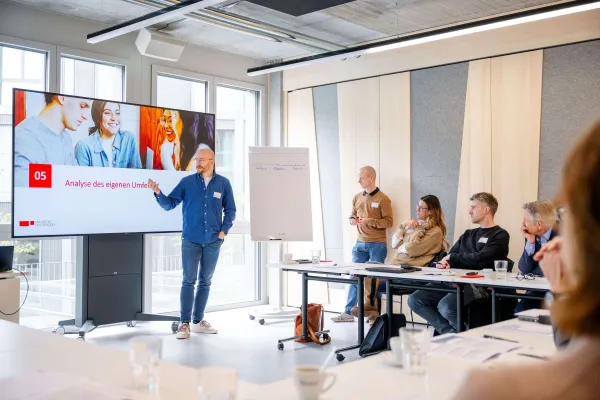
A convincing public appearance begins with the first impression. In this intensive course, participants receive practical training on how to communicate confidently, effectively and with clear purpose – whether in media work, the professional environment or in public settings. Module 1 provides the foundations for a professional appearance. Module 2 focuses on the strategic use of AI tools in communication.
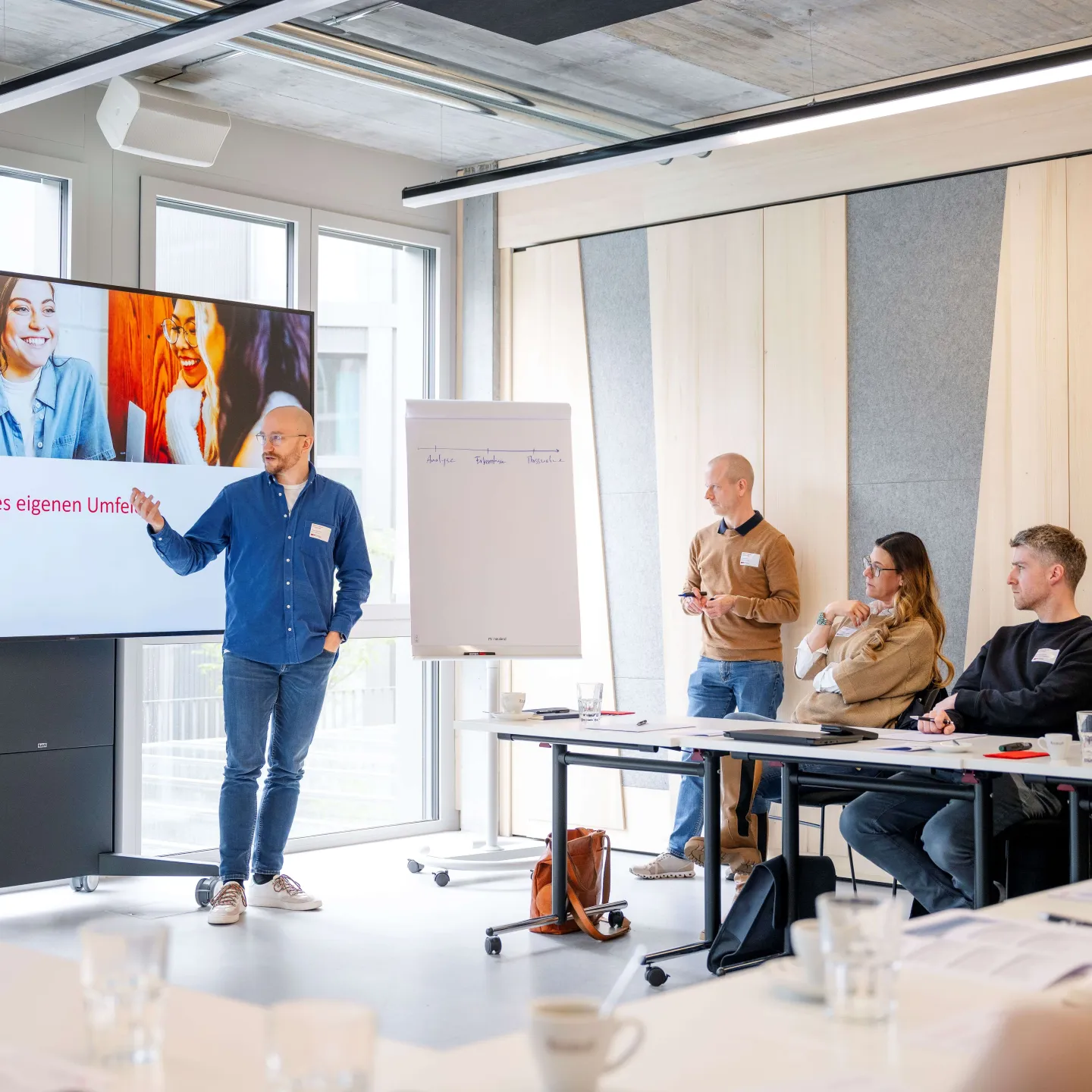
Fabian Schmid, Head of the Office of Information Technology Liechtenstein, offers practical insight as co-speaker into the legal framework and opportunities of using AI, using the example of the Liechtenstein National Administration. Module 3 provides intensive video training with individual feedback.
The combination of solid theory, practical exercises and personal reflection sustainably strengthens the participants’ impact skills. Small groups ensure intensive, individual learning in a secure environment.
Target Group
Executives, team leaders and specialists who wish to develop their communication and media skills in a targeted way.
Course Fees
The course fee is CHF 2,650.00. This includes electronic course materials and seminar refreshments.
Module 1: Fit for Public Engagement
The Video Training Reveals the First Impression
There is no second chance to make a first impression. The focus of this introductory module is on foundational knowledge and practice in communication. Communication psychology principles form the basis for all subsequent modules. Through an initial video recording with follow-up feedback, you will discover how your self-image differs from how others see you and learn how to optimise your external impact. The feedback method taught here, along with an understanding of key relevance criteria, are central elements in Modules 3, 4 and 5.
Date:
Friday, 13 February 2026
Speaker:
Claudia Schanza, M.A.
Module 2: AI in Communication
How to Use Artificial Intelligence in Everyday Work
You will get to know tools that help make your communication in leadership more efficient, freeing up more time for strategic tasks. You will understand the advantages and limitations of these tools and be able to make informed decisions about their use. You will work intensively on a specific case from your own leadership experience and experiment with the AI tools presented. For example, you will learn how AI can be used to improve employee communication, create talks or presentations more quickly, accelerate decision-making processes and increase your leadership effectiveness.
Date:
Friday, 6 March 2026
Speakers:
Katia Murmann, M.A.
Fabian Schmid, MSc
Module 3: Video Training with Feedback
Making Presentations Enjoyable for You and Your Audience
In this small-group module, you will work with your own presentation to discover what your audience needs in order to follow you with interest. You will practise useful routines to get to the point quickly and trigger the desired reaction in your target audience. Video feedback will highlight your strengths and areas for improvement, giving you the chance to put these insights into practice. Aligning your own goals with audience expectations often leads to very positive surprises, greater self-confidence, more efficient preparation and a new perspective on your target audience and communication objectives. The feedback method and relevance criteria learned in the first module will be applied and deepened here.
Date:
Thursday, 26 March 2026 or
Friday, 27 March 2026
Speaker:
Claudia Schanza, M.A.
Particularly valuable were the video training sessions in the classroom and in the TV studio, along with the accompanying feedback rounds. The course helped me recognise and break my bad habits, enabling me to present myself more professionally and project greater self-confidence."
The intensive course offers a well-balanced mix of theoretical knowledge and practical application. Within a short time, I was able to gain greater confidence in communicating complex content and, thanks to the hands-on exercises in small groups, professionalise my personal presentation."
Impact, Media Presence and Communication in a Crisis

This intensive course shows leaders how to enhance their impact, master interviews professionally and communicate confidently in crisis situations. All three modules use video feedback to demonstrate individual progress. Module 1 covers the foundations of a confident appearance. Module 4 offers interview training in a TV studio with an external media professional. Module 5 focuses on effective crisis communication using realistic scenarios. The combination of feedback methodology, strategic communication and practical relevance strengthens media presence and confidence in handling sensitive situations.

Target Group
Leaders and their deputies who wish to develop their communication and media skills in a targeted way.
Course Fees
The course fee is CHF 2,990.00, including lunch. Electronic course materials and seminar refreshments are also included.
Module 1: Fit for Public Engagement
The Video Training Reveals the First Impression
There is no second chance to make a first impression. The focus of this introductory module is on foundational knowledge and practice in communication. Communication psychology principles form the basis for all subsequent modules. Through an initial video recording with follow-up feedback, you will discover how your self-image differs from how others see you and learn how to optimise your external impact. The feedback method taught here, along with an understanding of key relevance criteria, are central elements in Modules 3, 4 and 5.
Date:
Friday, 13 February 2026
Speaker:
Claudia Schanza, M.A.
Module 4: Interview in the TV Studio
Careful, the Camera Is Rolling! Asked, Broadcast.
This fourth module focuses in a small group on professional preparation for an interview in front of the microphone and camera. The preparation is based on a topic from your own area of work, developed with the course director at the university. At the 1FLTV studio, an external media professional from a neighbouring country awaits, conducts the interview on camera and then reveals which segment would be broadcast. The goal of this workshop is to deliver your message effectively, appear and sound good on camera, and experience realistic working conditions for TV interviews with external media professionals. The feedback method and relevance criteria learned in the first module will be applied and further deepened here.
Date:
Thursday, 27 August 2026 or
Friday, 28 August 2026
Speakers:
Claudia Schanza, M.A.
Nicolai Morawitz, M.A., M.A.
Module 5: Crisis Communication
Confident Communication Before and During Crises
Blackout, hacking attack, sexual harassment – this fifth module is dedicated to the topic of crisis communication. Working in a small group with scenarios from your own area of work, you will train with communication professional Karsten Wolff, who will show how to identify crises early and communicate strategically to protect your reputation and avoid potentially greater damage. If a crisis does become public, he will outline strategies to turn it into an opportunity.
In the concluding critical interview with Claudia Schanza, Karsten Wolff will support participants in their preparation by developing key messages and argumentation strategies together. Video feedback will demonstrate whether the insights from the first four modules are being applied in practice. The feedback method and relevance criteria learned in the first module will be applied and further deepened here.
Date:
Thursday, 17 September 2026 or
Friday, 18 September 2026
Speakers:
Claudia Schanza, M.A.
Karsten Wolff
Certificate Programme in Journalism

Finally seeing your own name online or in the newspaper, under an article you wrote yourself – that is still the goal of many young people looking to start a career in the media. But how do I find compelling topics, ask critical questions, prepare for an interview, or recognise fake news?

Current Events
Currently, no events are available for booking. New dates will be announced shortly. Subscribe to our newsletter to receive all important dates and information on Media in a timely manner.
In Cooperation with

Downloads and Links