Skip to Main Content

Personal Resources at Work

Project Description

The Job Demands-Resources Model provides a flexible framework through which to study the effects of job characteristics on employees: job demands lead to adverse effects such as burnout, and job resources lead to beneficial effects such as engagement. To date, it remains unclear how and why individual differences between employees evoke different appraisals of similar situations, and how their outcomes can be shaped in a self-responsible manner. The purpose of the presented research project is to investigate the influence of malleable personal resources on the model’s pathways. First, sustained attention, psychological capital, and mindfulness were identified as relevant personal resources. Two experimental studies will now be conducted to examine the scope, magnitude, and mechanisms of effect of mindfulness training on strengthening these personal resources among employees, as well as their perceptions of their job characteristics and their experiences of burnout, engagement, and well-being. This research project will serve to identify applicable methods to empower people in complex work environments to surmount their demands in a way that is conducive to both sustained performance and well-being.

Performance Measurements in Asset Management Reports for Private and Institutional Clients

Project Description

Based on recent knowledge in performance analysis different applied reporting systems are analysed to find best practice approach for reporting in asset management for private and institutional clients.

Project Participants

Employee
Prof. em. Dr. Marco J. Menichetti
- Principal Investigator
Professor Emeritus - Liechtenstein Business School
Principal Investigator

Performance Management und Bewertungen mit Process Mining und Big Data

Project Description

Im Bereich Corporate Finance zeichnet sich ein zunehmender Trend zur Einbeziehung von Daten für das Performance Management und zur Unternehmensbewertung ab. Insbesondere spielen neue Verfahren zur Prozessanalyze (Process Mining) als auch (etablierte) Big Data Methoden eine zunehmende Rolle.
Jedoch ist deren Potential noch unklar. In der Bewertung von Unternehmen oder einzelner Produkte und Services werden heutzutage Bewertungen oft von Experten durchgeführt, was kostenaufwändig ist und eine Prüfung schwierig macht. In diesen Projekt werden mittels Big Data Technologien Peer Groups identifiziert, um den Unternehmensbewertungsprozess zu vereinfachen.
Ein weiterer Aspekt ist die Prüfung der Anwendbarkeit von Process Mining Techniken. Process Mining ist besonders geeignet, um die Analyse von prozessrelevanten Big Data auszuwerten. Hier herrscht allerdings weitgehend Unklarheit darüber, inwiefern Process Mining auch bei kleineren Unternehmen zum Einsatz kommen und implementiert werden kann. Im Rahmen dieser Vorstudie wird daher eine erste Version eines Vorgehensmodells entwickelt, um Prozesse der Unternehmen besser evaluieren und kontrollieren zu können.

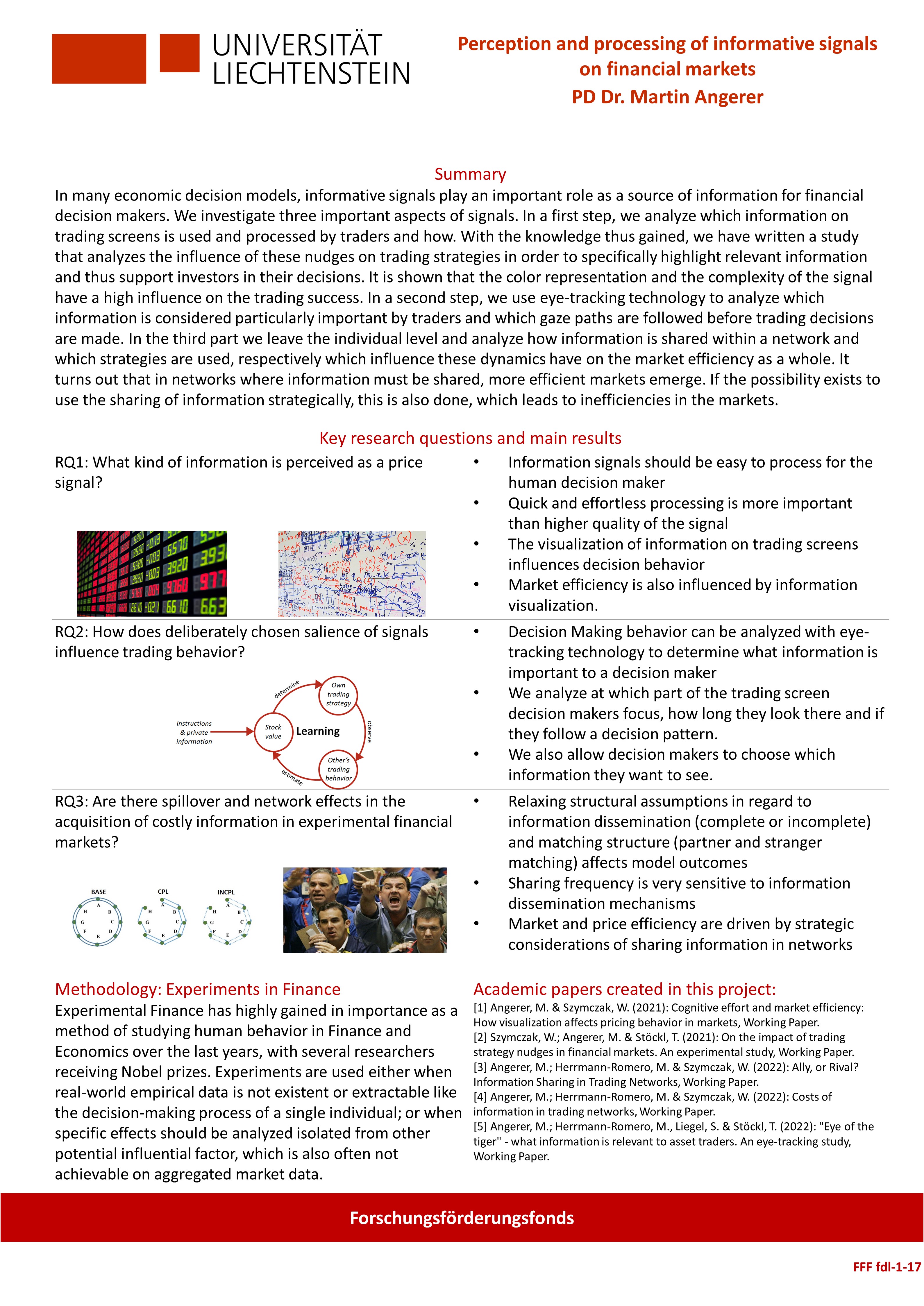
Perception and processing of informative signals on financial markets

Project Description

Many decision-making models highlight the importance of informative signals as a relevant source of information on financial markets. However, although this importance is undisputed as such, we know only little about what kind of signals gain our attention, how we can increase salience of specific information sources, how we perceive different types of signals and how they influence our decision behavior.

In this project we concentrate on experimental asset markets and focus on three important aspects of signals. First, we look at existing trading screens and analyze what kind of information gets the most attention by traders. In a second step, we will use the produced knowledge and analyze how specific information sources that are objectively important can be visualized so that they become more salient, hence get more attention and therefore lead to enhanced investor behavior. In a third step we loosen the assumption that signals are provided for free. We analyze how costly information is spread (un-)willingly over the market and how trader networks process and buy information.

In a nutshell, we want to examine the importance of signals, the influence of manipulation in salience of signals, and the costly acquisition of signals in networks. To this end, we will conduct experimental asset market studies and study individual trader behavior and market outcomes. The results deliver important academic evidence, but are also highly valuable information for practitioners, who can learn about the visualization and processing of informative signals. This not only helps to improve trading strategies and trading platforms to achieve better trading returns, but might also contribute to a stabilization of the financial system because of a reduction or elimination of bubbles and crashes triggered by irrational behavior.

Project results:

Participating Institutions

PATHFINDER – Pioneering AI Technology in Higher Education to Facilitate Innovation and Nurture the Development of Entrepreneurial Resources

Project Description

Motivation

Our goal is to improve the understanding and application of artificial intelligence (AI) in higher education. We achieve this by providing teachers and students with the necessary information and resources for the effective and responsible integration of AI. Our efforts promote digital readiness, stimulate innovation, strengthen resilience and improve employability. We achieve this by championing innovative educational methods and promoting innovation and entrepreneurial skills.

Approach

We will create strategic guidelines for the integration of AI in education, develop AI-based tools for lesson planning and support, and establish a learning journey to improve students' AI skills. We intend to advance educational practice through these activities by harnessing the power of AI. By sharing the knowledge gained with the European education community, we will make the responsible use of AI accessible and usable for educators and institutions.

Outcomes

We expect outcomes such as improved digital readiness of teachers and learners, strengthened educational practices through AI-based tools, a cultural shift towards fostering innovation and wider access to responsible AI use within the European educational community. Our efforts aim to equip educators and learners with the skills and knowledge required for the evolving digital landscape to improve teaching practices, foster innovation and ensure ethical AI integration.

Deliverables

- SAGE is a framework to support teachers in effectively integrating AI tools into the classroom. We will create a concept that combines AI technologies with innovative teaching methods and standardizes digital teaching methods in different courses.
- GUARD is an AI-supported toolkit for lesson planning and teaching. It helps teachers apply the SAGE framework, enables personalized learning experiences and fosters creativity.
- ARTISAN is a competency-based learning program that teaches students how to use AI technology effectively. It improves students' ability to innovate and prepares them for the future world of work by strengthening entrepreneurial skills in higher education.

Patent and reciprocal support structures

Project Description

Today, there is almost no building without the use of patented construction elements and with the increase in technological progress, the patent is gaining in importance in terms of rationalization, standardization, production of prefabricated parts and automation of the construction site. The patent in architecture is a carrier of technical development and provides information about global contexts of architectural economy and constructive heritage.
The project's field of investigation is the circular use of reciprocal load-bearing structures with short demountable elements to bridge large spans. The innovations are divided into individual epochs and placed in relation to the buildings, which are the information carriers of the construction. Overall, this results in a variety of insights into how material-efficient, circular load-bearing structures can be conceived.

Parking Warme Sense

Project Description

Purpose is the development of urban and landscape integrated solutions for the use of parking spaces and other infrastructural areas for the production of photovoltaic electricity.

Participating Institutions

Institute of Architecture and Planning / Partner
Delinat Institut für Ökologie u. Klimafarming / Partner

Project Participants

Employee
Prof. em. DI MAAS Peter Droege
- Professor
Professor

Parameter Uncertainty: Measurement and resulting implications for portfolio management

Project Description

This project is concerned with estimation errors and parameter uncertainty in the investment process. The first study extends a previous study using investors reaction to parameter uncertainty to predict the equity premium to further predict a large variety of factor premia. The second study is extending the uncertainty of estimating expected returns to uncertainty about the estimation of the entire return distribution.

Keywords

parameter uncertainty factor premium Kullback-Leibler divergence style investing

Paradox and cultural complexity

Project Description

Organizational life is full of paradoxical tensions (for example between goals such as innovation and efficiency or economic and social value creation). These tensions are increasingly amplified in a globalized and digitized business environment. The dissertation aims at studying multiple such paradoxical tensions and how they are framed and managed differently in different cultural contexts. The combination of paradox and international business research shall help to provide novel contributions for our theoretical understanding of international collaboration. Furthermore, I strive to provide relevant insights for organizations and their managers in Liechtenstein and the Rhine Valley on how to deal with today's paradoxical challenges in internationally diverse organizations. This is especially important, as organizations from Liechtenstein are particularly active in international markets.

Project Participants

Employee
Mirjam Roswitha Langenbacher MSc
- PhD-Student
Research Assistant / PhD Student - Entrepreneurship and Strategic Management
PhD-Student
icon
Employee
Prof. Dr. Alexander Zimmermann
- Supervisor
Supervisor
Prof. Dr. Tina Claudia Ambos
- Co-Supervisor
Co-Supervisor

Paradox and cultural complexity

Project Description

Organizational life is full of paradoxical tensions (for example between goals such as innovation and efficiency or economic and social value creation). These tensions are increasingly amplified in a globalized and digitized business environment. The dissertation aims at studying multiple such paradoxical tensions and how they are framed and managed differently in different cultural contexts. The combination of paradox and international business research shall help to provide novel contributions for our theoretical understanding of international collaboration. Furthermore, I strive to provide relevant insights for organizations and their managers in Liechtenstein and the Rhine Valley on how to deal with today's paradoxical challenges in internationally diverse organizations. This is especially important, as organizations from Liechtenstein are particularly active in international markets.
Subscribe to