
Digitalisation

Digitalisation, as one of the University of Liechtenstein’s Topics in Focus, represents profound societal transformation. Emerging technologies such as artificial intelligence, blockchain, and smart services are reshaping how we work, do business, and live together. A responsible and nuanced approach to digitalisation also considers its social and environmental implications.
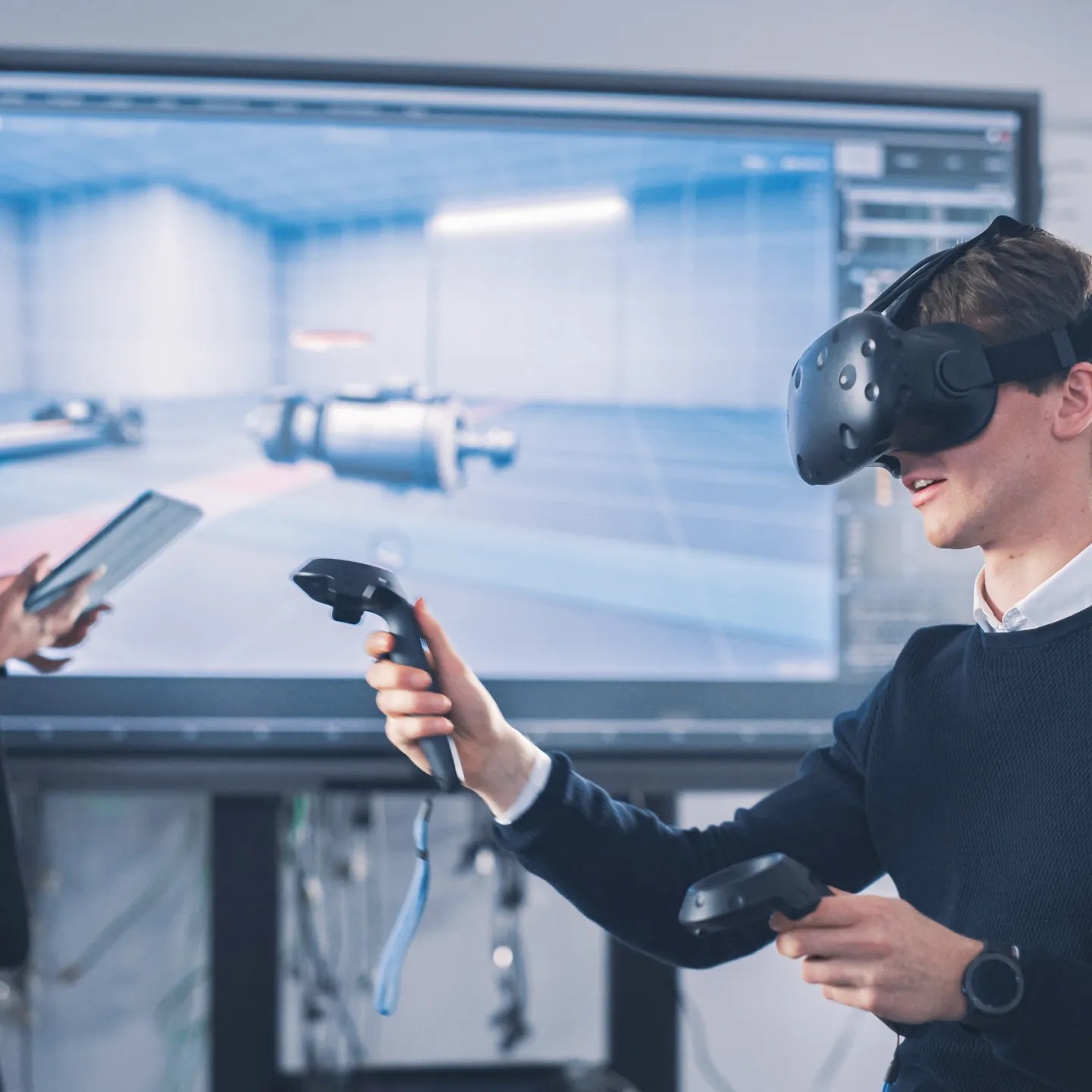

Digitalisation means, among other things, one-click online shopping, instant answers to any question thanks to artificial intelligence (AI), video calls with friends, or training AI on medical data to save lives. My team is working to drive digitalisation forward through tangible innovations – and to generate knowledge that helps us better understand its opportunities and risks."
Digitalisation in Research and Knowledge Transfer
At the University of Liechtenstein, digitalisation is a central Topic in Focus across research and knowledge transfer. The emphasis lies on developing and evaluating digital innovations that contribute to sustainable transformation. Research addresses current challenges of digital transformation in fields such as architecture and spatial development, economics, law, and society. This work generates new approaches for shaping a digital and responsible future. Practice-oriented projects, interdisciplinary collaboration, and direct dialogue with industry and society are at the heart of these efforts.

Digitalisation is increasingly shaping economic life and presents new challenges for criminal law. My research and teaching focus on economic and cyber criminal law as well as current regulatory frameworks such as DORA and MiCAR. At the same time, technological innovations such as blockchain and artificial intelligence are central to my work — along with their implications for criminal liability and regulatory compliance."
Selected Publications on Digitalisation
-
Liegl, S., Maran, T., Furtner, M., & Sachse, P. (2026). Eyes on the Leader: Gaze Behavior as a Cue for Follower Conscientiousness. Journal of Applied Social Psychology, 56(1), 43-54.More
-
Herrmann-Romero, M., Liegl, S., Angerer, M., & Stöckl, T. (2026). Golden eye - How traders focus on and select information in experimental asset markets. Journal of Behavioral and Experimental Finance, 49(March).More
-
Tassinari, M., Marinucci, M., & Hasler, B. S. (2026). Immersive Technologies and Intergroup Relations: A Critical Review of Theoretical Questions and Methodological Challenges. Computers in Human Behavior, 178(May 2026).More
-
Papathanasiou, K., & Bauch, C. (2026). Die (Ketten-)Anstiftung und ihre Vorrangstellung gegenüber der Beihilfe. Besprechung zu BGH, Urt. v. 12.6.2024 - 1 StR 463/23. Zeitschrift für das juristische Studium: ZJS(1), 219-226.More
-
Bassen, A., Kordsachia, O., Lopatta, K., & Tan, W. (2025). Revenue Alignment with the EU Taxonomy Regulation in Developed Markets. Journal of Banking & Finance, 170(January).More
-
Yuan, Y., Apruzzese, G., & Conti, M. (2025). Beyond the west: Revealing and bridging the gap between Western and Chinese phishing website detection. Computers & Security, 148(January).More
-
Butterstein, A. (2025). Liechtenstein als führender Philanthropiestandort - Rechtliche Rahmenbedingungen und Standortvorteile. The Philanthropist(03), 23-24.More
-
Lettenbichler, M. (2025). Spezialvollmacht und Änderung der Stiftungserklärung (Anmerkung zu OGH 20. 9. 2024, 6 Ob 162/23a). Österreichische Jurist:innenzeitung(5), 305-306.More
-
Rosenzweig, B., Dalla Valle, V., Apruzzese, Giovanni, & Fass, A. (2025). It's Not Easy: Applying Supervised Machine Learning to Detect Malicious Extensions in the Chrome Web Store. ACM Transactions on the Web.More
-
Meske, C., Junglas, I., Trier, M., Schneider, J., Jaakonmäki, R., & vom Brocke, J. (2025). Capturing the "Social" in Social Networks: The Conceptualization and Empirical Application of Relational Quality. Journal of the Association for Information Systems, 26(4).More
-
Peled, A., Leinonen, T., & Hasler, B. S. (2025). Telerobotic Theater of the Oppressed in Israel and Palestine: Becoming Digital Jokers. ACM Transactions on Computer-Human Interaction, 32(3).More
-
Schröer, S., Seideman, J. D., Shoufu, L., Apruzesse, G., Dietrich, S., & Laskov, P. (2025). Using a Stack to Find an AI Needle: Topic Modeling for Cyber Threat Intelligence. Digital Threats: Research and Practice, 6(4).More
-
Rubin, M., Howe, L. B., & Parker, A. (2025). “She’s Here and I’m Not”: Parenthetical Parenting, Hegemonic Masculinity, and the Hidden Geographies of Oppression in the Gauteng City-Region, South Africa. The Professional Geographer, 77(6), 759-770.More
-
Furtner, M., Liegl, S., & Klösel, K. (2025). Self-leadership: The essential drive for entrepreneurs. Journal of the International Council for Small Business, 6(2).More
-
Giffen, B., Beitinger, G., Ludwig, H., Schiano, B., Schmidt, K., & vom Brocke, J. (2025). The Culture Clash of AI Adoption in Lean Quality Management. Resolving the Tensions at Siemens Electronics Works Amberg. Information Systems Journal.More
-
Schadner, W. (2025). Hurst Exponent as Implied by Option Prices. Studies in Nonlinear Dynamics & Econometrics.More
-
Schröer, S., Pajola, L., Castagnaro, A., Apruzesse, G., & Conti, M. (2025). Exploiting AI for Attacks: On the Interplay between Adversarial AI and Offensive AI. IEEE Intelligent Systems.More
-
Burtscher, B. (2025). Neuer Einwendungsdurchgriff im Kreditkartengeschäft? Recht der Wirtschaft (RdW)(3), 167-173.More
-
Zivkovic, D., & Liegl, S. (2025). Paradoxical leadership: the role of leader emotions and the mediating effect of paradoxical mindset on followers' performance. Leadership & Organization Development Journal, 46(7), 1024-1040.More
-
Ebner, F., Aubrunner, F., & Kalss, S. (2025). Diskussionsentwurf für ein Gesetz über digitale Wertpapiere und digitale Werte (Teil II). Der Gesellschafter(5).More
-
Hörler, R., Stein, F., Bayrle, N., Angerer, M., & Kordsachia, O. (2025). A bibliometric review of the EU sustainable finance initiative: evolving research dynamics. Sustainability Accounting, Management and Policy Journal.More
-
Seidel, S., Frick, C. J., & vom Brocke, J. (2025). Regulating Emerging Technologies: Prospective Sensemaking through Abstraction and Elaboration. MIS Quarterly, 49(1), 179-204.More
-
Jenni, M., Schadner, W., & Angerer, M. (2025). Hard forks, hard questions: Unraveling the microstructure effects on Bitcoin's return, volume, and volatility. Economic Letters, 257(December).More
-
Ballandies, M. C., Holzwarth, V., Sunderland, B., Pournaras, E., & vom Brocke, J. (2025). Advancing Customer Feedback Systems with Blockchain - When Design Science Research Meets Value-Sensitive Design. Business & Information Systems Engineering, 67, 449-471.More
-
Furtner, M., & Tenschert, J. (2025). Leading others to lead themselves: Followers' perceptions of leaders' self-leadership. Psychologie des Alltagshandelns / Psychology of Everyday Activity, 18(2).More
-
Wenz, M., Kaiser, N., & Zotkaj, K. (2025). Pillar Two and Approaches to Redesigning Tax Incentives. New Zealand Journal of Taxation Law and Policy, 31(1), 27-49.More
-
Gau, M., Greif-Winzrieth, A., Maedche, A., Weinhardt, C., & vom Brocke, J. (2025). Engaging citizen scientists: designing an open research system for collaborative problem exploration. Electronic Markets, 35.More
-
Ebner, F. (2025). Die Rezeption des österreichischen Börserechts in Liechtenstein. ÖBA, 2025(6).More
-
Shakina, E., Hanke, M., & Ellis, S. (2025). Central Bank Digital Currencies: Experimental Evidence of Deposit Conversion. The B.E. Journal of Economic Analysis & Policy, 25(1), 127.137.More
-
Ebner, F., Aubrunner, F., & Brameshuber, G. (2025). Tagungsbericht zur 3. Digital Assets Rechtstagung: Der neue EU-Regelungsrahmen für Kryptowerte und das digitale Finanzwesen. Der Gesellschafter - Zeitschrift für Gesellschafts- und Unternehmensrecht (GesRZ)(2), 109-113.More
-
Angerer, M., Hanke, M., Shakina, E., & Szymczak, W. (2025). The Effect of Different Saving Mechanisms in Pension Saving Behavior: Evidence from a Life-Cycle Experiment. Journal of Risk and Financial Management, 18(5).More
-
Butterstein, A. (2025). Die Rechtsstellung der Begünstigten in der geplanten Reform des liechtensteinischen Trustrechts. Journal für Erbrecht und Vermögensnachfolge (JEV), 1(2025).More
-
Papathanasiou, K. (2025). Cyberresilienz und Strafrecht - DORA zwischen Prävention und Sanktion. Liechtensteinische Juristen-Zeitung, 46(1), 7-20.More
-
Burtscher, B., Ebner, F., & Isci, J. (2025). Tagungsbericht: Liechtensteinisches Bankrechtsforum 2024. Liechtensteinische Juristen-Zeitung, 46(1).More
-
Knapp, D., Bayrle-Kelso, N., Nigg-Stock, A., & Brecht, L. (2025). The Impact of Governmental Regulations and Environmental Activities on Innovation Efficiency. Sustainability, 17(2).More
-
Herburger, J., & Howe, L. (2025). Densification by commodification: Comparing the production of housing in the Gauteng City-Region and Alpine Rhine Valley. Urban Studies.More
-
Angerer, M., Gramlich, M., & Hanke, M. (2025). Order Book Liquidity on Crypto Exchanges. Journal of Risk and Financial Management, 18(3).More
-
Liborius, P., Kiewitz, C., & Faber, A. (2025). Up Close and Powerful: Leaders' Personal Sense of Power and Psychological Closeness to Their Team as Antecedents of Leader Humility, Subordinate Job Engagement and Trust. Journal of Organizational Behavior, 46(9).More
-
Haselsberger, D. (2025). Die Ästhetik steckt im Kleinen. Hochparterre(November), 46-49.More
-
Klammer, A., Grisold, T., Nguyen, N., & Hsu, S.-w. (2025). Organizational unlearning as a process: What we know, what we don’t know, what we should know. Management Review Quarterly, 75, 2147-2171.More
-
Isci, J., & Hirtenlehner, J. (2025). Die Verwendung von Kunden-Kryptowerten auf eigene Rechnung. BKR - Zeitschrift für Bank- und Kapitalmarktrecht(8), 337-384.More
-
Kirn, T., & Dekkers, G. (2025). Assessing Vertical Equity in Defined Benefit Pension Plans: An Application to Switzerland. Risks, 13(5).More
-
Güven, G. N., Kaiser, N., Pointecker, A.-C., Stöckl, N. N., & Wernberger, M. (2025). Betriebsstättenbegründung durch Shared Office im internationalen Vergleich. Steuer und Wirtschaft International, 35(12).More
-
Burtscher, B. (2025). Kreditbearbeitungsgebühren nach 7 Ob 169/24i? Österreichische Juristen:innenzeitung(7), 403 - 405.More
-
Schaunig, G. (2025). House Searches and Seizures in Criminal Proceedings: The Perspective of an Effective Protection of Fundamental Rights with a Focus on Mobile Devices and Data. University of Vienna Law Review, 9(1), 20-54.More
-
Kirn, T., Oschwald, P., & Anderl, R. (2025). SWISSMOD – A New Tax-Benefit Model of Switzerland. International Journal of Microsimulation, 18(2).More
-
Mlcoch, J., & Schaunig, G. (2025). Besonderer Steuersatz auch für GmbH-Optionen? taxlex: Fachzeitschrift für Steuerrecht(12), 388-393.More
-
Scheuffele, M., Fetkenheuer, N., & Brecht, L. (2025). Introducing a data-driven approach for validating the practical relevance of emerging innovation fields - Trend insights on the technologies and twin transformation. International Journal of Innovation Management, 29(05n06).More
-
Tenschert, J., Furtner, M., & Peters, M. (2025). The effects of self-leadership and mindfulness training on leadership development: a systematic review. Management Review Quarterly, 75, 2811-2862.More
-
Schneider, J., & Casanova, A. (2025). Improving classifier decision boundaries and interpretability using nearest neighbors. Discover Artificial Intelligence, 5(128).More
-
Burtscher, B. (2025). Versicherungsschutz für Klimaklagen. Versicherung in Recht und Wirtschaft (VRW), 1(1), 4-13.More
-
Schneider, J. (2025). Mental model shifts in human-LLM interactions. Journal of Intelligent Information Systems, 63, 1737–1752.More
-
Piotrowski, P., & Stockhammer, D. (2025). BIM-enabled material reuse: Needs and barriers from a SwissLiechtenstein perspective. Phase0 - Journal für integriertes Planen, Bauen und Betreiben(3).More
-
vom Brocke, J., Franzoi, S., Kipping, G., & Grisold, T. (2025). Managing Business Processes in Times of Continuous Change. Balancing Emergence and Control. CONTROLLING - Zeitschrift für erfolgsorientierte Unternehmenssteuerung, 37(1), 11-17.More
-
Ebrahimi, P., & Schneider, J. (2025). Fine-Tuning Image-to-Text Models on Liechtenstein Tourist Attractions. Electronic Markets, 35(55).More
-
Ebner, F., Aubrunner, F., & Kalss, S. (2025). Diskussionsentwurf für ein Gesetz über digitale Wertpapiere und digitale Werte (Teil I). Der Gesellschafter(3), 170.More
-
Papathanasiou, K. (2025). Wahrheitsfindung und strafprozessuale Verständigung - ein hypothetischer Zusatz zu Schockenhoffs "Zur Lüge verdammt?". Zeitschrift für Lebensrecht(Beiheft 2), 187-196.More
-
Papathanasiou, K. (2025). Strafbarkeitsrisiken im Sanktionenrecht - das liechtensteinische ISG und die neuen EU-Straftatbestände. Liechtensteinische Juristen-Zeitung, 46(2), 52-60.More
-
Paleit, S., Riar, F. J., Hülsbeck, M., & Hack, A. (2025). Family Firm Perceptions and Investment Decisions: An Experimental Conjoint Analysis of Private Equity Investors. Journal of Family Business Strategy, 16(3).More
-
Snider, K. L., Cohen, A., Dal Bello, G., Baratz, G., Hasler, B. S., & Canetti, D. (2025). Terrorism, Perceived Threat, and Support for Surveillance: A Virtual Reality Experiment on Cyber vs. Conventional Terrorism. International Journal of Environmental Research and Public Health, 22(11).More
-
Papathanasiou, K. (2025). Nachruf auf Claus Roxin. Zeitschrift für das juristische Studium: ZJS, 17(2), 184-185.More
-
Meng,Qiao, Knapp, D., Brecht, L., & Eckert, R. (2025). A Comparative Analysis of Corporate Sustainability Reporting: A Multi-Method Approach to China and the United States. Sustainability, 17(22).More
-
Burtscher, B. (2024). Der EuGH und Art 82 DSGVO. Österreichische Jurist:innenzeitung (ÖJZ)(10), 584-586.More
-
Hardeck, I., Inger, K. K., Moore, R. D., & Schneider, J. (2024). The impact of tax avoidance and environmental performance on tax disclosure in CSR reports. Journal of the American Taxation Association, 46(4), 83-111.More
-
Schaunig, G. (2024). Steuerstrafrecht, Spezialprävention und Steuerkontrollsystem im Unternehmenskontext. Steuer- und Wirtschaftskartei: SWK, 2024(17), 863-868.More
-
Lettenbichler, M. (2024). Vermögensverwaltung durch den Stiftungsrat im Kontext der Nachhaltigkeit. Liechtensteinische Juristen-Zeitung(1), 17 - 22.More
-
Isci, J. (2024). Das Vorausvermächtnis und die Schenkung auf den Todesfall. Österreichische Juristinnenzeitung (ÖJZ)(15), 914-920.More
-
Butterstein, A. (2024). Die Governance der liechtensteinischen Stiftung als Instrument für die Nachfolgeplanung. Die Privatstiftung(3), 100.More
-
Brecht, L., & Knapp, D. (2024). Die Rolle des organisationalen Lernens zur Steigerung der Innovationseffizienz. Zeitschrift für KMU & Entrepreneurship, 72(3-4).More
-
Schadner, W. (2024). Direct Fit for SVI Implied Volatilities. Journal of Derivatives, 31(3).More
-
Divjak, J. (2024). Der Datendiebstahl nach § 131a StGB. Liechtensteinische Juristen-Zeitung(3).More
-
Altheimer, J., & Schneider, J. (2024). Smart-watch-based construction worker activity recognition with hand-held power tools. Automation in Construction, 167.More
-
Branger, N., Hanke, M., & Weissensteiner, A. (2024). The information content of wheat derivatives regarding the Ukrainian war. Journal of Futures Markets, 44(3), 420-431.More
-
Divjak, J. (2024). Die grenzüberschreitende Videovernehmung im Strafverfahren. Journal für Strafrecht: JSt(4).More
-
Lara Machado, P., van de Ven, M., Aysolmaz, B., Turetken, O., & vom Brocke, J. (2024). Navigating Business model redesign - the compass method for identifying changes to the operating model. Business & Information Systems Engineering, 66(5).More
-
Divjak, J. (2024). Der strafprozessuale Datenschutz im Überblick. Ecolex: Fachzeitschrift für Wirtschaftsrecht(8), 712-714.More
-
Schneider, J. (2024). Explainable Generative AI (GenXAI): a survey, conceptualization, and research agenda. Artificial Intelligence Review, 57(289).More
-
Burtscher, B., & Raschner, P. (2024). Finanzvertrieb über «Tippgeber». Österreichische Jurist:innenzeitung(4), 202-208.More
-
Howe, L. B. (2024). From lively spatial combinations to lively theorizations. Urban Geography, 45(3).More
-
Rigamonti, A., & Lucivjanska, K. (2024). Mean-Semivariance Portfolio Optimization Using Minimum Average Partial. Annals of Operations Research, 334, 185-203.More
-
Divjak, J. (2024). Anmerkung zu VfGH G212/2023. Juristische Blätter(8).More
-
Papathanasiou, K., & Bauch, C. (2024). Widerstand gegen Vollstreckungsbeamte durch das Festkleben auf der Fahrbahn. Besprechung zu KG, Beschl. v. 16.8.2023 - 3 ORs 46/23 - 161 Ss 61/23. Zeitschrift für das juristische Studium: ZJS(1), 229-237.More
-
Burtscher, B. (2024). Schweizer Reformanstösse für das liechtensteinische Versicherungsrecht? Liechtensteinische Juristenzeitung, 45(1), 8-16.More
-
Nueber, M. (2024). Plädoyer für den Obersten Gerichtshof im Fürstentum Liechtenstein. Ecolex: Fachzeitschrift für Wirtschaftsrecht, 2024(1), 41.More
-
Liegl, S., Maran, T., Kraus, S., Furtner, M., & Sachse, P. (2024). Eyes That Lead: The Charismatic Influence of Gaze Signaling on Employee Approval and Extra-Effort. Journal of Business Research, 183, 114861.More
-
Burtscher, B. (2024). Glosse zu OGH 24.1.2024 9 ObA 79/23t EvBl 2024/189. Österreichische Jurist:innenzeitung, 2024(11).More
-
Zotkaj, K., & Aliu, F. (2024). The concept of sustainable taxation and its impact on tax policy. eJournal of Tax Research, 22(3), 462-491.More
-
Butterstein, A. (2024). Trust Governance - Überlegungen zur Rolle der Begünstigten im liechtensteinischen Recht. Liechtensteinische Juristen-Zeitung, 45(3), 114-117.More
-
Yuan, Y., Apruzzese, G., & Conti, M. (2024). Multi-SpacePhish: Extending the Evasion Space of Adversarial Attacks against Phishing Website Detectors using Machine Learning. Digital Threats: Research and Practice, 5(2).More
-
Liegl, S., & Furtner, M. (2024). Emotional leader communication in the digital age: An experimental investigation on the role of emoji. Computers in Human Behavior, 154, 108148.More
-
Papathanasiou, K., & Divjak, J. (2024). Die strafrechtliche Prospekthaftung - eine Analyse des Art 13 Abs 1 EWR-WPPDG. Liechtensteinische Juristen-Zeitung, 45(2), 84-91.More
-
Papathanasiou, K. (2024). Strafanwendungsrecht und MiCAR - normentheoretische Überlegungen zur Marktmanipulation auf Krypto-Börsen. Zeitschrift für das Recht der digitalen Wirtschaft (ZdiW)(7-8).More
-
Papathanasiou, K. (2024). Wie weit reicht die staatliche Strafbefugnis? Zum Strafanwendungsrecht im Allgemeinen und zur österreichischen Regelung im Besonderen. Zeitschrift für Wirtschafts- und Finanzstrafrecht(1), 18-30.More
-
Ravet-Brown, T., Furtner, M., & Kallmuenzer, A. (2024). Transformational and entrepreneurial leadership: A review of distinction and overlap. Review of Managerial Science, 18, 493-538.More
-
Bokstaller, J., Schneider, J., Lux, S., & vom Brocke, J. (2024). Battery Health Index: Combination of Physical and ML-Based SoH for Continuous Health Tracking. IEEE Internet of Things Journal, 11(20).More
-
Nigg-Stock, A., Klammer, A., & Brecht, L. (2024). Old and new: a dynamic capabilities perspective of learning and unlearning. Industry and Innovation, 31(9).More
-
Schneider, J., Meske, C., & Kuss, P. (2024). Foundation Models. Business & Information Systems Engineering, 66, 221-231.More
-
Herburger, J. (2024). “In densification we trust” – on the role of abstract space in the production of urban densification in the Alpine Rhine Valley. Urban Geography, 1-21.More
-
Longo, L., Brcic, M., Cabitza, F., Choi, J., Confalonieri, R., Del Ser, J., Guidotti, R., Hayashi, Y., Herrera, F., Holzinger, A., Jiang, R., Khosravi, H., Lecue, F., Malgieri, G., Páez, A., Samek, W., Schneider, J., Speith, T., & Stumpf, S. (2024). Explainable Artificial Intelligence (XAI) 2.0: A manifesto of open challenges and interdisciplinary research directions. Information Fusion, 106(June).More
-
Van den Bosch, K., Kirn, T., Kump, N., Liégeois, P., Stropnik, N., Barslund, M., Vergnat, V., & Dekkers, G. (2024). The impact of taking up care tasks on pensions: Results of typical-case simulations for several European countries. European Journal of Social Security, 26(1).More
-
Lettenbichler, M., & Weber, L. (2024). Rechtsvergleichende Aspekte der österreichischen Flexiblen Kapitalgesellschaft und der Liechtenstein Venture Cooperative. Spektrum des Wirtschaftsrechts, 93-106.More
-
Piotrowski, P. (2024). Focusing on architectural beauty to reduce construction waste. Nature Reviews Earth & Environment, 5, 749-750.More
-
Hacker, J., Trier, M., & Richter, A. (2024). Unfolding the contextual nature of enterprise social media use - a morphogenetic approach. European Journal of Information Systems, 33(6), 921-952.More
-
Schaunig, G. (2024). Das Steuerstrafrecht des Fürstentums Liechtenstein im Überblick. Liechtensteinische Juristenzeitung: LJZ(4), 179-186.More
-
Ebner, F., Aubrunner, F., & Brameshuber, G. (2024). Tagungsbericht zur 2. Digital Assets Rechtstagung: Digital Assets im Privatrecht - in Österreich und im internationalen Vergleich. Der Gesellschafter - Zeitschrift für Gesellschafts- und Unternehmensrecht (GesRZ)(3), 160-162.More
-
González, A., Stockhammer, D., & Schneider, J. (2024). Künstliche Intelligenz für den Wiederaufbau von Kulturgütern am Beispiel der Rekonstruktionsfrage von Schloss Vaduz. Forschungsmagazin 160 im Quadrat(5).More
-
Schauer, M., & Nueber, M. (2024). Private foundations in Austria - between consolidation and reform. Trust & Trustees, 30(6), 308-310.More
-
Lettenbichler, M., & Brüstle, J. L. (2024). Zur Rechtsnatur der Tischreservierung und dem Wesen der No-Show-Gebühr. Juristische Blätter(9), 564-573.More
-
Zavolokina, L., Bauer-Hänsel, I., Hacker, J., & Schwabe, G. (2024). Organizing for value creation in blockchain information systems. Information and Organization, 34(3).More
-
Sagodi, A., van Giffen, B., Schniertshauer, J., Niehues, K., & vom Brocke, J. (2024). How Audi Scales Artificial Intelligence in Manufacturing. Management Information Systems Quarterly Executive, 23(2).More
-
Burtscher, B. (2024). Haftung für "Shitstorm". Österreichische Jurist:innenzeitung(14), 848-853.More
-
Divjak, J. (2024). Glosse zu OGH 14.5.2024, 11 Os 40/24b. Österreichische Juristen Zeitung, 79(15), 956.More
-
Razgallah, H., Vlachos, M., Ajalloeian, A., Liu, N., Schneider, J., & Steinmann, A. (2024). Using Neural and Graph Neural Recommender Systems to Overcome Choice Overload: Evidence From a Music Education Platform. ACM Transactions on Information Systems, 42(4), 1 - 26.More
-
Lettenbichler, M. (2024). Der Einfluss von Nachhaltigkeitsaspekten auf die Willensbildung des Leitungsorgans einer AG. Der Gesellschafter : GesRZ, 98-104.More
-
Schneider, J., & Breitinger, F. (2023). Towards AI forensics: Did the artificial intelligence system do it? Journal of Information Security and Applications, 76.More
-
Gau, M., Maedche, A., & vom Brocke, J. (2023). Towards an Open Repository for Design Science Research: A Meta-Model and Its Instantiation for the Representation of Design Science Research Processes. Enterprise Modelling and Information Systems Architectures, 18.More
-
Boemelburg, R., Zimmermann, A., & Palmié, M. (2023). How paradoxical leaders guide their followers to embrace paradox: Cognitive and behavioral mechanisms of paradox mindset development. Long Range Planning, 56(4), 102319.More
-
Schneider, J., & Vlachos, M. (2023). Reflective-net: learning from explanations. Data Mining and Knowledge Discovery, 38.More
-
Apruzzese, G., & Subrahmanian, V. (2023). Mitigating Adversarial Gray-Box Attacks Against Phishing Detectors. IEEE Transactions on Dependable and Secure Computing (TDSC), 20(5).More
-
Schneider, J., Seidel, S., Basalla, M., & vom Brocke, J. (2023). Reuse, Reduce, Support: Design Principles for Green Data Mining. Business & Information Systems Engineering, 65.More
-
Utama, C., Meske, C., Schneider, J., Schlatmann, R., & Ulbrich, C. (2023). Explainable artificial intelligence for photovoltaic fault detection: A comparison of instruments. Solar Energy, 249, 139-151.More
-
Butterstein, A. (2023). A comparison of the Newly Reformed German and the Liechtenstein Foundation Law against the background of the competition between the legal systems. Trust & Trustees, 29(6), 586-593.More
-
Kotlarz, P., Hanke, M., & Stöckl, S. (2023). Regime-dependent drivers of the EUR/CHF exchange rate. Swiss Journal of Economics and Statistics, 159(3), 1-18.More
-
Baldegger, U., & Klösel, K. (2023). Fashion Entrepreneurship: Narcissism and Entrepreneurial Intention. Journal of Enterprising Culture, 31(03), 233-251.More
-
Becker, J., Chasin, F., Rosemann, M., Beverungen, D., Priefer, J., vom Brocke, J., Matzner, M., del Rio Ortega, A., Resinas, M., Santoro, F., Song, M., Park, K., & Di Ciccio, C. (2023). City 5.0: Citizen involvement in the design of future cities. Electronic Markets, 33(10).More
-
Butterstein, A. (2023). Liechtenstein - Vorbild und Wettbewerber zur Privatstiftung? Der Gesellschafter : GesRZ ; Zeitschrift für Gesellschafts- u. Unternehmensrecht(4), 245-248.More
-
Chandra Kruse, L., Bergener, K., Conboy, K., Lundström, J. E., Maedche, A., Sarker, S., Seeber, I., Stein, A., & Tømte, C. E. (2023). Understanding the Digital Companions of Our Future Generation. Communications of the Association for Information Systems(52).More
-
Brüstle, J. L. (2023). Nachhaltigkeit und Lauterkeitsrecht. Spektrum des Wirtschaftsrechts, 139-148.More
-
Moder, S., Jehle, E., Furtner, M., & Kraus, S. (2023). Short-term mindfulness meditation training improves antecendes of opportunity recognition. Journal of Business Venturing Insights, e00381.More
-
Kordsachia, O., Bassen, A., Fieberg, C., & Wolters, K. (2023). Market perceptions on the role of female leadership in adapting to climate change. Journal of Risk Finance, 24(4), 424-448.More
-
Rubin, M., Howe, L. B., Charlton, S., Suelman, M., Cani, A., Tshuwa, L., & Parker, A. (2023). The Indifference of Transport: Comparative Research of "Infrastructural Ruins" in the Gauteng City-Region and Greater Maputo. Urban Planning, 8(4).More
-
Grisold, T., Kremser, W., Mendling, J., Recker, J., vom Brocke J., & Wurm, B. (2023). Keeping pace with the digital age: Envisioning information systems research as a platform. Journal of Information Technology, 38(1), 60-66.More
-
Mueller, L., Bartel, M., & Schiereck, D. (2023). Europe's gone “right” – A comparative study of stock market reactions to populist success in Sweden and Italy. Finance Research Letters, 55.More
-
Simons, A., Wohlgenannt, I., Zelt, S., Weinmann, M., Schneider, J., & vom Brocke, J. (2023). Intelligence at play: game-based assessment using a virtual-reality application. Virtual Reality, 27, 1827–1843.More
-
Herburger, J., Hilti, N., & Lingg-Grabher, E. (2023). Let's work together - erfolgreiche Gremienarbeit in der Raumentwicklung. Swiss Real Estate Journal, 27, 46-54.More
-
Abraham, R., Schneider, J., & vom Brocke, J. (2023). A taxonomy of data governance decision domains in data marketplaces. Electronic Markets, 33(22).More
-
Krampitz, J., Tenschert, J., Furtner, M., Simon, J., & Glaser, J. (2023). Effectiveness of online self-leadership training on leaders’ self-leadership skills and recovery experiences. Journal of Workplace Learning, 35(9), 66-85.More
-
Pekaric, I., Groner, R., Witte, T., Adigun, J. G., Raschke, A., Federer, M., & Tichy, M. (2023). A systematic review on security and safety of self-adaptive systems. Journal of Systems and Software, 203.More
-
Schneider, J., & Apruzzese, G. (2023). Dual Adversarial Attacks: Fooling Humans and Classifiers. Journal of Information Security and Applications, 75.More
-
Papathanasiou, K. (2023). Zum Begriff der juristischen Person iSd § 74a Abs. 2 Z. 1 StGB – Zugleich Vorschlag einer Gesetzesanpassung. Liechtensteinische Juristenzeitung(2), 109-118.More
-
Linardatos, D. (2023). Konformitätsbewertung und Korrekturmaßnahmen in der avisierten KI-Regulatorik. Zeitschrift für das Recht der digitalen Wirtschaft(1).More
-
Klammer, A., Hora, W., & Kailer, N. (2023). Opposites attract: How incumbents learn and unlearn in coopetitive relationships with start-ups. Industrial Marketing Management, 112, 85-97.More
-
Lettenbichler, M. (2023). Zulässigkeit von Smart Contracts in der österreichischen Versicherungsrechtsdogmatik. Zeitschrift für Versicherungsrecht, 3, 98-104.More
-
Kirn, T., & Dekkers, G. (2023). The Projected Development of the Gender Pension Gap in Switzerland: Introducing MIDAS_CH. International Journal of Microsimulation, 16(3).More
-
Linardatos, D. (2023). Drittemittenten und Kreditkarten. RdZ - Recht der Zahlungsdienste(2).More
-
Raschner, P. (2023). „AI Governance“ am Kapitalmarkt: Von Pflichten zu Prinzipien. Zeitschrift für Finanzmarktrecht (ZFR)(9).More
-
Papathanasiou, K. (2023). Zur Relevanz von Criminal Compliance für die Strafbarkeit juristischer Personen im Fürstentum Liechtenstein. Zeitschrift für Internationale Strafrechtswissenschaft, 2023(2), 95-101.More
-
Nigg-Stock, A., Bayrle, N., & Brecht, L. (2023). Drivers of exploitative and explorative innovation efficiency. Digital Business, 3(2).More
-
Weinmann, M., Mishra, A., Kaiser, L., & vom Brocke, J. (2023). Attraction Effect in Crowd-funding: Evidence from Eight Studies. Information Systems Research (ISR), 34(3).More
-
Liegl, S., & Furtner, M. (2023). Introverted and yet effective? A faceted approach to the relationship between leadership and extraversion. Frontiers in Psychology, 14, 1185271.More
-
Linardatos, D. (2023). BGH: * Jahresentgelt in Bausparverträgen während der Ansparphase. NJW - Neue Juristische Wochenschrift(5).More
-
Schauer, M. (2023). Unvereinbarkeit von Begünstigung und Stiftungsrat - Österreich und Liechtenstein im Rechtsvergleich. Journal für Erbrecht und Vermögensnachfolge (JEV), 2023(2), 81-84.More
-
Meserth, M. (2023). Legalbewährung jugendlicher Straftäter:innen nach einem Täter-Opfer-Ausgleich: Kriminologische Entwicklungen und Anforderungen an die empirische Forschung. TOA-Magazin: die Fachzeitschrift zum Täter-Opfer-Ausgleich, 2023(1), 11-14.More
-
Schauer, M. (2023). Fehlerhafte Beendigung einer Stiftung und Organstellung - eine Untersuchung nach liechtemsteinischen Recht. Die Privatstiftung, 2023(4), 156-160.More
-
Schaunig, G. (2023). Annäherung an Grundrechtsprobleme in der digitalen Welt. Zeitschrift für Informationsrecht: ZIIR(2), 147-156.More
-
Lettenbichler, M., Brüstle, J. L., & Jörg, M. (2023). Kryptokunst im Fürstentum Liechtenstein. Spektrum des Wirtschaftsrechts, 21-27.More
-
Herburger, J. (2023). It’s not about compact cities. Dialogues in Human Geography, 13(1), 1-6.More
-
Angerer, M., Neugebauer, T., & Shachat, J. (2023). Arbitrage bots in experimental asset markets. Journal of Economic Behavior & Organization, 206, 262-278.More
-
Hacker, J., Miscione, G., Felder, T., & Schwabe, G. (2023). Commit or Not? How Blockchain Consortia Form and Develop. California Management Review, 65(3), 110-131.More
-
Bassen, A., Fieberg, C., Kordsachia, O., Lopatta, K., & Nendza, B. (2023). Index construction for sustainable development investing. Journal of Sustainable Finance & Investment, 13(1).More
-
Apruzzese, G., Laskov, P., Montes de Oca, E., Mallouli, W., Burdalo Rapa, L., Grammatopoulos, A. V., & Di Franco, F. (2023). The Role of Machine Learning in Cybersecurity. ACM Digital Threats: Research and Practice, 4(1).More
-
Kosolapova, M., Hanke, M., & Weissensteiner, A. (2023). Estimating time-varying risk aversion from option prices and realized returns. Quantitative Finance, 23(1), 1-17.More
-
Papathanasiou, K. (2022). Der Falschspieler mit dem Karo-Ass. Eine Tour durch Wirtschaftsstrafrecht, Compliance und Digitalisierung (Antrittsvorlesung). Liechtensteinische Juristen-Zeitung, 43.(3), 155-161.More
-
Linardatos, D. (2022). Neue Technologien im Insolvenzrecht - Einsatzfelder von künstlicher Intelligenz, Blockchain und Smart Contracts. ZIP - Zeitschrift für Wirtschaftsrecht, 2022(4), 153-161.More
-
Apruzzese, G., Vladimirov, R., Tastemirova, A., & Laskov, P. (2022). Wild Networks: Exposure of 5G Network Infrastructures to Adversarial Examples. IEEE Transactions on Network and Service Management (TNSM), 19(4).More
-
Papathanasiou, K. (2022). Blockchain und Strafrecht - Herausforderungen und Chancen. Zeitschrift für Wirtschafts- und Finanzstrafrecht, 5, 178-184.More
-
Hinteregger, C., Baldegger, U., & Durst, S. (2022). Exploring the Link Between Strategic Human Resource Management, Organizational Culture, and Corporate Entrepreneurship. Management Revue, 33(2), 135-160.More
-
Papathanasiou, K. (2022). Wie viel Konsens verträgt der Strafprozess? - Eine philosophische Annäherung anlässlich der Verständigung nach § 257c StPO, erweiterte Fassung des Habilitationsvortrags vom 10.3.2021. Zeitschrift für die gesamte Strafrechtswissenschaft, 134(1), 242-262.More
-
Jörg, M. (2022). Liechtensteinisches Stiftungsrecht und Verantwortungseigentum. Spektrum des Wirtschaftsrechts, 119-126.More
-
Dekkers, G., Van den Bosch, K., Barslund, M., Kirn, T., Baumann, N., Kump, N., Liégeois, P., Moreira, A., & Stropnik, N. (2022). How do gendered labour market trends and the pay gap translate into the projected gender pension gap? A comparative analysis of five countries with low, middle and high GPGs. Social Sciences, 11(7).More
-
Jakob, D., & Trajkova, R. (2022). Entwicklungen im Vereins- und Stiftungsrecht Le point sur le droit des associations et fondations. SJZ-RSJ(21), 1027–1033.More
-
Klösel, K. (2022). Self-leadership: the power behind empowerment. Journal of the International Council for Small Business, 3(4), 262-269.More
-
Linardatos, D. (2022). Einwendungen und Ausschlussgründe bei elektronischen Wertpapieren. Zeitschrift für Bank- und Kapitalmarktrecht(7), 486-493.More
-
Tastemirova, A., Schneider, J., Chandra Kruse, L., Heinzle, S., & vom Brocke, J. (2022). Microexpressions in digital humans: perceived affect, sincerity,and trustworthiness. Electronic Markets, 32, 1603-1620.More
-
Maran, T. K., Baldegger, U., & Klösel, K. (2022). Turning Visions into Results: Unraveling the distinctive paths of leading with vision and autonomy to goal achievement. Leadership & Organization Development Journal, 43(1), 133-154.More
-
Jakob, D., & Brugger, L. (2022). Swiss Foundation Law—Tightrope act between freedom and regulation. Trusts & Trustees, 28(6), 596–602.More
-
Watson, R., Ketter, W., Recker, J., & Seidel, S. (2022). Sustainable Energy Transition: Intermittency Policy Based on Digital Mirror Actions. Journal of the Association for Information Systems, 23(3).More
-
Burtscher, B., Schindl, & Dominik. (2022). Klimaklagen: eine Zeitenwende? Österreichische Juristen Zeitung, 649-657.More
-
Hirtenlehner, J. (2022). Schaden des Erben aus schlechter (Steuer-)Beratung der Erblasserin – Anmerkung zu OGH 5 Ob 88/21h. Österreichische Juristenzeitung, 112.More
-
Hentschel, B. (2022). Die Schweizer Chemieindustrie und der Neubarock. Typologisch-stilistische Aneignungen und Innovationen des Historismus. Zeitschrift des Schweizer Netzwerks für Historismus: Technische und typologische Innovationen des Historismus, 2022(03).More
-
Baldegger, U., & Klösel, K. (2022). Visionäre Führung und Empowering in KMU. Zeitschrift für KMU und Entrepreneurship, 69(3), 151-168.More
-
Linardatos, D. (2022). Auf dem Weg zu einer europäischen KI-Verordnung - ein (kritischer) Blick auf den aktuellen Kommissionsentwurf. Zeitschrift für das Privatrecht der Europäischen Union (GPR), 2022.More
-
Burtscher, B. (2022). Haftungsausschluss, Legalzession und Regressverzicht des Sachversicherers - Korrespondenz zu OGH 7 Ob 219/20m. Juristische Blätter(2), 123-128.More
-
Liborius, P., & Kiewitz, C. (2022). When leader humility meets follower competitiveness: Relationships with follower affective trust, intended and voluntary turnover. Journal of Vocational Behavior, 135.More
-
Raschner, P. (2022). Das (neue) Marktmanipulationsrecht für Kryptowerte. Zeitschrift für Bank- und Kapitalmarktrecht, 217-224.More
-
Linardatos, D. (2022). "Ein Unglück kommt selten allein" - Klausur für die Anfängerübung im Zivilrecht. JURA - Juristische Ausbildung.More
-
Bassen, A., Kordsachia, O., Lopatta, K., Tammen, T., & Alexander, E.-K. (2022). Views and perceptions of financial analysts during the global COVID-19 pandemic. Journal of Sustainable Finance & Investment.More
-
Burtscher, B. (2022). Missbrauch von Zahlungskarten zwischen Aufsichtsrecht, Zivilrecht und Vertragsgestaltung. BankArchiv(1), 20-31.More
-
Angerer, M., Herrmann-Romero, M., & Szymczak, W. (2022). Losing funds or losing face? Reputation and accountability in the credit rating industry. Journal of Economic Dynamics and Control, 143, 1-32.More
-
Schadner W. and Traut J. (2022). Estimating Forward-Looking Stock Correlations from Risk Factors. Mathematics, 10(10), 1-19.More
-
Schopper, A., & Raschner, P. (2022). Privat- und aufsichtsrechtliche Rahmenbedingungen für Krypto-Banking. BankArchiv. Zeitschrift für das gesamte Bank- und Börsenwesen, 262-277.More
-
Lucke, G. A., Furtner, M. R., Unterrainer, C. M., & & Chwalla, B. (2022). Authentic military leadership and its effect on job satisfaction and performance: The mediating role of commitment to the leader and self-leadership. Journal Psychologie des Alltagshandelns / Psychology of Everyday Activity, 15(2), 27-42.More
-
Reibenspiess, V., Drechsler, K., Eckhardt, A., & Wagner, H.-T. (2022). Tapping into the wealth of employees‘ ideas: Design principles for a digital intrapreneurship platform. Information and Management, 59(3).More
-
Herburger, J., Hilti, N., & Lingg, E. (2022). Negotiating Vertical Urbanization at the Public–Private Nexus: On the Institutional Embeddedness of Planning Committees. Urban Planning, 7(4).More
-
Schadner, W. (2022). U.S. Politics from a multifractal perspective. Chaos, Solitons & Fractals, 155(111677), 1-11.More
-
Hochwarter, W., Jordan, S., Kiewitz, C., Liborius, P., Lampaki, A., Franczak, J., Deng, Y., Babaloa, M. T., & Khan, A. K. (2022). Losing compassion for patients? The implications of COVID-19 on compassion fatigue and event-related post-traumatic stress disorder in nurses. Journal of Managerial Psychology, 37(3).More
-
Howe, L. B. (2022). Processes of Peripheralization: Toehold and Aspirational Urbanization in the GCR. Antipode, 54(6), 1803-1828.More
-
Butterstein, A. (2022). Rezeption und Fortentwicklung des Genossenschaftswesens im PGR - Die Liechtenstein Venture Cooperative. Liechtensteinische Juristen-Zeitung(3), 121-127.More
-
Thies, F., Wallbach, S., Wessel, M., Besler, M., & Benlian, A. (2022). Initial coin offerings and the cryptocurrency hype - the moderating role of exogenous and endogenous signals. Electronic Markets, 32, 1691-1705.More
-
van Giffen, B., Herhausen, D., & Fahse, T. (2022). Overcoming the pitfalls and perils of algorithms: A classification of machine learning biases and mitigation method. Journal of Business Research, 144, 93-106.More
-
Sagodi, A., Schniertshauer, J., & van Giffen, B. (2022). Engineering AI-Enabled Computer Vision Systems: Lessons from Manufacturing. IEEE Software, 39(6), 51-57.More
-
Lettenbichler, M. (2022). Der automationsunterstützte Vertragsschluss im Rechtsvergleich des liechtensteinischen, österreichischen und schweizerischen Vertrags- und Verbraucherrechts. Zeitschrift für Europarecht, Internationales Privatrecht und Rechtsvergleichung, ZfRV(5), 210 - 215.More
-
Maran, T. K., Liegl, S., Davila, A., Moder, S., Kraus, S., & Mahto, R. V. (2022). Who fits into the digital workplace? Mapping digital self-efficacy and agility onto psychological traits. Technological Forecasting and Social Change, 175(2), 121352.More
-
Damjanovic, D. (2022). Spieglein, Spieglein an der Wand, gibt es Notare im Fürstenland? Liechtensteinische Juristen-Zeitung, 43(1), 38 - 41.More
-
Howe, L. B. (2022). Towards a Cooperative Urbanism? An Alternative Conceptualization of Urban Development for Johannesburg's Mining Belt. Environment and Urbanization, 34(2), 391-412.More
-
Jörg, M. (2022). Verantwortungseigentum in Liechtenstein - Eine Darstellung anhand der liechtensteinischen Stiftung. Liechtensteinische Juristen-Zeitung(4), 224 - 229.More
-
Stockhammer, D., & Furrer, B. (2022). Einfälle statt Abfälle. Phänomene der Wieder- und Weiterverwendung im alpinen Bauen. k a, Kunst und Architektur in der Schweiz, 73(1).More
-
Papathanasiou, K. (2022). EncroChat - das "WhatsApp der Kriminellen" und seine strafverfahrensrechtliche Relevanz, Anmerkung zu OLG Karlsruhe, Beschl. v. 10.11.2021 - 2 Ws 261/21. Zeitschrift für das juristische Studium : ZJS, 21(261), 259-263.More
-
Holler, M., Dremel, C., Hehn, J., van Giffen, B., & Galeno, G. (2022). Digitale Plattformen in der Praxis-Einsatz-und Entwicklungsmodelle. HMD Praxis der Wirtschaftsinformatik, 59(5), 1258-1268.More
-
Butterstein, A. (2022). Die liechtensteinische Stiftung im Umfeld aktueller Reformen in der Schweiz und in Deutschland. Liechtensteinische Juristen-Zeitung, 43(4), 209-213.More
-
Howe, L. B. (2022). The Gender-Poverty-Mobility Nexus and the Post-Pandemic Era in South Africa. Urban Planning, 7(3), 35-48.More
-
Burtscher, B., & Spitzer, M. (2022). Vertrauensschutz im Eigenkapitalersatzrecht. Wirtschaftsrechtliche Blätter(11), 601-614.More
-
Lettenbichler, M. (2022). Kryptowährungen im Kontext der liechtensteinischen Stiftung. Liechtensteinische Juristen-Zeitung(4), 229-233.More
-
Doblinger, C., Wales, W., & Zimmermann, A. (2022). Stemming the downturn: How ambidexterity and public policy influence firm performance stability during economic crises. European Management Journal, 40(2), 163-174.More
-
Schaunig, G. (2022). Vom "Störfaktor": Gedanken zum strafprozessualen Sachverständigenbeweis. Journal für Strafrecht: JSt, 2022, 115-127.More
-
Bellhäuser, H., Liborius, P., & Schmitz, B. (2022). Fostering Self-Regulated Learning in Online Environments: Positive Effects of a Web-Based Training With Peer Feedback on Learning Behavior. Frontiers in Psychology, 13.More
-
Lettner, N., Wilhelm, S., Güldenberg, S., & Güttel, W. (2022). Customers as knowledge partners in a digital business ecosystem: From customer analytics towards knowledge partnerships. Journal of Digital Economy, 1(2), 130-140.More
-
Pufahl, L., Zerbato, F., Weber, B., & Weber, I. (2022). BPMN in healthcare: Challenges and best practices. Information Systems, 107.More
-
Hanke, M., Stöckl, S., & Weissensteiner, A. (2022). Recovering Election Winner Probabilities from Stock Prices. Finance Research Letters, 45, 1-5.More
-
Meske, C., Bunde, E., Schneider, J., & Gersch, M. (2022). Explainable artificial intelligence: Objectives, stakeholders and future research opportunities. Information Systems Management, 39(1), 53-63.More
-
Schaunig, G. (2022). Erweiterung psychosozialer und juristischer Prozessbegleitung im Strafverfahren (§ 66b StPO). Österreichische Juristen Zeitung, 2022, 716-724.More
-
Seiger, R., Malburg, L., Weber, B., & Bergmann, R. (2022). Integrating process management and event processing in smart factories: A systems architecture and use cases. Journal of Manufacturing Systems, 63, 575-592.More
-
Schneider, J. (2022). Correlated Initialization for Correlated Data. Neural Processing Letters, 54(3).More
-
Grisold, T., Groß, S., Stelzl, K., vom Brocke, J., Mendling, J., Röglinger, Maximilian, & Rosemann, M. (2022). The Five Diamond Method for Explorative Business Process Management. Business & Information Systems Engineering, 64, 149–166.More
-
Schaunig, G. (2022). Tatbegriff und Fortlaufhemmung der Verjährung im Finanzstrafrecht. Zeitschrift für Steuerstrafrecht und Steuerverfahren: ZSS, 2022, 169-177.More
-
Lettenbichler, M. (2022). Die Generalversammlung der liechtensteinischen Aktiengesellschaft und die Übertragung von deren Befugnissen auf andere Organe. Zeitschrift für Vergleichende Rechtswissenschaft(121/2022), 52-67.More
-
Apruzzese, G., Andreolini, M., Ferretti, L., Marchetti, M., & Colajanni, M. (2022). Modeling Realistic Adversarial Attacks against Network Intrusion Detection Systems. Digital Threats: Research and Practice, 3(3).More
-
Schaunig, G. (2022). "Willkommen und Abschied": Steuergeschenk Zuzugsfreibetrag. Taxlex : Fachzeitschrift für Steuerrecht, 2022, 335-339.More
-
Opel, A. S. (2022). Zukunft für die Schweizer Familienstiftung: Anpassungsbedarf in zivilrechtlicher und steuerrechtlicher Hinsicht. SJZ, 951 ff.More
-
Blanka, C., Krumay, B., & Rueckel, D. (2022). The interplay of digital transformation and employee competency: A design science approach. Technological Forecasting and Social Change, 178.More
-
Herburger, J. (2022). The Myth of Urban Densification: Tracing the Pathway of a Discourse on the Case of the Alpine Rhine Valley in Austria. European Journal of Spatial Development, 19(4), 25-43.More
-
Jörg, M. (2022). Blockchain-Technologie und liechtensteinisches Immaterialgüterrecht. Spektrum des Wirtschaftsrechts, 321-329.More
-
Ladler, M. P. (2022). Meilensteine der Banken- und Kapitalmarktunion: Re-Regulierung ohne Ordnungsprinzipien? Zeitschrift für Finanzmarktrecht(11), 524 - 530.More
-
Allan, J., Eggimann, S., Wagner, M., Ho, Y., Züger, M., Schneider, U., & Orehounig, K. (2022). Operational and embodied emissions associated with urban neighbourhood densification strategies. Energy and Buildings, 276(Dec), 276.More
-
Papathanasiou, K. (2022). Criminal liability of legal entities and criminal compliance in the principality of Liechtenstein. Compliance Elliance Journal, 8(1), 3-12.More
-
Hoffmann, A., Maran, T., Grünbaum, T., Liegl, S., Lobis, U., & Sachse, P. (2022). A psychophysiological investigation of mourning: There are two sides to the story. Motivation and Emotion, 46.More
-
Grisold, T., Wurm, B., vom Brocke, J., Kremser, W., Mendling, J., & Recker, J. (2022). Managing Process Dynamics in a Digital World: Integrating Business Process Management and Routine Dynamics in IS Curricula. Communications of the Association for Information Systems, 51(1), 637-656.More
-
Papathanasiou, K. (2022). Keine Datenhehlerei bei Verwendung "geleakter" Informationen von Whistleblowern, Anmerkung zu BVerfG, Beschl. v. 30.3.2022 - 1 BvR 2821/16 Informationen von Whistleblowern. Zeitschrift für das Juristische Studium, 15.(6), 924-927.More
-
Divjak, J. (2022). Die (falsche) eidesstattliche Erklärung im Straf- und Strafprozessrecht. Journal für Strafrecht (JSt), 2023(6).More
-
Linardatos, D., Pfisterer, N., & Pfurtscheller, V. (2022). Zur Regulierung der Schwarmfinanzierungsdienstleistungen durch die europäische Crowdfunding-Verordnung. Liechtensteinische Juristen-Zeitung(4), 234-248.More
-
Chandra Kruse, L., Purao, S., & Seidel, S. (2022). How Designers Use Design Principles: Design Behaviors and Application Modes. Journal of the Association for Information Systems, 23(5), 1235-1270.More
-
Divjak, J. (2022). Die Durchsetzung von Datenschutzrechten im Ermittlungsverfahren. Juristische Blätter, 2022(8).More
-
Schurr, F., & Layr, A. (2022). Emission und Übertragung von DLT-Wertrechten im internationalen Privatrecht Liechtensteins und der Schweiz. Zeitschrift für Vergleichende Rechtswissenschaft(121, 2022), 32-51.More
-
Apruzzese, G., Pajola, L., & Conti, M. (2022). The Cross-Evaluation of Machine Learning-based Network Intrusion Detection Systems. IEEE Transactions on Network and Service Management, 19(4).More
-
Baldegger, U., Faltin, S., & Klösel, K. (2022). Narzissmus und Unternehmerische Intention in Modehochschulen. Zeitschrift für KMU und Entrepreneurship, 70(2), 71-90.More
-
Ebner, F. (2022). Finanzinstrumente auf der Blockchain: Die neue EU-Pilotregelung für DLT-Marktinfrastrukturen im Überblick. Der Gesellschafter - Zeitschrift für Gesellschafts- und Unternehmensrecht (GesRZ), 271-281.More
-
Chandra Kruse, L., & Drechsler, K. (2022). Digitalization of Multisensory Collective Activity: The Case of Virtual Wine Tasting. Journal of Information Technology, 37(4), 341-358.More
-
Zampou, E., Mourtos, I., Pramatari, K., & Seidel, S. (2022). A Design Theory for Energy and Carbon Management Systems in the Supply Chain. Journal of the Association for Information Systems, 23(1), 329-371.More
-
Riar, F. J., Wiedeler, C., & Kammerlander, N. K. (2022). Venturing Motives and Venturing Types in Entrepreneurial Families: A Corporate Entrepreneurship Perspective. Entrepreneurship Theory and Practice, 46(1), 44-81.More
-
Ebner, F. (2022). Die österreichische digitale Sammelurkunde. RDi - Recht Digital (3), 108 - 115.More
-
Brüstle, J. L. (2022). Die Täuschungsgefahr gesundheitsbezogener Geschäftspraktiken. Österreichische Blätter für gewerblichen Rechtsschutz und Urheberrecht(4), 144-151.More
-
Burtscher, B. (2024). Ein neues Finanzmarktrecht für Liechtenstein. Zeitschrift für Finanzmarktrecht, 2024(12).More
-
Baskerville, R., vom Brocke, J., Mathiassen, L., & Scheepers, H. (2023). Clinical research from information systems practice. European Journal of Information Systems, 32(1).More
-
Miranda, S., Berente, N., Seidel, S., Safadi, H., & Burton-Jones, A. (2022). Editor's Comments: Computationally Intensive Theory Construction: A Primer for Authors and Reviewers. MIS Quarterly, 46(2), iii-xviii.More
-
Schwarzmann, W. (2022). Ressourcenschonend Bauen mit Holz; Teil 8 der aktuellen holzbau austria-Serie. HolzbauAustria Magazin(4).More
-
Dwivedi, Y. K., Hughes, L., Kar, A. K., Baabdullah, A. M., Grover, P., Abbas, R., Andreini, D., Abumoghl, I., Barlette, Y., Bunker, D., Chandra Kruse, L., Constantiou, I., Davison, R. M., De, R., Dubey, R., Fenby-Taylor, H., Gupta, B., He, W., Kodama, M., Mantymaki, M., Metri, B., Michael, K., Olaisen, J., Panteli, N., Pekkola, S., Nishant, R., Raman, R., Rana, N. P., Rowe, F., Sarker, S., Scholtz, B., Sein, M., Shah, J. D., Teo, T. S., Tiwari, M. K., Vendelø, M. T., & Wade, M. (2022). Climate change and COP26: Are digital technologies and information management part of the problem or the solution? An editorial reflection and call to action. International Journal of Information Management, 63, 102456.More
-
Burtscher, B. (in press). Zahlungsverkehr und Zivilrecht (Habilitationsschrift). Wien: Verlag MANZ.More
-
Ramosaj, B., & Brecht, L. (in press). Mit Foresight zu Insight - Analytische Methoden zur Bestimmung zukünftiger Handlungsfelder : Springer Gabler.More
-
Schenk, B. (2025). Advanced Management Information Systems - Models, Concepts and Cases. Cham, Schweiz: Springer.More
-
Gottschald, M., & Nenning, M. (2025). Vereine und Betätigungsbereiche in Liechtenstein 2024. Eine quantitative Erhebung. Vaduz: Universität Liechtenstein.More
-
Gottschald, M., Eulenstein, N., Nenning, M., Butterstein, A., & Wenz, M. (2025). Philanthropiereport 2025. Vaduz: Universität Liechtenstein.More
-
Gottschald, M., & Nenning, M. (2024). Vereine und Betätigungsbereiche in Liechtenstein. Eine quantitative Erhebung. Vaduz, Liechtenstein: Universität Liechtenstein.More
-
Lettenbichler, M. (2023). Stiftung 2.0 - Der digitale Wandel im Kontext des liechtensteinischen Stiftungsrecht : Dike Verlag AG.More
-
Furtner, M., & Baldegger, U. (2023). Self-Leadership und Führung - Theorien, Modelle und praktische Umsetzung (3. vollständig überarbeitete und erweiterte Neuauflage). Wiesbaden: Springer Gabler.More
-
Geyer, A., Hanke, M., Littich, E., & Nettekoven, M. (2023). Grundlagen der Finanzierung ( 7 ed.). Wien: Linde Verlag.More
-
Schaunig, G. (2023). "Klimaklagen", Umweltabgaben und Menschenrechte. Wien: facultas Verlag.More
-
Raschner, P. (2023). Algorithm Governance am Kapitalmarkt - Prinzipien und Pflichten für den ordnungsgemäßen sowie fairen Einsatz von Algorithmen beim Börsehandel : Verlag Österreich.More
-
Schwarzmann, W. (2023). Digital transformation and crafts: How is the profession of the carpenter changing due to modern joinery robots?. Vaduz: Liechtenstein School of Architecture.More
-
Linardatos, D., & Raschner, P. (2023). Crowdfunding und Plattformregulierung - Grundzüge des europäischen Rechts für Schwarmfinanzierungsdienstleistungen. Baden-Baden: Nomos.More
-
Rist-Stadelmann, C., & Meister, U. (2022). Modellwerkstatt: Bauprozess im Entwurfsstudio. Zürich: Park Books.More
-
Schaunig, G. (2022). Gleichheitssatz und Abgabenrecht. Wien: Linde Verlag.More
-
Bitter, G., & Linardatos, D. (2022). Lern- und Fallbuch zum Handelsrecht ( Vol. 4.): Vahlen.More
-
Gursky, K.-H., & Linardatos, D. (2022). 20 Probleme aus dem Bereicherungsrecht ( 7. ed.): Vahlen.More
-
Lettenbichler, M. (2022). Zivilrechtliche Aspekte von Smart Homes : Jan Sramek Verlag.More
-
A. Butterstein, M. Gottschald, B. Burtscher, K. Papathanasiou & M. Wenz (Eds.). (in press). 100 Jahre liechtensteinisches Personen- und Gesellschaftsrecht im Dialog. Vaduz: DIKE Verlag AG.More
-
A. Butterstein, B. Lorenz, M. Schauer & H. Heiss (Eds.). (2026). Festschrift 100 Jahre PGR. Vaduz: Manz Verlag.More
-
K. Papathanasiou & M. Löhnig (Eds.). (2026). Georg Ludwig v. Maurer (1790–1872) – Gesetzgeber Griechenlands : Duncker & Humblot.More
-
A. Butterstein, M. Gottschald, B. Burtscher, K. Papathanasiou & M. Wenz (Eds.). (2026). 100 Jahre liechtensteinisches Personen- und Gesellschaftsrecht im Dialog. Vaduz: DIKE Verlag AG.More
-
C. Rist-Stadelmann & U. Meister (Eds.). (2025). Ebaholz Campus Extension. Zürich, Switzerland: Park Books.More
-
B. Burtscher (Ed.). (2025). Neukonzeption des liechtensteinischen Finanzmarktrechts : Jan Sramek Verlag.More
-
K. Papathanasiou & M. Löhnig (Eds.). (2024). Feuerbach 2.0? - Georg Ludwig v. Maurers Strafgesetzbuch für Griechenland von 1834.More
-
P. Droege, S. Güldenberg, M. J. Menichetti & S. Seidel (Eds.). (2023). Cross-Border Life and Work. Cham, Switzerland: Springer.More
-
K. Papathanasiou (Ed.). (2023). Unternehmensstrafrecht und Criminal Compliance. Corporate Criminal Law and Criminal Compliance. Wien: Jan Sramek.More
-
M. Wenz (Ed.). (2022). Liechtensteinische Steuergesetze 2022. Vaduz: Universität Liechtenstein.More
-
K. Papathanasiou (Ed.). (2022). Zufall - Rechtliche, philosophische und theologische Aspekte ( Vol. 109). Berlin: Duncker & Humbolt.More
-
Burtscher, B., & Spitzer, M. (in press). Das Kontokorrent. In M. Kellner, M. Oppitz & O. Riss (Eds.), Österreichisches Bankvertragsrecht II : LexisNexis.More
-
Isci, J. (in press). Die Begründung von Pfandrechten an GmbH-Anteilen. In A. Butterstein, M. Gottschald, B. Burtscher, K. Papathanasiou & M. Wenz (Eds.), 100 Jahre liechtensteinisches Personen- und Gesellschaftsrecht im Dialog.More
-
Burtscher, B. (in press). Delikshaftung von Verbandspersonen. In FS N.N..More
-
Papathanasiou, K. (in press). Es gibt keine Zufälle. In A. Dutta & M. Fornasier (Eds.), Migrationsbiographien in der deutschen Rechtswissenschaft : Mohr Siebeck.More
-
Butterstein, A. (in press). Die mitgliedschaftliche Treuepflicht im liechtensteinischen Gesellschaftsrecht. In A. Butterstein, M. Gottschald, M. Wenz, B. Burtscher & K. Papathanasiou (Eds.), 100 Jahre liechtensteinisches Personen- und Gesellschaftsrecht im Dialog. Vaduz.More
-
Butterstein, A. (in press). Foundation Governance und Nachhaltigkeit. In Schriftenreihe Recht und Nachhaltigkeit - in Erscheinung. Vaduz: Universität Liechtenstein.More
-
Lettenbichler, M., & Brüstle, J. L. (in press). Grenzen des Ermessens: Die (Un-)Gleichheit als Einflussfaktor bei Ermessensbegünstigungen. In A. Butterstein, M. Gottschald, M. Wenz, B. Burtscher & K. Papathanasiou (Eds.), 100 Jahre liechtensteinisches Personen- und Gesellschaftsrecht im Dialog (pp. 57-76).More
-
Ebner, F. (in press). Liability of Credit Rating Agencies: Country Report Austria. In Hopt & Leyens (Eds.), Liability of Credit Rating Agencies : Intersentia.More
-
Butterstein, A., Kloster, F., & Wenz, M. (in press). Liechtenstein - Legal Environment for Philanthropy in Europe 2024. In Philea Europe Association (Ed.), Philea Philanthropy Report 2024. Brussels.More
-
Papathanasiou, K. (in press). Nachhaltigkeit und Wirtschaftsstrafrecht - Eine Einführung. In A. Sinn, F. Streng & M. Takizawa (Eds.), Festschrift für Makoto Ida zum 70. Geburtstag.More
-
Burtscher, B. (in press). Versicherung und Haftung: Perspektiven für ein zukunftsfähiges österreichisches Haftungsrecht (Referat zum XXII. Österreichischen Juristentag). In Verhandlungen des 22. Österreichischen Juristentages, Abteilung Zivilrecht II/2 : Verlag C.H.Beck.More
-
Lettenbichler, M. (in press). Die Privatautonomie des Stifters im Spannungsfeld des Diskriminierungsschutzes. In H. Heiss, B. Lorenz, M. Schauer & A. Butterstein (Eds.), Festschrift 100 Jahre PGR.More
-
Burtscher, B. (in press). (Kein) Rechtsschutz bei Abberufung von Leitungsorganen in Banken? In A. Butterstein, M. Gottschald, B. Burtscher, K. Papathanasiou & M. Wenz (Eds.), 100 Jahre liechtensteinisches Personen- und Gesellschaftsrecht im Dialog.More
-
Schurr, F., & Butterstein, A. (in press). Enterprise Foundations in Liechtenstein. In A. Sanders & S. Thomsen (Eds.), Enterprise Foundation Law in a Comparative Perspective (2nd ed., ).More
-
Butterstein, A. (2026). Die Substiftung im liechtensteinischen Recht. In H. Heiss, B. Lorenz, M. Schauer & A. Butterstein (Eds.), Festschrift 100 Jahre PGR.More
-
Wenz, M., & Kaiser, N. (2026). Besteuerung liechtensteinischer Verbandspersonen. In A. Butterstein, H. Heiss, B. Lorenz & M. Schauer (Eds.), Festschrift 100 Jahre Personen- und Gesellschaftsrecht (PGR) (pp. 343-369). Wien: Manz.More
-
Papathanasiou, K. (2026). Business Judgment Rule und Untreue. Im Spannungsfeld von Art 182 Abs 2 PGR und § 153 StGB. In A. Butterstein, M. Gottschald, B. Burtscher, K. Papathanasiou & M. Wenz (Eds.), 100 Jahre liechtensteinisches Personen- und Gesellschaftsrecht im Dialog (pp. 313-328). Vaduz: DIKE Verlag AG.More
-
Wenz, M., & Kaiser, N. (2026). Implementierung der Globalen Mindeststeuer in Liechtenstein. In A. Butterstein, M. Gottschald, B. Burtscher, K. Papathanasiou & M. Wenz (Eds.), 100 Jahre liechtensteinisches Personen- und Gesellschaftsrecht im Dialog (pp. 197-228). Zurich: Dike.More
-
Wenz, M., & Kaiser, N. (2026). Alternative Konzepte zur Besteuerung von segmentierten Verbandspersonen. In A. Butterstein, M. Gottschald, B. Burtscher, K. Papathanasiou & M. Wenz (Eds.), 100 Jahre liechtensteinisches Personen- und Gesellschaftsrecht im Dialog (pp. 229-249). Zurich: Dike.More
-
Wenz, M., Zotkaj, K., Bär, D., & Kaiser, N. (2026). Die Rolle der Steuerpolitik zur Unterstützung einer nachhaltigen Entwicklung in Liechtenstein. In A. Butterstein, M. Gottschald, B. Burtscher, K. Papathanasiou & M. Wenz (Eds.), 100 Jahre liechtensteinisches Personen- und Gesellschaftsrecht im Dialog (pp. 251-285). Zurich: Dike.More
-
Papathanasiou, K. (2026). Strafrecht im PGR - Skizzierung einer systematischen Inkonsistenz und Reformbedarfe. In M. Schauer, H. Heiss, A. Butterstein & B. Lorenz (Eds.), Festschrift 100 Jahre Personen- und Gesellschaftsrecht (PGR) (pp. 277-283): Manz Verlag.More
-
Papathanasiou, K. (2026). Maurers Gesetzgebung zum Kulturgüterschutz. Griechenland als Vorreiter im internationalen Kontext. In K. Papathanasiou & M. Löhnig (Eds.), Georg Ludwig v. Maurer (1790-1872) - Gesetzgeber Griechenlands (pp. 161-175): Duncker & Humblot.More
-
Papathanasiou, K. (2025). Hallazgos neurobiológicos frente al principio jurídico-penal de culpabilidad. In U. Neumann & C. López (Eds.), Culpabilidad penal. Interpretaciones clásicas y actuales (1 ed., pp. 207-233): tirant lo blanch.More
-
Papathanasiou, K. (2025). Der Souveränitätsbegriff Bodins - Eine Frucht des intellektuellen Erbes der französischen Staatsphilosophie. In G. Dietlein, C.-W. Hillgruber, M. Pawlik, M. Striet & T. Windhöfel (Eds.), Festschrift für Christian Hillgruber (Beiheft (BH ZFL) ed., Vol. 3, pp. 1-9): Duncker & Humblot.More
-
Papathanasiou, K. (2025). Strafanwendungsrecht und MICAR - normentheoretische Überlegungen zur Marktmanipulation auf Krypto-Börsen. In S. Bock, L. K. Neumann & L. Wörner (Eds.), Potentiale der Normtheorie im Prozess der strafrechtlichen Internationalisierung (pp. 41-58): Nomos.More
-
Wenz, M., Kaiser, N., & Lässer, R. (2025). International Taxation of Foundations and Trusts According to Special Tax Cooperation Agreements. In A. Báez Moreno, M. Tenore, V. Chand & S. V. Kostic (Eds.), Taxation of Trusts, Foundations and Similar Arrangements in a Global Setting (pp. 207-229).More
-
Burtscher, B., & Isci, J. (2025). Widerruf, Kündigung und vorzeitige Rückzahlung von Verbraucherkrediten. In C. Kronthaler, S. Laimer & J. Told (Eds.), Neues Verbraucherkreditrecht - Überlegungen zur Umsetzung der Verbraucherkreditrichtlinie 2023 (pp. 145-182).More
-
Herburger, J. (2025). Käse, Wein und die Verteilung von Wachstum: Was Arbeit mit Raumentwicklung zu tun hat. In D.-J. Buj Reitze (Ed.), "8 ½ Stunden sind kein Tag - Über die Arbeit und wie sie unser Leben bestimmt (pp. 292-306).More
-
Gurtner, W., Papst, S., & Schaunig, G. (2025). Außenprüfungen und verwandte Maßnahmen im Abgaben- und angrenzenden Finanzstrafverfahren. In C. Endfellner & M. Puchinger (Eds.), BAO - Bundesabgabenordnung (4 ed., pp. 175-224). Graz, Austria: dbv-Verlag.More
-
Haselsberger, D., & Haselsberger, I. (2025). (WO)MAN-MADE: On the Relationship of Changing Building Practices and Gender Segregation in India. In M. El Moussaoui, K. Krois & T. Palmieri (Eds.), Power in Transformation: Creative Practices as Catalysts of Change : oekom.More
-
Schwarzmann, W., & Herle, L. A. (2025). Prozess oder Produkt - über die Komplexität handwerklicher Unterichtsmethoden im Architekturstudium. In C. Rist-Stadelmann & U. Meister (Eds.), Ebaholz Campus Extension. Zürich, Switzerland: Park Books.More
-
Weber, M., Kipping, G., vom Brocke, J., & Schweitzer, M. (2025). Adopting the Internet of Things (IoT) Technology Paradigm Using the IoT Implementation Framework. In J. vom Brocke, J. Mendling & M. Rosemann (Eds.), Business Process Management Cases Vol. 3. Cham: Springer.More
-
Ebner, F. (2025). Grundfragen des liechtensteinischen Handelsplatz- und Börsegesetzes. In B. Burtscher (Ed.), Neukonzeption des liechtensteinischen Finanzmarktrechts : Jan Sramek Verlag.More
-
Gottschald, M., & Butterstein, A. (2025). The 2025 Global Philanthropy Environment Index Liechtenstein. In The Global Philanthropy Environment Index 2025. Indiana University: Lilly Family School of Philanthrophy.More
-
Stockhammer, D., & Tarsoly, C. (2025). Farbcode "Bluegreen": Zur (Plan-)Darstellung einer wiederentdeckten Erhaltungskultur. In . E. Stricker, D. Bayer, J. Graf, B. Lenherr & B. Milla (Eds.), Wege zur Bauwende. Klima- und ressourcenschonend konstruieren (pp. 121–130). Zürich, Switzerland: Triest Verlag.More
-
Burtscher, B. (2025). Grundfragen des neuen liechtensteinischen Bankengesetzes. In B. Burtscher (Ed.), Neukonzeption des liechtensteinischen Finanzmarktrechts : Jan Sramek Verlag.More
-
Schwarzmann, W., & Herle, L. A. (2025). Circular timber construction: Approaching material defects for re-use. In Structures and Architecture. In Structures and Architecture Structures and Architecture Structures and Architecture (pp. 8): CRC Press.More
-
Burtscher, B., & Schindl, D. (2025). Klimaklagen: Zeitenwende revisited. In S. Augenhofer, A. Schopper & J. Told (Eds.), Nachhaltigkeit im Unternehmensrecht (pp. 111-125).More
-
vom Brocke, J., Weber, M., Baumgartner, C., Roettcher, A., & Segerlund, S. (2025). On the Development of the BPM Governance Matrix - The Case of Endress Hauser. In J. vom Brocke, J. Mendling & M. Rosemann (Eds.), Business Process Management Cases Vol. 3. Berlin, Heidelberg: Springer.More
-
Wenz, M., Kögl, T., & Zotkaj, K. (2024). Exchange of information and transparency and the NCJ listing process: exchange of information and the level playing field of taxation. In M. Serrat Romaní, J. Korving & M. Eliantonio (Eds.), Exchange of Information in the EU (pp. 163-175). Cheltenham, United Kingdom: Edward Elgar.More
-
Báez Moreno, A., & Wenz, M. (2024). Exchange of information, national tax havens regimes and EU/EEA law. In M. Serrat Romaní, J. Korving & M. Eliantonio (Eds.), Exchange of Information in the EU (pp. 151–162). Cheltenham, United Kingdom: Edward Elgar.More
-
Papathanasiou, K. (2024). Das griechische Strafrecht von 1834: die "vollständigste und mildeste unter allen vorhandenen Strafgesetzgebungen"? - straftheoretische und rechtsphilosophische Überlegungen, in: Feuerbach 2.0? - Georg Ludwig v. Maurers Strafgesetzbuch für Griechenland von 1834. In K. Papathanasiou & M. Löhnig (Eds.), : Duncker & Humblot.More
-
Papathanasiou, K. (2024). Lässt sich das Klimastrafrecht dem Universalitätsprinzip zuordnen? Zugleich ein Beitrag zum sog. Internationalen Strafrecht. In H. Satzger & N. von Maltitz (Eds.), Klimastrafrecht - Die Rolle von Verbots- und Sanktionsnormen im Klimaschutz (pp. 421 - 436): Nomos.More
-
Hanke, M. (2024). AIF und Liquiditäts-(risiko-)management aus finanzökonomischer Perspektive. In T. Stern (Ed.), Praxishandbuch Alternative Investmentfonds (pp. 393-405). Wien: Linde Verlag.More
-
vom Brocke, J., Weber, M., & Kipping, G. (2024). A process-oriented perspective on digital transformation. In J. Q. Dong & P. C. Verhoef (Eds.), A Research Agenda for Digital Transformation: Multidisciplinary Perspectives. Cheltenham, UK: Edward Elgar Publishing.More
-
Wenz, M., & Kaiser, N. (2024). Liechtenstein: Taxation of non-resident individuals with income from public service employment. In G. Kofler, M. Lang, P. Pistone, A. Rust, J. Schuch, K. Spies, C. Staringer & R. Szudoczky (Eds.), CJEU - Recent Developments in Direct Taxation 2023 (pp. 245-254). Vienna, Austria: Linde.More
-
Scheuffele, M., Bayrle-Kelso, N., & Brecht, L. (2024). Data-driven foresight in life cycle management: an interview study. In D. Schallmo, A. Baiyere, F. Gersten, C. A. Foss Rosenstand & C. A. Williams (Eds.), Digital Disruption and Transformation - Case Studies, Approaches, and Tools (1 ed., pp. 131-151). Cham: Springer Cham.More
-
Hentschel, B. (2023). Das K-26: Eine Industrieikone der Ciba unter Schutz. Ein für das neue Quartier klybeckplus wegweisender Prozess. In Jahresbericht Kantonale Denkmalspflege Basel-Stadt 2022. Basel.More
-
Butterstein, A. (2023). Überlegungen zu den aktuellen Entwicklungen im liechtensteinischen Stiftungsrecht. In C. Frommelt & M. Geiger (Eds.), Festschrift zum 75. Geburtstag von Guido Meier "Und nach dem Nachdenken kommt das Handeln" (Vol. 63, ): Verlag der Liechtensteinischen Akademischen Gesellschaft.More
-
Radzi, A., Droege, P., Seidel, S., Fuchs, B., & Menichetti, M. J. (2023). Regional Affordances and Resilient Communities. In P. Droege, S. Güldenberg, M. J. Menichetti & S. Seidel (Eds.), Cross-Border Life and Work. Contributions to Management Science. Cham: Springer.More
-
Raschner, P. (2023). Supervisory Oversight of the Use of AI and ML by Financial Market Participants. In L. Böffel & J. Schürger (Eds.), Digitalisation, Sustainability, and the Banking and Capital Markets Union [:] Thoughts on Current Issues of EU Financial Regulation (pp. 99–123): palgrave macmillan.More
-
Linardatos, D. (2023). §7. Qualitätskontrolle, Korrekturmechanismen und Code of Conduct. In E. Hilgendorf & D. Roth-Isigkeit (Eds.), Die neue Verordnung der EU zur Künstlichen Intelligenz : C.H. Beck.More
-
Güldenberg, S., Hecker, L., Klammer, A., Schurr, F., Staub, P., & Wilhelm, S. (2023). Site Selection According to Life Cycles in Agglomeration Areas: A Dynamic and Interdisciplinary Location Analysis of the Four-Country-Region Lake Constance-Alpine Rhine Valley. In P. Droege (Ed.), Cross-Border Life and Work (pp. 21-42). Cham: Springer Nature Switzerland.More
-
Gottschald, M., & Butterstein, A. (2023). The 2023 Global Philanthropy Environment Index Liechtenstein. In The Global Philanthropy Environment Index 2023. Indiana University: Lilly Family School of Philanthrophy.More
-
Schurr, F. A., & Menichetti, M. J. (2023). Cross-Border Philanthropy: Current Challenges in Corporate Governance and Financial Risk Management. In P. Droege, S. Güldenberg, M. J. Menichetti & S. Seidel (Eds.), Cross-Border Life and Work. Contributions to Management Science. Cham: Springer.More
-
Raschner, P. (2023). Meaningful information on the use of AI in the robo-investing context. In Kuhlmann, De Gregorio, Fertmann, Ofterdinger & Sefkow (Eds.), Transparency or Opacity [:] A Legal Analysis of the Organization of Information in the Digital World : Nomos/Manz/Dike.More
-
Papathanasiou, K. (2023). Grenzüberschreitende Einziehung von Vermögenswerten - Supra/internationale Verpflichtungen und die Rechtslage in DE. In R. Esser & J. Bockemühl (Eds.), 11. Dreiländerforum Strafverteidigung Passau "Wenn der Staat Grenzen überschreitet" (pp. 157-178): Verlag Österreich.More
-
Linardatos, D. (2023). Ungerechtfertigte Bereicherung und der Geschäftsführung ohne Auftrag. In Eckpfeiler des Zivilrechts (8 ed., ): Otto Schmidt / De Gruyter.More
-
Stieg, P., Kraus, S., Kirn, T., & Menichetti, M. (2023). Family Business Across National Borders: Strategies and Processes of Internationalization. In P. Droege, S. Güldenberg, M. Menichetti & S. Seidel (Eds.), Cross-Border Life and Work. Cham: Springer.More
-
Angerer, M., Hanke, M., Kirn, T., Preiner, C., Wenz, M., & Amann, M. (2023). Cross-Border Wealth Management. In P. Droege, S. Güldenberg, M. Menichetti & S. Seidel (Eds.), Cross-Border Life and Work. Cham: Springer.More
-
Angerer, M., Kraus, S., & Peter, A. (2023). Crowdfunding in German-Speaking Countries: A Literature Review from an Economics and Legal Perspective. In P. Droege, S. Güldenberg, M. Menichetti & S. Seidel (Eds.), Cross-Border Life and Work (pp. 93-118): Springer.More
-
Alessi, A. (2023). Drawing is Communication. In H. Biechteler, D. Dietz, J. Käferstein & J. Sergison (Eds.), Drawing in Architecture, Education and Research : Hochschule Luzern & Park Books.More
-
Papathanasiou, K. (2023). Unternehmensstrafrecht und Criminal Compliance in Liechtenstein. In K. Papathanasiou (Ed.), Unternehmensstrafrecht und Criminal Compliance. Corporate Criminal Law and Criminal Compliance (pp. 421-472): Jan Sramek Verlag.More
-
Hora, W., Kailer, N., & Zivkovic, D. (2023). Geschäftsmodellinnovation in Dienstleistungsunternehmen – Volatile Zeiten als Chance zum Wandel nutzen. In M. Bruhn & K. Hadwich (Eds.), Gestaltung des Wandels im Dienstleistungsmanagement. Wiesbaden, Germany: Springer Fachmedien Wiesbaden GmbH.More
-
Kailer, N., & Hora, W. (2023). Sinn- und werteorientierte Führung von Familienunternehmen. In C. Duller, M. R. Hiebl, M. Kuttner, S. Mayr & C. Mitter (Eds.), Herausforderungen im Management von Familienunternehmen : Spiegel.More
-
Schurr, F., & Layr, A. (2023). DLT and PIL from the Perspective of Liechtenstein. In A. Bonomi, M. Lehmann & S. Lalani (Eds.), Blockchain and Private International Law (pp. 754-764). Leiden: Brill / Nijhoff.More
-
Rist-Stadelmann, C., & Meister, U. (2022). Methods of Building. In C. Rist-Stadelmann & U. Meister (Eds.), Modellwerkstatt: Bauprozess im Entwurfsstudio (pp. 73-78). Zürich: Park Books.More
-
vom Brocke, J., Grisold, T., & Kipping, G. (2022). Process Science. In N. Gronau, J. Becker, N. Kliewer, J. M. Leimeister & S. Overhage (Eds.), Enzyklopädie der Wirtschaftsinformatik. Berlin: GITO.More
-
Sild, J. E., & Raschauer, N. (2022). § 43 Aufsichtsrecht und Einlagensicherung/ Anlegerentschädigung. In V. Lang, F. Schäfer & R. Sethe (Eds.), Handbuch der Vermögensverwaltung (Vol. 3., pp. 933-958): Beck/Linde.More
-
Nägele, T. (2022). Das Blockchain Gesetz in Liechtenstein. In D. Kunschke, M. Spitz & J. Pohle (Eds.), FinTech - Digitalisierung, Künstliche Intelligenz und aufsichtsrechtliche Regulierung von Finanzdienstleistungen (pp. 331 - 346): Erich Schmidt Verlag.More
-
Kirchmayr, S., & Schaunig, G. (2022). § 61 - Besteuerung der Vermögensverwaltungsvergütung. In F. Schäfer, R. Sethe & V. Lang (Eds.), Handbuch der Vermögensverwaltung (3. ed., pp. 1108-1116). München: Beck Verlag.More
-
Rist-Stadelmann, C. (2022). Hands-on als didaktische Methode. In C. Rist-Stadelmann & U. Meister (Eds.), Modellwerkstatt: Bauprozess im Entwurfsstudio (pp. 21-26): Park Books.More
-
Rist-Stadelmann, C. (2022). Hands-on Didactics. In C. Rist-Stadelmann & U. Meister (Eds.), Modellbauwerkstatt: Bauprozess im Entwurfsstudio (pp. 27-31). Zürich: Park Books.More
-
Höcher, M. (2022). Gedanken zur Sicherstellung von Mobiltelefonen. In O. Dietrich, S. Glaser, R. Kert & A. Tipold (Eds.), Festschrift für Wolfgang Brandstetter (pp. 419-428). Wien: Jan Sramek Verlag.More
-
Papathanasiou, K. (2022). Einleitung - Zufall, Wissen und Willensfreiheit. In K. Papathanasiou (Ed.), Zufall - rechtliche, philosophische und theologische Aspekte (109 ed., pp. 9-17): Verlag Duncker & Humbolt.More
-
Rist-Stadelmann, C. (2022). Materialbewusstsein und Tektonik. In C. Rist-Stadelmann & U. Meister (Eds.), Modellwerkstatt: Bauprozess im Entwurfsstudio (pp. 36-41): Park Books.More
-
Rist-Stadelmann, C. (2022). Material Consciousness and Tectonics. In C. Rist-Stadelmann & U. Meister (Eds.), Modellwerkstatt: Bauprozess im Entwurfsstudio (pp. 42-46). Zürich: Park Books.More
-
Rist-Stadelmann, C. (2022). Handwerk als kollektiver Prozess. In C. Rist-Stadelmann & U. Meister (Eds.), Modellwerkstatt: Bauprozess im Entwurfsstudio (pp. 51-56). Zürich: Park Books.More
-
Fuhrer, S. (2022). Zur Entwicklung des Versicherungsvertragsrechts in der Schweiz. In S. Fuhrer, U. Kieser & S. Weber (Eds.), Mehrspuriger Schadenausgleich – Des différentes voies menant à la réparation du dommage (pp. 383 - 360): Dike.More
-
Schwarzmann, W. (2022). Wettbewerb und Wissenstransfer. In C. Ferrer, T. Hildebrand & C. Martinez-Cañavate (Eds.), Touch Wood; Material Architektur Zukunft (pp. 304). Zurich: Lars Mueller Publishers.More
-
Rist-Stadelmann, C. (2022). Craft as Collective Process. In C. Rist-Stadelmann & U. Meister (Eds.), Modellwerkstatt: Bauprozess im Entwurfsstudio (pp. 57-61). Zürich: Park Books.More
-
Rist-Stadelmann, C., & Meister, U. (2022). Bretter und Balken. In C. Rist-Stadelmann & U. Meister (Eds.), Modellwerkstatt: Bauprozess im Entwurfsstudio (pp. 6-10). Zürich: Park Books.More
-
vom Brocke, J., & Kipping, G. (2022). Digital Nudging. In S. Roth & H. Corsten (Eds.), Handbuch Digitalisierung (pp. 199-204). München: Vahlen.More
-
Lettenbichler, M. (2022). Privatautonome Kontrollmechanismen im Kontext der liechtensteinischen Stiftung. In J. Croon-Gestefeld, S. Korch, L. Kuschel, R. Sarel & P. Scholz (Eds.), Das Private im Privatrecht (pp. 197 - 220).More
-
Rist-Stadelmann, C., & Meister, U. (2022). Boards and Beams. In C. Rist-Stadelmann & U. Meister (Eds.), Modellwerkstatt: Bauprozess im Entwurfsstudio (pp. 11-14). Zürich: Park Books.More
-
vom Brocke, J., Frick, C. J., & Kipping, G. (2022). Digitalisierungsunternehmen. In N. Gronau, J. Becker, N. Kliewer, J. M. Leimeister & S. Overhage (Eds.), Enzyklopädie der Wirtschaftsinformatik. Berlin: GITO.More
-
Rist-Stadelmann, C., & Meister, U. (2022). Methoden des Bauens. In C. Rist-Stadelmann & U. Meister (Eds.), Modellwerkstatt: Bauprozesse im Entwurfsstudio (pp. 66-72). Zürich: Park Books.More
-
Raschner, P. (2022). Klimaschutz durch Kapitalanlegerschutz? Zur Rolle des Privatrechts auf dem Weg hin zu einer nachhaltigen Wirtschaft beim Investmentgeschäft. In S. K. J. Croon-Gestefeld (Ed.), Das Private im Privatrecht (pp. 221-247).More
-
Burtscher, B. (in press). Kommentierung der §§ 64 - 68a VersVG. In Fenyves/Perner/Riedler (Ed.), Kommentar zum VersVG (Vol. 2., ). Wien.More
-
Butterstein, A. (in press). 20. Kapitel Stiftungsaufsicht §§ 110-111. In H. G. V. Beuthien (Ed.), Münchener Handbuch des Gesellschaftsrechts (5 ed., Vol. 6, ). München.More
-
Papathanasiou, K. (in press). Kommentierung der §§ 176-176e, 184-184e und 184l StGB. In U. Kindhäuser, U. Neumann, F. Saliger, K. Gaede & M. Kuhli (Eds.), Nomos Kommentar Strafgesetzbuch (StGB) (Vol. 7, ): Nomos.More
-
Papathanasiou, K. (2025). Kommentierung von § 4 StGB (Keine Strafe ohne Schuld). In H. Hinterhofer (Ed.), Salzburger Kommentar zum Strafgesetzbuch. 52. Lieferung.More
-
Gröss, S., & Lettenbichler, M. (2025). § 1333 - 1341 ABGB (Stand: 1.7.2025). In A. Kletecka & M. Schauer (Eds.), Allgemeines bürgerliches Gesetzbuch - ABGB-ON : Manz'sche Verlags- und Universitätsbuchhandlung GmbH.More
-
Kloster, F., & Wenz, M. (2025). DBA Liechtenstein. In D. Gosch, H.-K. Kroppen, S. Grotherr & G. Kraft (Eds.), DBA-Kommentar Doppelbesteuerungsabkommen (62 ed., ): NWB Verlag.More
-
Höcher, M., & Dietrich, O. (2025). Paragraphen 144, 155, 156, 157, 158, 159 und 166 StPO. In A. Birklbauer, R. Haumer, R. Nimmervoll & N. Wess (Eds.), StPO - Linzer Kommentar zur Strafprozessordnung (2 ed., ).More
-
Divjak, J. (2024). Kommentierung von § 11 StGB (Zurechnungsunfähigkeit). In H. Hinterhofer, C. Rosbaud & O. Triffterer (Eds.), Salzburger Kommentar zum Strafgesetzbuch (50 ed., ): LexisNexis ARD ORAC.More
-
Wenz, M., & Kaiser, N. (2024). Kommentierung zu Art. 11 OECD-MA. In F. Haase (Ed.), Heidelberger Kommentar Aussensteuergesetz/Doppelbesteuerungsabkommen (4 ed., pp. 1151-1199). Heidelberg: C.F. Müller Verlag.More
-
Wenz, M., & Kloster, F. (2024). Kommentierung zu § 15 AStG. In F. Haase (Ed.), Heidelberger Kommentar Aussensteuergesetz/Doppelbesteuerungsabkommen (4 ed., pp. 523-585). Heidelberg: C.F. Müller Verlag.More
-
Papathanasiou, K. (2024). Kommentierung der §§ 333-337 StGB. In J. P. Graf, M. Jäger & P. Wittig (Eds.), Wirtschafts- und Steuerstrafrecht (3. ed., ): C.H.Beck.More
-
Papathanasiou, K. (2024). Kommentierung der Bußgeld- und Strafvorschriften der GewO (§§ 144–148b GewO). In J. P. Graf, M. Jäger & P. Wittig (Eds.), Wirtschafts- und Steuerstrafrecht (3. ed., ): C.H.BECK.More
-
Ebner, F. (2024). Kommentierung der Art 83 - 84 MiCAR (Eigentümerkontrollverfahren). In S. Kalss, C. Krönke & O. Völkel (Eds.), Crypto-Assets (Kommentar) : C.H.Beck.More
-
Ebner, F. (2024). Kommentierung Art 85 MiCAR (Signifikante Anbieter von Kryptowerte-Dienstleistungen). In S. Kalss, C. Krönke & O. Völkel (Eds.), Crypto-Assets (Kommentar) : C.H.Beck.More
-
Ebner, F. (2024). Kommentierung der Art 4 - 19 DLT-Pilotregelung. In S. Kalss, C. Krönke & O. Völkel (Eds.), Crypto-Assets (Kommentar) : C.H.Beck.More
-
Papathanasiou, K. (2024). Kommentierung des Art. 33 DDG (Bußgeldvorschriften). In A. Heldt & S. Legner (Eds.), Digitale-Dienste-Gesetz: DDG. Handkommentar (1 ed., pp. 326-346): Nomos Verlag.More
-
Hanke, M., & Zetzsche, D. A. (2023). §29 Risikomanagement; Verordnungsermächtigung. In H. D. Assmann, E. Wallach & D. A. Zetzsche (Eds.), KAGB Kommentar (2 ed., pp. 422-473). Köln: Dr. Otto Schmidt KG.More
-
Hanke, M., & Zetzsche, D. A. (2023). §30 Liquiditätsmanagement; Verordnungsermächtigung. In H. D. Assmann, E. Wallach & D. A. Zetzsche (Eds.), KAGB Kommentar (2 ed., pp. 473-482). Köln: Dr. Otto Schmidt KG.More
-
Papathanasiou, K. (2023). Kommentierung der §§ 176-176e, 183a, 184b-184c und 184l StGB. In U. Kindhäuser, U. Neumann & H.-U. Paeffgen (Eds.), Nomos Kommentar Strafgesetzbuch (StGB) (6. ed., ): Nomos.More
-
Hanke, M., & Zetzsche, D. A. (2023). Derivateverordnung (DerivateV). In H. D. Assmann, E. Wallach & D. A. Zetzsche (Eds.), KAGB Kommentar (2 ed., pp. 2825-2856). Köln: Dr. Otto Schmidt KG.More
-
Linardatos, D. (2023). Algorithmischer Handel. In M. Ebers (Ed.), Legal Tech. Baden-Baden: Nomos.More
-
Linardatos, D. (2023). FinTech. In M. Ebers (Ed.), Legal Tech. Baden-Baden: Nomos.More
-
Linardatos, D. (2023). Robo Advice. In M. Ebers (Ed.), Legal Tech. Baden-Baden: Nomos.More
-
Papathanasiou, K. (2022). Kommentierung der §§ 101, 102-104, 112-114 RhPf-LJVollzG. In F. G. Sönke (Ed.), BeckOK Strafvollzugsrecht Rheinland-Pfalz Rheinland-Pfalt Online-KommentarStrafvollzugsrechtRheinland-Pfalz (17. ed., ): Beck Online.More
-
Lorenz, B. (2022). Kommentierung der Art 129, 166–179, 522 §§ 5–13, 16–18 PGR sowie Art 1Abs 4 und 5 ÜBStiG. In M. Schauer, B. Lorenz & H. Heiss (Eds.), Kommentar zum liechtensteinischen Stiftungsrecht. Basel: Helbing Lichtenhahn Verlag.More
-
Papathanasiou, K. (2022). Kommentierung der §§ 60-65a S-UVollzG RhPf-LJVollzG. In Hettenbach (Ed.), BeckOK Strafvollzugsrecht Saarland (16. ed., ): Beck Online.More
-
Papathanasiou, K. (2022). Kommentierung der §§ 81-91 S-LStVollzG. In Hettenbach (Ed.), BeckOK Strafvollzugsrecht Saarland (16. ed., ): Beck Online.More
-
Papathanasiou, K. (2022). Kommentierung der §§ 23-45, 62-75, 97-108 Br-JStVollzG. In Peglau (Ed.), BeckOK Strafvollzugsrecht Bremen (17. ed., ): Beck Online.More
-
Linardatos, D. (2022). Kommentierung der §§ 28, 29 eWpG. In C. Conreder & J. Meier (Eds.), eWpG - Gesetz über elektronische Wertpapiere - mit weiterführenden Vorschriften -Kommentar : Erich Schmidt.More
-
Verkerken, M., D'hooge, L., Volckaert, B., De Turck, F., & Apruzzese, G. (2026). ConCap: Practical Network Traffic Generation for (ML- and) Flow-based Intrusion Detection Systems. Paper presented at the 4th IEEE Conference on Secure and Trustworthy Machine Learning, Technical University of Munich, Germany.More
-
Burger, M., Näscher, H.-H., Kipping, G., Gau, M., & vom Brocke, J. (2026). Designing Explainable AI: The Case of Dashboard Design for Fraud Detection in Public Transport Ticketing Systems. Paper presented at the 59th Hawaii International Conference on System Sciences (HICSS), Maui, USA.More
-
Scheuffele, M., Martini, M., John, M., & Brecht, L. (2025). Job Postings Analysis as a Tool for Technology Foresight. Paper presented at the ISPIM Innovation Conference, Bergen, Norway.More
-
Pajola, L., Schröer, S. L., Tricomi, P. P., Conti, M., & Apruzzese, G. (2025). Elephant in the Room: Dissecting and Reflecting on the Evolution of Online Social Network Research. Paper presented at the Nineteenth International AAAI Conference on Web and Social Media, Copenhagen, Denmark.More
-
Fetkenheuer, N., & Brecht, L. (2025). Process Efficiency and Performance: A Data-Driven Approach for European Firms. Paper presented at the ISPIM Connects Yokohama, Yokohama, Japan.More
-
Beales, T., Zivkovic, D., & Brecht, L. (2025). Resource efficient firms and stock returns. Paper presented at the 36. ISPIM Innovation Conference, Bergen Norway.More
-
Schröer, S., Canevascini, N., Pekaric, I., Widmer, P., & Laskov P. (2025). The Dark Side of the Web: Towards Understanding Various Data Sources in Cyber Threat Intelligence. Paper presented at the 7th Workshop on Attackers and Cyber-Crime Operations, IEEE European Symposium on Security and Privacy, Venezia, Italy.More
-
Herle, L. (2025). Crooked Wood - Seeking potential for local deciduous wood. Paper presented at the Sustainable Built Environment Conference 2025, Zurich, Switzerland.More
-
Bokstaller, J., Altheimer, J., Dormehl, J. A., Buss, A., Wiltfang, J. I., Schneider, J., & Röglinger, M. (2025). Enhancing ML Model Interpretability: Leveraging Fine-Tuned Large Language Models for Better Understanding of AI. Paper presented at the ECIS 2025, Amman, Jordan.More
-
Meister, U., & Rist-Stadelmann, C. (2025). Full-scale approaches. Comparing didactic methods in four different construction cultures. Paper presented at the Structures and Architecture - REstructure REmaterialize REthink REuse, Antwerp, Belgium.More
-
Sturm, S., & van Giffen, B. (2025). How Organizations Design Portfolio Management to Govern AI: A Taxonomy Approach. Paper presented at the ECIS 2025, Amman, Jordan.More
-
Scheuffele, M., & Brecht, L. (2025). Future-ready technologies for Switzerland: Trend insights from job postings analysis. Paper presented at the ISPIM Connects Cape Town, South Africa - Transforming Futures Through Innovation, Cape Town, South Africa.More
-
Schwarzmann, W., & Herle, L. A. (2025). Circular timber construction: Approaching material defects for reuse. Paper presented at the Structures and Architecture. REstructure, REmaterialize, REthink, REuse, Antwerp, Belgium.More
-
Nigg-Stock, A., Zivkovic, D., & Brecht, L. (2025). Senior leaders's role and skills for being innovation-efficient. Paper presented at the ISPIM Connects Cape Town, South Africa - Transforming Futures Through Innovation, Cape Town, South Africa.More
-
Howe, L. B., & Mackowitz, M. (2025). Upscaling Earth Building Practices through Social, Technological, and Institutional Collaboration. Paper presented at the Sustainable Built Environment 2025 (SBE25), Zurich, Switzerland.More
-
Krause, F., Sturm, S. G., & van Giffen, B. (2025). How Ethical Theories Can Help Build Effective AI Governance in Organizations: Evidence From a Case Study at E-Commerce Company OTTO. Paper presented at the European Group of Organisational Studies (EGOS) Colloquium, Athens, Greece.More
-
Flores Comeca, A. L., Masarykova, N., Halinkovic, M., Galinski, M., Laskov, P., & Vinel, A. (2025). Robots for Safer Pedestrian Crossing on Two-Lane Roads. Paper presented at the 2025 IEEE International Automated Vehicle Validation Conference (IAVVC).More
-
Zivkovic, D., & Liegl, S. (2025). Paradoxical leadership: The role of leader emotions and the mediating effect of paradoxical mindset on followers' performance. Paper presented at the European Group for Organizational Studies (EGOS), Athens, Greece.More
-
Pajola, L., Caripoti, E., Banzer, S., Pizzi, S., Conti, M., & Apruzzese, G. (2025). E-PhishGEN: Unlocking Novel Research in Phishing Email Detection. Paper presented at the 18 th ACM Workshop on Artificial Intelligence and Security, Taipei, Taiwan.More
-
Sturm, S., Schmid, S., Endejan, M., Kressin, B., Christophersen, T., & van Giffen, B. (2025). How to Identify Promising AI Use Cases Under Real Business Conditions: Learnings from OTTO. Paper presented at the 22nd Conference of the Italian Chapter of AIS, Castellanza, Italy.More
-
Weinz, M., Zannone, N., Allodi, L., & Apruzesse, G. (2025). The Impact of Emerging Phishing Threats: Assessing Quishing and LLM-generated Phishing Emails against Organizations. Paper presented at the 20th ACM Asia Conference on Computer and Communications Security.More
-
Andreswari, R., Fahrenkrog-Petersen, S. A., & Mendling, J. (2025). Fairness for Process Mining: A Systematic Literature Review. Paper presented at the Process Mining Workshops (ICPM 2025 Int. Workshops), Montevideo, Uruguay.More
-
Flores Comeca, A. L., Masarykova, N., Halinkovic, M., Galinski, M., Laskov, P., & Vinel, A. (2025). Social Robots for Road Safety: Pedestrian Crossing Assistance Use-Case. Paper presented at the International Symposium ELMAR.More
-
Maldonado, A., Frey, C. M., Aryasomayajula, S. A., Zellner, L., & Fahrenkrog-Petersen, S. A. (2025). SHAining on Process Mining: Explaining Event Log Characteristics Impact on Algorithms. Paper presented at the 7th International Conference on Process Mining (ICPM 2025), Montevideo, Uruguay.More
-
Pfister, M., Arpuzzese, G., & Pekaric, I. (2025). Department-Specific Security Awareness Campaigns: A Cross-Organizational Study of HR and Accounting. Paper presented at the APWG's 2025 Symposium on Electronic Crime Research (eCrime 2025), San Diego, USA.More
-
Hillmann, P.-J., Fahrenkrog-Petersen, S. A., & Mendling, J. (2025). Cross-organizational Analysis of Parliamentary Processes: A Case Study. Paper presented at the 7th International Conference on Process Mining (ICPM 2025), Montevideo, Uruguay.More
-
Beales, T., Zivkovic, D., & Brecht, L. (2025). Misvaluing Sustainability: The case for Resource Efficiency. Paper presented at the 2025 New Zealand Finance Meeting, Queenstown, New Zealand.More
-
Kirchmann, H., Fahrenkrog-Petersen, S. A., Lu, X., & Weidlich, M. (2025). Let's simply count: Quantifying Distributional Similarity between Activities in Event Data. Paper presented at the 7th International Conference on Process Mining (ICPM 2025), Montevideo, Uruguay.More
-
Haselsberger, D., & Faisst, C. (2025). Empowering Changemakers: Lessons from a Transdisciplinary Educational Format. Paper presented at the Sustainable Built Environment Conference, Zurich, Switzerland.More
-
Gau, M., Kretzer, F., Maedche, A., & vom Brocke, J. (2025). AI-Based Design Science Research: An Exploratory Framework for Leveraging Artificial Intelligence in Design Science Research. , Local Solutions for Global Challenges. DESRIST 2025.More
-
Pekaric, I., & Apruzzese, G. (2025). "We provide our resources in a dedicated repository": Surveying the Transparency of HICSS Publications. Paper presented at the 58th Hawaii International Conference on System Sciences.More
-
Wenz, M., & Kaiser, N. (2025). The Implementation of the Global Minimum Corporate Tax in Liechtenstein. Paper presented at the 2024 WU Conference on The Implementation of the Global Minimum Corporate Tax.More
-
Reiners, S., Kipping, G., Tingelhoff, F., & Gau, M. (2025). Past Lessons, Future Directions: An Author-Informed Review of Design Science Research in Information Systems. Paper presented at the Local Solutions for Global Challenges. DESRIST 2025.More
-
Schröer, S., Apruzzese, G., Human, S., Laskov, P., Anderson, H., Bernroider, E., Fass, A., Nassi, B., Rimmer, V., Roli, F., Salam, S., Sehn, A., Sunyaev, A., Wadhaw-Brown, T., Wagner, I., & Wang, G. (2025). SoK: On the Offensive Potential of AI. Paper presented at the 3rd IEEE Conference on Secure and Trustworthy Machine Learning, Copenhagen, Denmark.More
-
Vladimirov, R., & Laskov, P. (2025). The Risk of Adversarial Perturbations for Deep Learning in Antenna Measurements. Paper presented at the 2025 IEEE Conference on Antenna Measurements and Applications (CAMA), Antibes Juan-les-Pins, France.More
-
Kipping, G., Gau, M., Terzis, J., & Zourou, K. (2025). Design of a Micro-Credentialing System for Skills Recognition in Education and Training. Paper presented at the Thirty-Third European Conference on Information Systems (ECIS 2025), Amman, Jordan.More
-
Rizvani, A., Apruzzese, G., & Laskov, P. (2025). The Ephemeral Threat: Assessing the Security of Algorithmic Trading Systems Powered by Deep Learning. Paper presented at the 15th ACM Conference on Data and Application Security and Privacy, Pittsburgh, USA.More
-
Vladimirov, R., & Laskov, P. (2025). Challenges of Predictive Beamforming Using Geographical Positioning: Insights from the DeepSense Dataset. Paper presented at the 16th edition of the IFIP Wireless and Mobile Networking Conference (IFIP WMNC), Leuven, Belgium.More
-
Gau, M., & Gnewuch, U. (2025). Facilitating Design Knowledge Access With a Generative AI-Based Conversational Assistant. Paper presented at the Thirty-Third European Conference on Information Systems (ECIS 2025), Amman, Jordan.More
-
Pekaric, I., Sauerwein, C., Laichner, S., & Breu, R. (2025). How Do Mobile Applications Enhance Security? An Exploratory Analysis of Use Cases and Provided Information. Paper presented at the 2025 ACM Southeast Conference, Cape Girardeau, Missouri.More
-
Eisele, L., & Apruzzese, G. (2024). “Hey Players, there is a problem…”: On Attribute Inference Attacks against Videogamers. Paper presented at the IEEE Conference on Games, Milan, Italy.More
-
Hao, Q., Diwan, N., Yuan, Y., Apruzzese, G., Conti, M., & Wang, G. (2024). It Doesn’t Look Like Anything to Me: Using Diffusion Model to Subvert Visual Phishing Detectors. Paper presented at the 33rd USENIX Security Symposium, Philadelphia, USA.More
-
Scheuffele, M., Fetkenheuer, N., & Brecht, L. (2024). An Attempt at Data-Driven Validation of Early-Stage Technology Trends. Paper presented at the ISPIM Connects Porto Alegre - Social Innovation and Impact in the Global South, Porto Alegre, Brasil.More
-
Kipping, G., Gau, M., & vom Brocke, J. (2024). Towards a Reference Model for Designing Micro-Credentials in Higher Education. Paper presented at the 45th International Conference on Information Systems, Bangkok, Thailand.More
-
Ziche, C., & Apruzzese, G. (2024). LLM4PM: A Case Study on Using Large Language Models for Process Modeling in Enterprise Organizations. Paper presented at the International Conference on Business Process Management, Krakow, Poland.More
-
Yuan, Y., Hao, Q., Apruzzese, G., Conti, M., & Wang, G. (2024). "Are Adversarial Phishing Webpages a Threat in Reality?" Understanding the Users' Perception of Adversarial Webpages. Paper presented at the ACM Web Conference 2024, Singapore.More
-
Braun, T., Pekaric, I., & Apruzzese, G. (2024). Understanding the Process of Data Labeling in Cybersecurity. Paper presented at the ACM Symposium on Applied Computing (ACM SAC), Avila, Spain.More
-
Eisele, L., & Apruzzese, G. (2024). "Are Crowdsourcing Platforms Reliable for Video Game-related Research?" A Case Study on Amazon Mechanical Turk. Paper presented at the 2014 Annual Symposium on Computer-Human Interaction in Play, Tampere, Finland.More
-
Koh, F., Grosse, K., & Apruzzese, G. (2024). Voices from the Frontline: Revealing the AI Practitioners' viewpoint on the European AI Act. Paper presented at the Hawaii International Conference on System Sciences (HICSS).More
-
Pekaric, I., Frick, M., Adigun, J. G., Groner, R., Witte, T., Raschke, A., Felderer, M., & Tichy, M. (2024). Streamlining Attack Tree Generation: A Fragment-Based Approach. Paper presented at the 57th Hawaii International Conference on System Sciences.More
-
Johny, L., Dechant, H., & Schneider, J. (2024). Taking Data Scientists Out-of-the-Loop in Knowledge Intense Analytics - A Case Study for Product Designs. Paper presented at the European Conference on Information Systems 2024, Paphos, Cyprus.More
-
Schneider, J., Haag, S., & Chandra Kruse, L. (2024). Negotiating with LLMs: Prompt Hacks, Skill Gaps, And Reasoning Deficits. Paper presented at the International Conference on Computer-Human Interaction Research and Applications, Porto, Portugal.More
-
Herburger, J. (2024). Informelle Intermediäre und ihre Rolle am Vorarlberger Grundstücksmarkt. Paper presented at the Stadt, Land, Wohnen - Regionale Wohnungsmärkte zwischen Boom und Krise, Salzburg, Austria.More
-
Schneider, J., Schenk, B., & Niklaus, C. (2024). Towards LLM-Based Autograding for Short Textual Answers. Paper presented at the 16th International Conference on Computer Supported Education.More
-
Scheuffele, M., & Brecht, L. (2024). Anticipating Technology Convergence with Online Job Postings Data. Paper presented at the ISPIM Innovation Symposium, Manchester, UK.More
-
Schneider, J., Chandra Kruse, L., & Seeber, I. (2024). Validity Claims in Children-AI discurse: Experiment with ChatGPT. Paper presented at the 16th International Conference on Computer Supported Education.More
-
Schwarzmann, W. (2024). Limitations in the use of reclaimed wood on spatial structures in a carpentry workshop; a field study. Paper presented at the IASS 2024 Symposium Redefining the Art of Structural Design, Zurich, Switzerland.More
-
Lange, K., Fontana, F., Rossi, F., Varile, M., & Apruzzese, G. (2024). Machine Learning in Space: Surveying the Robustness of on-board ML models to Radiation. Paper presented at the IEEE Space Computing Conference, Mountain Vies, USA.More
-
Schneider, J., & Prabhushankar, M. (2024). Understanding and Leveraging the Learning Phases of Neural Networks. Paper presented at the AAAI Conference on Artificial Intelligence.More
-
Weinz, M., Schröer, S. L., & Apruzzese, G. (2024). "Hey Google, Remind me to be Phished" Exploiting the Notificatons of the Google (AI) Assistant on Android for Social Engineering Attacks. Paper presented at the APWG Symposium on Electronic Crime Research, Boston, USA.More
-
Apruzzese, G., Fass, A., & Pierrazzi, F. (2024). When Adversarial Perturbations meet Concept Drift: An Exploratory Analysis on ML-NIDS. Paper presented at the 2024 Workshop on Artifical Intelligence and Security.More
-
Haselsberger, D., & Dhingra, I. (2024). Half-Baked: Developing a hybrid between traditional and modern building typologies in the Indian village of Bahuarwa. Paper presented at the UIA World Congress of Architects 2023, Copenhagen.More
-
Gau, M., Maedche, A., & vom Brocke, J. (2023). Accessing the Design Science Knowledge Base - A Search Engine for the Accumulation of Knowledge Across Decentrally Organized Publication. Paper presented at the 18th International Conference on Design Science Research in Information Systems and Technology, South Africa.More
-
Grisold, T., & Schneider, J. (2023). Dynamics of Human-AI Delegation in Organizational Routines. Paper presented at the Rising like a Phoenix: Emerging from the Pandemic and Reshaping Human Endeavors with Digital Technologies (ICIS 2023), Hyderabad, India.More
-
Groner, R., Witte, T., Raschke, A., Hirn, S., Pekaric, I., Frick, M., Tichy, M., & Felderer, M. (2023). Model-Based Generation of Attack-Fault Trees. Paper presented at the International Conference on Computer Safety, Reliability, and Security.More
-
Schwarzmann, W. (2023). Carpenter and Robot: How to benefit from the knowledge of craftsmen and the strength of robots. Paper presented at the World Conference on Timber Engineering (WCTE 2023), Oslo, Norway.More
-
Apruzzese, G., Anderson, H. S., Dambra, S., Freeman, D., Pierazzi, F., & Roundy, K. A. (2023). "Real Attackers Don't Compute Gradients": Bridging the Gap Between Adversarial ML Research and Practice. Paper presented at the IEEE Conference on Secure and Trustworthy Machine Learning (SaTML), Raleigh, North Carolina, USA.More
-
Weber, M., & vom Brocke, J. (2023). Managing BPM Projects and their Implications on Organizations - Experiences from Research and Teaching. Paper presented at the 21st International Conference on Business Process Management: Blockchain, Robotic Process Automation and Educators Forum, Utrecht, Netherlands.More
-
Draganovic, A., Dambra, S., Aldana louit, J., Roundy, K., & Apruzzese, G. (2023). "Do Users fall for Real Adversarial Phishing?" Investigating the Human response to Evasive Webpages. Paper presented at the APWG Symposium on Electronic Crime Research (eCrime), Barcelona, Spain.More
-
Tricomi, P. P., Facciolo, L., Apruzzese, G., & Conti, M. (2023). Attribute Inference Attacks in Online Multiplayer Video Games: a Case Study on Dota2. Paper presented at the ACM Conference on Data and Application Security and Privacy (CODASPY), Charlotte, NC, United States.More
-
Weber, M., Hacker, J., Karintaus, L., Pekkola, S., vom Brocke, J., & Ylinen, M. (2023). Preparing for Cyberattacks: A Resilience Case Study in the Healthcare Sector. Paper presented at the 31st European Conference on Information Systems (ECIS 2023), Kristiansand, Norway.More
-
Lorenz, J., Chandra-Kruse, L., & Recker, J. (2023). Value creation and value capture with digitalized experiential offerings. Paper presented at the European Conference on Information Systems 2023, Kristiansand, Norway.More
-
Schoormann, T., Möller, F., & Chandra Kruse, L. (2023). The Beauty of Messiness: A Flexible Tool for Design Principle Projects. Paper presented at the 56th Hawaii International Conference on System Sciences.More
-
Lee, J., Xin, Z., See, M. N., Sabharwal, K., Apruzzese, G., & Divakaran, D. (2023). Attacking Logo-based Phishing Website Detectors with Adversarial Perturbations. Paper presented at the European Symposium on Research in Computer Security (ESORICS).More
-
Schneider, J., Eisenhardt, D., Utama, C., & Meske, C. (2023). Impact of data collection on ML models: Analyzing differences of biases between low- vs. high-skilled annotators. Paper presented at the 18th International Conference on Wirtschaftsinformatik, Paderborn, Germany.More
-
Apruzzese, G., Laskov, P., & Schneider, J. (2023). SoK: Pragmatic Assessment of Machine Learning for Network Intrusion Detection. Paper presented at the IEEE European Symposium on Security and Privacy (IEEE EuroS&P), Delft, Netherlands.More
-
Hartl, S., Franzoi, S., Grisold, T., & vom Brocke, J. (2023). Explaining Change with Digital Trace Data: A Framework for Temporal Bracketing. Paper presented at the 56th Hawaii International Conference on System Sciences, Maui, Hawaii.More
-
Scheuffele, M., Bayrle-Kelso, N., & Brecht, L. (2023). Foresight for a product lifetime: developing a lifecycle-encompassing foresight process. Paper presented at the XXXIV ISPIM Innovation Conference, Ljubljana, Slovenia.More
-
Schneider, J., Meske, C., & Bikic, A. (2023). How individuals can shape AI through data - An AI literacy and morality perspective. Paper presented at the European Conference on Information Systems, Kristiansand, Norway.More
-
Franzoi, S., Grisold, T., & vom Brocke, J. (2023). Studying Dynamics and Change with Digital Trace Data: A Systematic Literature Review. Paper presented at the 31st European Conference on Information Systems (ECIS), Kristiansand, Norway.More
-
Haselsberger, D., Faisst, C., Hannes, E., Huybrechts, L., Princen, P., Andersson, C., Palmer, C. V., Beim, A., Mody, A., Kappel Lin, & Munch-Petersen, P. (2023). Social and Environmental Impact Academy for Architects! Impacting the Everyday Life Through Architectural Investigations. Paper presented at the UIA World Congress of Architects 2023, Copenhagen, Denmark.More
-
Drechsler, K., Grisold, T., Gau, M., & Seidel, S. (2022). Digital Infrastructure Evolution: A Digital Trace Data Study. Paper presented at the International Conference on Information Systems, Copenhagen, Denmark.More
-
Holler, M., Dremel, C., van Giffen, B., & Vogt, H. (2022). From Smart Connected Products to Systems of Systems: Case Study and Archetypes. Paper presented at the Product Lifecycle Management. Green and Blue Technologies to Support Smart and Sustainable Organizations, International Conference, Curitiba, Brazil.More
-
Drechsler, K., Grisold, T., & Seidel, S. (2022). Cascading Digital Options and the Evolution of Digital Infrastructures: The Case of IIoT. Paper presented at the International Conference on Information Systems, Copenhagen, Denmark.More
-
Majchrzak, T. A., Radianti, J., Fromm, J., & Gau, M. (2022). Towards Routinely Using Virtual Reality in Higher Education. Paper presented at the 55th Hawaii International Conference on System Sciences (HICSS), Maui, Hawaii, USA.More
-
Apruzzese, G., Conti, M., & Yuan, Y. (2022). SpacePhish: The Evasion-space of Adversarial Attacks against Phishing Website Detectors using Machine Learning. Paper presented at the Annual Computer Security Applications Conference, Austin, Texas, USA.More
-
Otto, M., Kipping, G., Gau, M., Grisold, T., & vom Brocke, J. (2022). Towards Space Mining: A Smart Space Management Solution to Minimize Indoor Spreading Risk of COVID-19. Paper presented at the 17th International Conference on Design Science Research in Information Systems and Technology, St. Petersburg, Florida, USA.More
-
Meyer, J., & Apruzzese, G. (2022). Cybersecurity in the Smart Grid: Practitioners' Perspective. Paper presented at the Industrial Control Systems Security Workshop (ICSS).More
-
Schwarzmann, W. (2022). What a carpenter can learn from "Thingiverse"; how robots are already changing the craft of carpentry. Paper presented at the Fifth International Conference on Structures and Architecture (ICSA 2022), Aalborg, Denmark.More
-
Fahse, T., Blohm I., Hruby, R., & van Giffen, B. (2022). Explanation Interfaces for Sales Forecasting. Paper presented at the European Conference of Information Systems (ECIS), Timisoara, Romania.More
-
Sagodi, A., Engel, C., Schniertshauer, J., & van Giffen, B. (2022). Becoming Certain about the Uncertain: How AI Changes Proof-of-Concept Activities in Manufacturing - Insights from a Global Automotive Leader. Paper presented at the Proceedings of the Annual Hawaii International Conference on System Sciences (HICCS).More
-
Bogdanova, O., Brusila-Meltovaara, K., Moder, S., Tenschert, J., Stojcic, N., & Vojvodic, K. (2022). Developing an entrepreneurial self-leadership and mindfulness-based course in international collaboration. Paper presented at the Cross-Cultural Business Conference, Steyr, Austria.More
-
Schäfer, M., Schneider, J., Drechsler, K., & vom Brocke, J. (2022). AI Governance: Are Chief AI Officers and AI Risk Officers needed?. Paper presented at the 30th European Conference on Information Systems, Timisoara, Rumania.More
-
Scheuffele, M., Bayrle-Kelso, N., & Brecht, L. (2022). Data-Driven Foresight in Life Cycle Management: An interview study. Paper presented at the ISPIM Connects Athens, Athens, Greece.More
-
Weber, M., & vom Brocke, J. (2022). Paving the Way for Enriched Patient Experience - On the Development of a Process Architecture for a Hospital. Paper presented at the Twenty-eighth Americas Conference on Information Systems, Minneapolis, Minnesota (USA).More
-
Franzoi, S., & vom Brocke, J. (2022). Sustainability by Default? Nudging Carbon Offsetting Behavior in E-Commerce. Paper presented at the 30th European Conference on Information Systems (ECIS), Timisoara, Romania.More
-
Grisold, T., Gau, M., & Yoo, Y. (2022). Studying the Co-evolution of Individual Actions and Emergent Social Structures using Digital Trace Data. Paper presented at the International Conference on Information Systems (ICIS), Copenhagen, Denmark.More
-
Möller, F., Chandra Kruse, L., Schoormann, T., & Otto, B. (2022). Design Principles for Boundary Spanning in Transdisciplinary Design Science Research. Paper presented at the International Conference on Design Science Research in Information Systems and Technology (DESRIST), Tampa, USA.More
-
Gau, M., Greif-Winzrieth, A., & Mädche, A. (2022). Leveraging Digital Citizen Science for Research Problem Discovery: Insights from a Home Office Challenge Participatory Action. Paper presented at the Mensch und Computer 2022 - Workshopband, Darmstadt.More
-
Schoormann, T., Möller, F., & Chandra Kruse, L. (2022). Uncovering Strategies of Design Principle Development. Paper presented at the International Conference on Design Science Research in Information Systems and Technology (DESRIST), Florida, USA.More
-
Weber, M., Kipping, G., & vom Brocke, J. (2022). Towards an IoT Implementation Framework - About a New Building Project of a Hospital in a European Microstate. Paper presented at the 17th International Conference on Design Science Research in Information Systems and Technology, St. Petersburg, Florida, USA.More
-
van Giffen, B., Barth, N., & Sagodi, A. (2022). Characteristics of Contemporary Artificial Intelligence Technologies and Implications for IS Research. Paper presented at the International Conference of Information Systems (ICIS), Copenhagen, Denmark.More
-
Schneider, J., & Apruzzese, G. (2022). Concept-based Adversarial Attacks: Tricking Classifiers and Humans alike. Paper presented at the IEEE Symposium on Security and Privacy: Deep Learning and Security Workshop (SP DLS).More
-
Kipping, G., Djurica D., Franzoi, S., Grisold, T., Marcus, L., Schmid, S., vom Brocke, J., Mendling, J., & Röglinger, M. (2022). How to Leverage Process Mining in Organizations - Towards Process Mining Capabilities. Paper presented at the 20th International Conference on Business Process Management, Münster, Germany.More
-
Apruzzese, G., Tastemirova, A., & Laskov, P. (2022). SoK: The Impact of Unlabelled Data for Cyberthreat Detection. Paper presented at the IEEE European Symposium on Security and Privacy (EuroSP).More
-
Rist-Stadelmann, C., & Meister, U. (2022). Methods of collaborations in full scale projects. Paper presented at the Structures and Architecture - A Viable Urban Perspective?, London.More
-
Goupil, F., Laskov, P., Pearic, I., Felderer, M., Duerr, A., & Thiesse, F. (2022). Understanding the Skil Gap in Cybersecurity. Paper presented at the Proceedings of 27th Annual ACM Conference on Innovation and Technology in Computer Science Education (ITiCSE).More
-
Angerer, M., & Gramlich, M. (2025). Standortattraktivität für Start-ups und Fintechs in Liechtenstein. Vaduz, Liechtenstein: Universität Liechtenstein.More
-
Faisst, C., & Haselsberger, D. (2024). Pro Bono Jahresbericht 2024 : Universität Liechtenstein, Stiftung Lebenswertes Liechtenstein.More
-
Lingg, E., Hilti, N., & Herburger, J. (2023). Gremien erfolgreich entwickeln - Forschungsbericht und Empfehlungen. Bregenz.More
-
Faisst, C., Haselsberger, D., Hannes, E., Huybrechts, L., Princen, P., Andersson, C., Palmer, C. V., Beim, A., Kappel, L., Mody, A., & Munch-Petersen, P. (2023). Social and Environmental Impact Academy for Architects : University of Liechtenstein, Hasselt University, Bergen School of Architecture, Royal Danish Academy.More
-
Schwarzmann, W. (2023). Mit dem Handwerk studieren und forschen: ein paar Fragen an Wolfgang Schwarzmann. Berlin.More