


Balzers morgen
Project Description
Balzers hat sich wie das gesamte Liechtenstein in den letzten Jahrzehnten stark verändert und es spricht viel dafür, dass sich dieser Prozess mit einiger Rasanz fortsetzen wird. So rechnen gewisse Szenarien bis 2040 gar mit einer Verdoppelung der Arbeitsplätze und der Bevölkerungszahl sowie einer Verdreifachung bei der Zahl der Grenzgänger im Land.
Das Forschungssemester " Balzers morgen" entwirft aufbauend auf der heutigen Situation den räumlichen Zukunftshorizont der Gemeinde. Dabei werden wir die Siedlungs- und Landschaftsentwicklung gemeinsam mit Aspekten des Wohn- und Arbeitsstandorts angehen. Die Zukunft von Balzers ist auch eine bauliche. Deshalb erfolgt das Forschungssemester in enger Zusammenarbeit mit dem Entwurf von Frank Zierau, der sich der Frage des gehobenen Wohnungsbaus in Balzers widmet.
Das Forschungssemester " Balzers morgen" entwirft aufbauend auf der heutigen Situation den räumlichen Zukunftshorizont der Gemeinde. Dabei werden wir die Siedlungs- und Landschaftsentwicklung gemeinsam mit Aspekten des Wohn- und Arbeitsstandorts angehen. Die Zukunft von Balzers ist auch eine bauliche. Deshalb erfolgt das Forschungssemester in enger Zusammenarbeit mit dem Entwurf von Frank Zierau, der sich der Frage des gehobenen Wohnungsbaus in Balzers widmet.
Project Participants

Architekturbiennale 2021
Project Description
How will we live together? Architekturbiennale Beitrag des Landes Liechtenstein an der 17. Architekturbiennale 2021 in Venedig*
Mehr Infos unter: https://www.uni.li/de/blog-denkraum/how-will-we-live-together
https://plusminus.site/
*Die 17. Architekturbiennale sollte ursprünglich 2020 stattfinden, wurde aber aufgrund der Coronakrise um ein Jahr auf 2021 verschoben. Die nächste Architekturbiennale findet 2023 statt.
Mehr Infos unter: https://www.uni.li/de/blog-denkraum/how-will-we-live-together
https://plusminus.site/
*Die 17. Architekturbiennale sollte ursprünglich 2020 stattfinden, wurde aber aufgrund der Coronakrise um ein Jahr auf 2021 verschoben. Die nächste Architekturbiennale findet 2023 statt.
Participating Institutions
Regierung des Fürstentums Liechtenstein
/ Auftraggeber
Kulturstiftung Liechtenstein
/ Sponsor
Architekturbiennale 2018
Project Description
The conquest of a remote territory from agricultural expansion to the first adventurers, to infrastructural development, to tourism, is a compelling narrative to capture Liechtenstein. We are set to explore the history of remoteness in the country and the architectures it entails, through Walking, Writing and Building.
An arbitrary line drawn on a map will guide our research. We will attentively study everything we cross while following the line: the Rhine banks, the streets of Vaduz, the castle, the fields, the cow pastures, the power station, the tunnel, the farmer's huts, the woods, the rocks, the cheese factory, the ski resort, the familiar and the unknown, the accessible and the remote.
Together, we will walk across Liechtenstein, from one border to the other, gathering impressions and carry out experiments. While strolling, we will collectively sketch ideas for in-situ wooden constructions. "To opt for minimal intervention is to guarantee that the significance of whatever already exists will be apprehended in full and accepted."* These interventions will provide "the opportunity to emphasise nature's free gifts of light - sunlight and moonlight, air, gravity, materials - natural and man-made resources." **
Each student will carefully design, prototype and build onto the landscape one of the structures. The studio seminar will encourage an immersive scrutiny of the landscape through the practice of walking and a collaborative approach to design and construction.
"As a literary structure, the recounted walk encourages digression and association, in contrast to the stricter form of a discourse or the chronological progression of a biographical or historical narrative. This kind of unstructured, associative thinking is the kind most often connected to walking, and it suggests walking as not an analytical but an improvisational act."***
The students are invited to take part in the exhibition taking place during the Biennale's opening weekend in Venice. Studio Venice is part of Liechtenstein's contribution to next year's architecture Biennale in Venice. Students will contribute to the Exhibition in Venice and to the accompanying publication.
* Why is Landscape Beautiful?: The Science of Strollology. Lucius Burckhardt, 2015, Birkhäuser.
** Freespace as defined by next year's Architecture Biennale curators Farrel and MacNamara, Grafton Architects, 2017.
*** Wanderlust: A History of Walking . Rebecca Solnit, 2001, Verso.
An arbitrary line drawn on a map will guide our research. We will attentively study everything we cross while following the line: the Rhine banks, the streets of Vaduz, the castle, the fields, the cow pastures, the power station, the tunnel, the farmer's huts, the woods, the rocks, the cheese factory, the ski resort, the familiar and the unknown, the accessible and the remote.
Together, we will walk across Liechtenstein, from one border to the other, gathering impressions and carry out experiments. While strolling, we will collectively sketch ideas for in-situ wooden constructions. "To opt for minimal intervention is to guarantee that the significance of whatever already exists will be apprehended in full and accepted."* These interventions will provide "the opportunity to emphasise nature's free gifts of light - sunlight and moonlight, air, gravity, materials - natural and man-made resources." **
Each student will carefully design, prototype and build onto the landscape one of the structures. The studio seminar will encourage an immersive scrutiny of the landscape through the practice of walking and a collaborative approach to design and construction.
"As a literary structure, the recounted walk encourages digression and association, in contrast to the stricter form of a discourse or the chronological progression of a biographical or historical narrative. This kind of unstructured, associative thinking is the kind most often connected to walking, and it suggests walking as not an analytical but an improvisational act."***
The students are invited to take part in the exhibition taking place during the Biennale's opening weekend in Venice. Studio Venice is part of Liechtenstein's contribution to next year's architecture Biennale in Venice. Students will contribute to the Exhibition in Venice and to the accompanying publication.
* Why is Landscape Beautiful?: The Science of Strollology. Lucius Burckhardt, 2015, Birkhäuser.
** Freespace as defined by next year's Architecture Biennale curators Farrel and MacNamara, Grafton Architects, 2017.
*** Wanderlust: A History of Walking . Rebecca Solnit, 2001, Verso.
Participating Institutions
Regierung des Fürstentums Liechtenstein
/ Auftraggeber
Zumtobel Lighting GmbH
/ Sponsor
Kulturstiftung Liechtenstein
/ Sponsor



Appenzell-Bauernhausstudie
Project Description
Thema
Immer drastischer wird bewusst wie verschwenderisch unsere Konsumgesellschaft mit den Ressourcen unserer Lebenswelt umgeht. Nur extreme Denkansätze können längerfristig Lösungen
aufzeigen wie wir Energie und Material sinnvoll über Generationen hinweg verwenden können. Die Schlagworte Reduce, Reuse und Recycle sollen in einem architektonischen Diskurs zu einem Rethink
und Redesign unserer gewohnten Lebensformen führen.
Aufgabe
Im Kanton Appenzell Innerroden soll ein Bauernhof als Teil einer, der landwirtschaftlichen Nutzung entzogenen, grossen Landparzelle eine andere Verwendung finden. Die neue Nutzung soll im gegeben Thema optimalen Raum finden.
Immer drastischer wird bewusst wie verschwenderisch unsere Konsumgesellschaft mit den Ressourcen unserer Lebenswelt umgeht. Nur extreme Denkansätze können längerfristig Lösungen
aufzeigen wie wir Energie und Material sinnvoll über Generationen hinweg verwenden können. Die Schlagworte Reduce, Reuse und Recycle sollen in einem architektonischen Diskurs zu einem Rethink
und Redesign unserer gewohnten Lebensformen führen.
Aufgabe
Im Kanton Appenzell Innerroden soll ein Bauernhof als Teil einer, der landwirtschaftlichen Nutzung entzogenen, grossen Landparzelle eine andere Verwendung finden. Die neue Nutzung soll im gegeben Thema optimalen Raum finden.
Project Participants
Älter werden in Mauren
Project Description
"sá tríto dérma" lautet der neugriechische Begriff für "wie eine dritte Haut".
"Älter werden in Mauren" ist die Bezeichnung des konkreten Programms, das in jahrelanger Zusammenarbeit von mehreren Vereinigungen ausgearbeitet, der Gemeinde vorgelegt und nun vom Gemeinderat genehmigt wurde; das Programm betrifft die Konzeption von neuen Seniorenbehausungen und deren Wechselwirkung auf das Dorfgeschehen.
"sá tríto dérma" ist das Metathema für diesen Semesterentwurf; "wie eine dritte Haut" steht für den Anspruch, den die neuen Behausungen für Senioren erfüllen müssen und zugleich für den Anspruch für deren Wechselwirkung auf deren Kontext. Es betrifft nicht nur die funktionellen Anforderungen der Bewohner, sondern auch die Auseinandersetzung mit den Eigenheiten der Außenhaut der zu planenden Gebäude.
"Älter werden in Mauren" stellt nun drei mögliche Standorte zur Debatte, deren Potential und Vorzüge durch die Projekte auszuformulieren und zu visualisieren sind.
Die Semesterarbeit entsteht im Wechselspiel zwischen Metathema und konkreter Aufgabe.
Die Ergebnisse der Semesterarbeit werden öffentlich präsentiert und werden zum integrierenden Bestandteil weiterer konkreter Planungs- und Umsetzungsschritte.
"Älter werden in Mauren" ist die Bezeichnung des konkreten Programms, das in jahrelanger Zusammenarbeit von mehreren Vereinigungen ausgearbeitet, der Gemeinde vorgelegt und nun vom Gemeinderat genehmigt wurde; das Programm betrifft die Konzeption von neuen Seniorenbehausungen und deren Wechselwirkung auf das Dorfgeschehen.
"sá tríto dérma" ist das Metathema für diesen Semesterentwurf; "wie eine dritte Haut" steht für den Anspruch, den die neuen Behausungen für Senioren erfüllen müssen und zugleich für den Anspruch für deren Wechselwirkung auf deren Kontext. Es betrifft nicht nur die funktionellen Anforderungen der Bewohner, sondern auch die Auseinandersetzung mit den Eigenheiten der Außenhaut der zu planenden Gebäude.
"Älter werden in Mauren" stellt nun drei mögliche Standorte zur Debatte, deren Potential und Vorzüge durch die Projekte auszuformulieren und zu visualisieren sind.
Die Semesterarbeit entsteht im Wechselspiel zwischen Metathema und konkreter Aufgabe.
Die Ergebnisse der Semesterarbeit werden öffentlich präsentiert und werden zum integrierenden Bestandteil weiterer konkreter Planungs- und Umsetzungsschritte.
Project Participants
A Framework for the Routing System in Supply Chains
Project Description
....
Participating Institutions
Project Participants
On the predictability of equity markets
Project Description
This dissertation aims to examine three core subjects within this framework: a) Reliability of qualitative predictions of professionals, b) a modified asset pricing model for prediction purposes, c) and a sophisticated asset allocation approach in order to evaluate performance of predictors in Wealth Management.
Opening analysis involves the Livingston panel, which is a biannual survey questioning professionals from various fields about expected developments of the economy and the US stock market. Members of the panel forecast future index levels in 6 and 12 months. Quality of these predictors has been in focus of analyses numerous times, yet no research has been conducted on the performance of members based on their sector belonging. Initial results show significant differences among groups and reveal partially better forecasting quality of academicians over bankers.
Second analysis takes a closer look at the consumption based asset pricing model (CCAPM), which received lot of attention recently. A proxy variable solution is able to solve empirical issues related to the model and with a further step this approach shall be modified for predicting proposes. Based on GMM tests the model seems to be inferior in terms of forecasting, but it sheds light on the strongly varying risk aversion of market participants. We also look for drivers of this phenomenon.
Closing research involves the Black-Litterman (BL) portfolio allocation model in combination with arbitrary linear econometric predictors. Key innovation of this sub-research is an approach in which goodness-of-fit measures of econometric estimations are linked to the confidence level of individual views of the BL model. Empirical findings show when using the Baltic-Dry Index as a predictor that this approach enables to enhance the performance of a global portfolio. Further simulation tests confirm empirical results and underline the robustness of the model.
Opening analysis involves the Livingston panel, which is a biannual survey questioning professionals from various fields about expected developments of the economy and the US stock market. Members of the panel forecast future index levels in 6 and 12 months. Quality of these predictors has been in focus of analyses numerous times, yet no research has been conducted on the performance of members based on their sector belonging. Initial results show significant differences among groups and reveal partially better forecasting quality of academicians over bankers.
Second analysis takes a closer look at the consumption based asset pricing model (CCAPM), which received lot of attention recently. A proxy variable solution is able to solve empirical issues related to the model and with a further step this approach shall be modified for predicting proposes. Based on GMM tests the model seems to be inferior in terms of forecasting, but it sheds light on the strongly varying risk aversion of market participants. We also look for drivers of this phenomenon.
Closing research involves the Black-Litterman (BL) portfolio allocation model in combination with arbitrary linear econometric predictors. Key innovation of this sub-research is an approach in which goodness-of-fit measures of econometric estimations are linked to the confidence level of individual views of the BL model. Empirical findings show when using the Baltic-Dry Index as a predictor that this approach enables to enhance the performance of a global portfolio. Further simulation tests confirm empirical results and underline the robustness of the model.
Participating Institutions
Project Participants


Publications
Zivil- und gesellschafts-rechtliche Fragen des "Smart Home"
Project Description
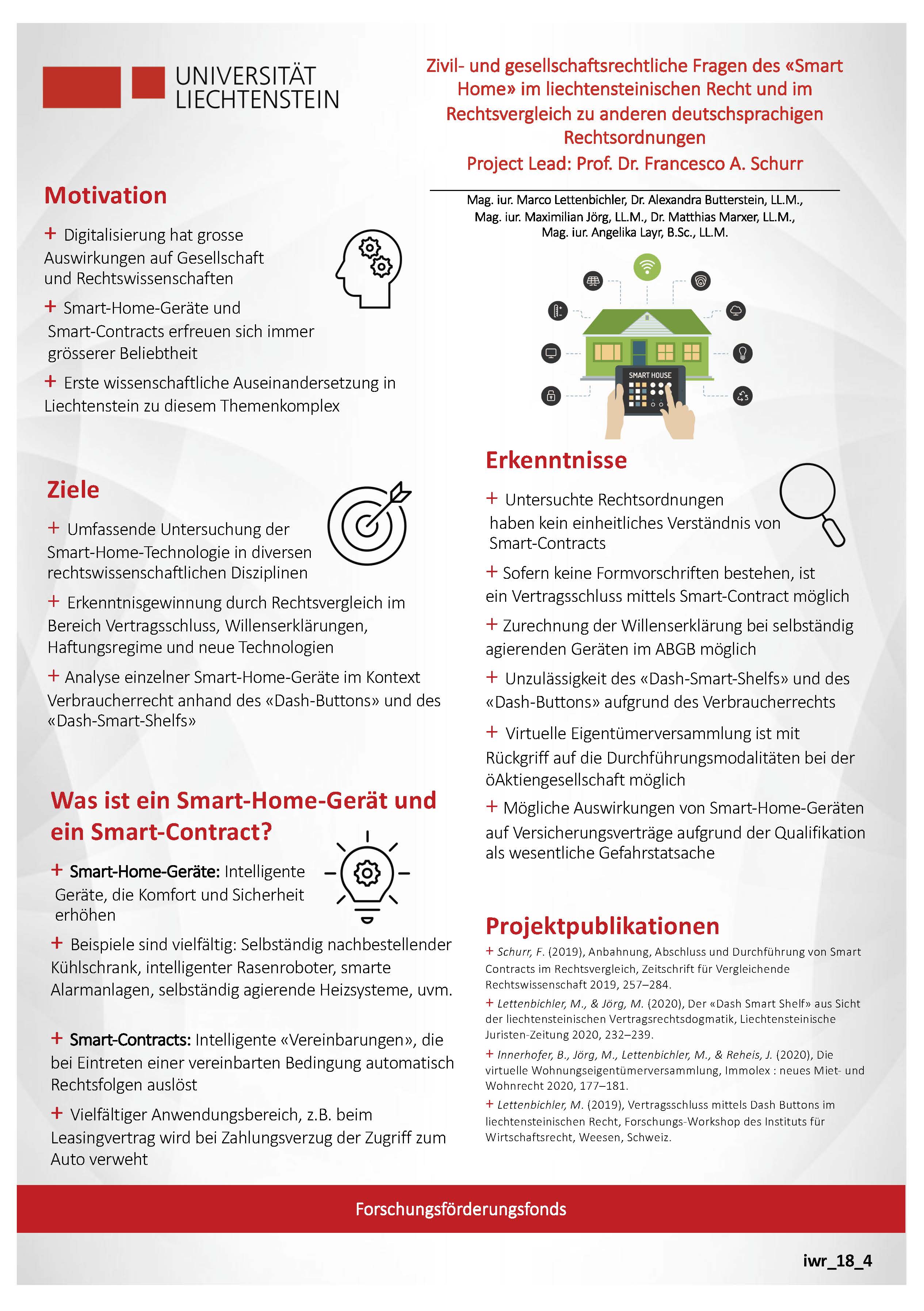
Smart homes are not dreams of the future, but are becoming increasingly popular, especially in Liechtenstein. The project will deal with private law issues raised by intelligent housing forms. Due to technological progress, a multitude of legal questions arises, such as: Who is liable for an incorrect order of a self-filling refrigerator? Is a household robot a legal entity or rather who is liable for its malfunctioning? Are one-click order buttons compatible with consumer protection? The project focuses on corporate, contract and consumer protection law. Whether other legal systems in the German-speaking area offer a satisfactory solution for legal problems that arise will also be investigated.
Project results:
Project results:
Relevance to Liechtenstein
The opportunities offered by this new housing forms have also been recognized in Liechtenstein. For example, some Liechtenstein municipalities had a feasibility study carried out in which it was examined whether a residential generation-appropriate house, equipped with Smart Home technology, could be implemented. Smart home technology could use motion detectors to make an emergency call if necessary, or a tablet could be used to control the light, room temperature and roller shutters. This not only promotes safety, but could also help elderly people to lead a self-determined life even in old age.
Participating Institutions





Publications
Circular construction with modular building blocks. Potentials of reusability of components from patent applications 1877-1960
Project Description
The construction sector öfters the highest potential for reducing waste and resource depletion that a
rising environmental and climate challenge so urgently needs: Through enduring use instead of consumption,
enabled by the principles of reuse and circularity.
Concepts and design Solutions for reusable (building) Systems aren't new - many of them were just forgotten,
Since property protection by patent rights in the 19th Century, construction-related inventions and
ideas have been accumulating in the archives of patent Offices. Even if applications for modular, potentially
reusable construction Systems were primarily intended to rationalize construction processes, speed them
up and reduce costs and material consumption, these archived ideas are still among the most important
datasets from the history of industrial construction - even under the changed premise and today's requirement
for a circular construction industry.
The aim of the research project is the rediscovery and reconstruction of forgotten concepts and principles
of potentially reusable constructions, Systems and components from the inventory of European patent Offices.
The work has a focus on reusable building modules.
rising environmental and climate challenge so urgently needs: Through enduring use instead of consumption,
enabled by the principles of reuse and circularity.
Concepts and design Solutions for reusable (building) Systems aren't new - many of them were just forgotten,
Since property protection by patent rights in the 19th Century, construction-related inventions and
ideas have been accumulating in the archives of patent Offices. Even if applications for modular, potentially
reusable construction Systems were primarily intended to rationalize construction processes, speed them
up and reduce costs and material consumption, these archived ideas are still among the most important
datasets from the history of industrial construction - even under the changed premise and today's requirement
for a circular construction industry.
The aim of the research project is the rediscovery and reconstruction of forgotten concepts and principles
of potentially reusable constructions, Systems and components from the inventory of European patent Offices.
The work has a focus on reusable building modules.
Relevance to Liechtenstein
An intensive exchange and cooperation is being pursued with the Lebenswertes Liechtenstein Foundation, one of whose main goals is to promote a circular economy in the country.
Scientific, Economic and Societal Impact
The work contributes to the development of the competence area Building Heritage & Upcycling and focuses on innovation, sustainability and responsibility in construction and architecture, which strives for a long-term contribution to society with a consistent focus on circular processes. The development of research to promote a circular construction industry contributes to the strategic thrust of Liechtenstein.