Skip to Main Content

Safety of Deep Learning and Robustness to Natural Adversarial Examples

Project Description

Unlike security, safety of learning algorithms has received little attention in the scientific community. For trustworthy AI systems both aspects must be considered. The key difference between these synonymous concepts lies in that safety deals with natural examples that may break learning systems. Natural examples are not subject to typical constraints of adversarial learning, e.g., being invisible or semantically intact, and hence cannot be handled by existing defenses. On the other hand, natural examples follow physical constraints that can be leveraged for the design of security mechanisms.
The main goal of this research is to develop methodology for safety analysis of deep learning given the knowledge of natural adversarial examples. This methodology should comprise techniques for systematic search for natural adversarial examples, attaining provable safety guarantees, exploratory verification of safety features as well as evaluation on applications.


Security of Artificial Intelligence Systems in 5G Networks

Project Description

The adoption of the 5G technology in telecommunications and rapid growth in numbers, variety and density of connected devices raises serious security concerns. The increasing amount of network traffic and complexity of cyberattacks require the implementation of AI systems in network security. Such applications need thorough assessment of the resistance to data input manipulation by sophisticated adversaries. Conventional performance evaluation techniques for learning systems assume that datasets for training and validation of the model belong to the same benign environment and sufficiently represent the addressed phenomena. This assumption is violated in adversarial settings, where deployed systems are susceptible to a carefully crafted deceptive input resulting in performance degradation.
The dissertation project investigates the robustness of machine learning models to malicious samples given the specific constraints of the attacker's capabilities in 5G networks. Better understanding of the potential vulnerabilities of machine learning and optimal attack strategies are essential for the design of effective countermeasures.

Security of Artificial Intelligence Systems in 5G Networks

Project Description

The adoption of the 5G technology in telecommunications and rapid growth in numbers, variety and density of connected devices raises serious security concerns. The increasing amount of network traffic and complexity of cyberattacks require the implementation of AI systems in network security. Such applications need thorough assessment of the resistance to data input manipulation by sophisticated adversaries. Conventional performance evaluation techniques for learning systems assume that datasets for training and validation of the model belong to the same benign environment and sufficiently represent the addressed phenomena. This assumption is violated in adversarial settings, where deployed systems are susceptible to a carefully crafted deceptive input resulting in performance degradation.
The dissertation project investigates the robustness of machine learning models to malicious samples given the specific constraints of the attacker's capabilities in 5G networks. Better understanding of the potential vulnerabilities of machine learning and optimal attack strategies are essential for the design of effective countermeasures.

Security of Artificial Intelligence in Finance

Project Description

This research project explores the genuine risks and vulnerabilities associated with leveraging machine learning across various financial functions. The aim is to develop methodologies for quantifying these risks and to conceive and test strategies aimed at enhancing the security and robustness of financial systems employing machine learning.

Shareholder Rights in Europe

Project Description

Untersucht werden Aktionärsrechte in grenzüberschreitenden Finanzstrukturen. So hat jeder Liechtensteinische Asset Manager und Fonds z.B. Stimmrechte, die aber selten ausgeübt werden. Die Reform der AKtionärsrechte-RL von Europa aus erhöht hier den Druck auf die Intermediäre, ihre Rechte auszuüben. Wie dies in Liechtenstein und Europa möglich ist, wird im Projekt untersucht.

Relevance to Liechtenstein

Die Reform der AKtionärsrechte-RL von Europa aus erhöht hier den Druck auf die Intermediäre, ihre Rechte auszuüben. Wie dies in Liechtenstein und Europa möglich ist, wird im Projekt untersucht.

Project Participants

Employee
Prof. Dr. Dirk Zetzsche LL.M. (Toronto)
- Professor
Professor

Shaping the future: Challenges and opportunities of the spatial development in Liechtenstein

Project Description

The foundation "Zukunft.li", a think tank for a sustainable development of Liechtenstein, invited the Institute of Architecture and Planning to think about the future spatial development of the principality.

In close cooperation with other experts of the think?tank we want to discuss the following questions:

  • Which existing frameworks (planning regulations, political decisions, population development) influence the spatial development of Liechtenstein currently?
-How will social trends (digitalization, internet of things, new forms of mobility, climate change, ageing population, new leisure needs, etc.) influence the spatial development of Liechtenstein in the next years?
-What does this mean for the settlement development, the landscape, the infrastructure or the population structure of Liechtenstein?
-What kind of new spatial qualities could these trends generate? (E.g. the autonomous cars are coming: what are we doing with the existing parking spaces?)
-Which future scenarios are possible, desirable or have to be avoided?
-How will Liechtenstein look like in the future: a polycentric region, an urban agglomeration, a metropolis?
-How can we illustrate and mediate scenarios as architects for a non?architectural audience?

Content
Anticipatory strategies are needed for adapting the urban structures of Liechtenstein in a way that the impacts of the social trends will not endanger but enrich the urban living environment. Therefore, we will think creatively about different kind of spatial models and scenarios for Liechtenstein in 2050 in a bigger scale. We also intent to zoom in and discuss specific spatial qualities on a smaller scale: where are
the outskirts, the city centre(s), the central parks of Liechtenstein?

Methodical approach
We will adopt different methods of analysing the existing spatial qualities of Liechtenstein as urban layer analysis, perceptual walks etc. We will learn how to develop spatial models and scenarios for the future development of a (urban) landscape like Liechtenstein. We will deal with different kind of scenarios (status quo, trend scenario,
alternative scenario, contrast scenario) and compare them to each other. We will experiment with different forms of visualising these spatial qualities - with landscape models, virtual models, movies etc.

Results
In an internal jury process with the think?tank, three works of students will be selected for a further scientific consideration. Besides we will work on an exhibition during the semester.

Keywords

Liechtenstein future future study

Participating Institutions

Project Participants

Employee
Dr. Anne Brandl
- Project Manager
Project Manager
Employee
Dr. Clarissa Rhomberg
- Project Collaborator
Project Collaborator
Employee
Dipl. Ing. Martin Mackowitz
- Project Collaborator
Senior Lecturer - Urbanism, Architecture and Society
Project Collaborator
icon
Employee
Anne-Sophie Zapf MSc Arch
- Project Collaborator
Project Collaborator

Setup and Management of a cryptocurrency fund

Project Description

Der "Digital and Physcial Gold Fund" - eine Liechtensteinische Erfolgsgeschichte
Die Incrementum AG aus Schaan hat bereits 2018 damit begonnen einen Fonds zu entwickeln, der klassische Anlagen in Gold und Silber mit der Wertanlage in moderne Kryptowährungen kombiniert und wird dabei seit Ende des Jahres 2019 vom Institut für Finance im Rahmen eines InnoSuisse-geförderten Projekts in vielen Teilbereichen unterstützt.
Der Fonds ist seit Februar 2020 für institutionelle und qualifizierte Investoren erhältlich und sticht sowohl durch seinen innovativen Ansatz als auch durch die sehr gute Performance heraus. Das Team der Universität Liechtenstein rund um Projektleiter PD Dr. Martin Angerer unterstützt den lokalen Vermögensverwalter in den Bereichen Risikomanagement (Prof. Dr. Michael Hanke), Portfoliomanagement (Dr. Lars Kaiser) und Verhaltens- und Informationsökonomie (M. Angerer).
Bei der Implementierung und Umsetzung dieses innovativen Fonds wird oftmals Neuland betreten. Viele der gängigen und bewährten Ansätze in den oben genannten Bereichen können entweder gar nicht oder nur stark adaptiert auf Anlagen im Kryptobereich angewandt werden. Die Adaptierung dieser Konzepte, die einerseits höchsten akademischen Qualitätskriterien entsprechen, andererseits aber auch praktisch anwendbar sein müssen, stehen im Vordergrund des Projekts. Die enge Zusammenarbeit und gegenseitige Unterstützung von praktischer und akademischer Seite liefern in diesem Projekt Ergebnisse von international gesehener aber auch hoher regionaler Relevanz.
Im November wurde der Fonds mit dem prestigeträchtigen Scope Award, oft auch als "Oscar der Fondindustrie" bezeichnet, in der Sonderkategorie Innovation ausgezeichnet und hat sich dabei gegen Finanzinstitutionen wie BNP Paribas oder JP Morgan durchgesetzt. Die internationale Anerkennung unterstreicht die Vorreiterrolle, die der Liechtensteiner Finanzmarkt im Bereich Innovativer Finanzwirtschaft einnimmt und welche Chancen sich aus kooperativen Projekten ergeben.
Das Institut für Finance unterstützt die Incrementum AG noch bis Mitte 2022 bei der Weiterentwicklung und Umsetzung des Fonds.

Keywords

Innovation Cryptocurrency Digitalization Finance Funds

Participating Institutions

Sensor-based activity recognition for hand-held power tools at the construction site

Project Description

Nowadays, the construction sector still lacks transparency in terms of productivity, work progress and tool utilization on the job site. The ongoing digitalization of the construction industry is considered as a great opportunity to overcome these challenges and requires data collection, processing, and analytics in a large-scale. Cameras, audio sensors and kinematic-based sensors erected on construction sites provide data for activity recognition and activity tracking of construction tools and workers. Especially, kinematic-based sensors such as accelerometers, gyroscopes and magnetometers are particularly suitable for use on the construction site. Activity recognition for hand-held power tools such as rotary hammers, on the other hand, is a vastly unexplored field but relevant of research. Sensors directly attached to the tool can enable the recognition of selected tool activities which will increase transparency about tool utilization, construction site productivity, tool user understanding and will provide information for tool development and tool design, among other. This thesis aims to address this research gap by exploring and identifying the potential of sensor-based activity recognition for hand-held power tools. Models for the recognition of different types of tool utilization will be developed and possible deployment scenarios will be evaluated.

Self-Leadership und Entrepreneurship

Project Description

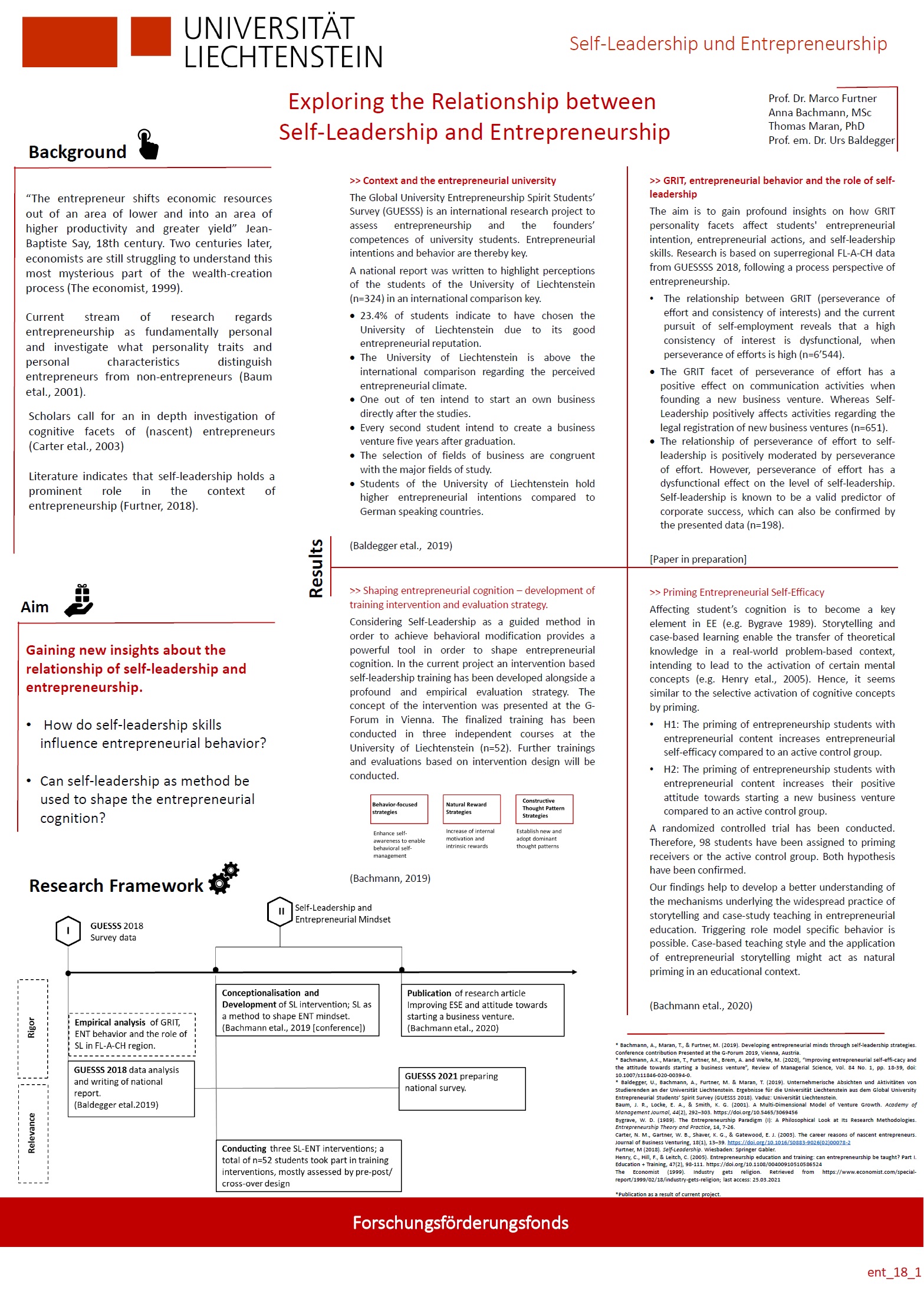
The aim of the research project was to gain new insights into the relationship between self-leadership and entrepreneurship. The results of the GUESSS study 2018 show how entrepreneurial the University of Liechtenstein is perceived by students in a German-speaking and international comparison, and furthermore, what impact the perceived entrepreneurial environment of the university have on the entrepreneurial intentions and activities of students. The publication "Improving entrepreneurial self-efficacy and the attitude towards starting a business venture" provides new insights into how the entrepreneurial cognition of students
can be effectively strengthened within the framework of teaching formats in the field of entrepreneurship.
The development of a module entitled "Self-Leadership as method to shape entrepreneurial cognition" opens up the possibility of sustainably strengthening students' entrepreneurial cognition. The activities carried out have both theoretical and practical relevance and reflect the essence of the research field of entrepreneurship

Project results:

Keywords

Entrepreneurship Self-leadership Entrepreneurial Intention Entrepreneurial Mindset
Subscribe to